
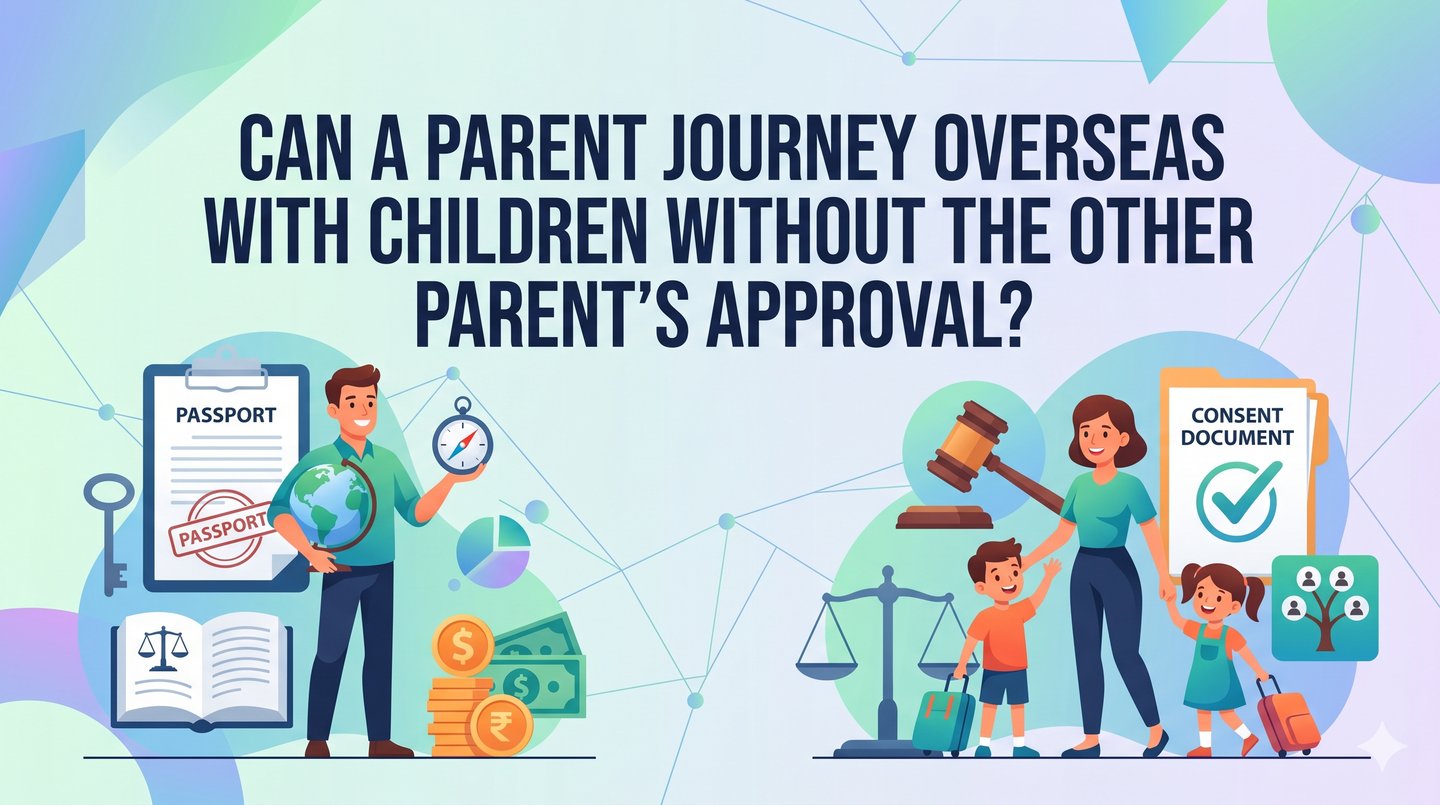
CAN A PARENT JOURNEY OVERSEAS WITH CHILDREN WITHOUT THE OTHER PARENT’S APPROVAL?
This article explores whether a mother can legally take her child abroad without the father's consent, covering custody rights, international law, and the consequences of travelling without proper authorisation.
FAMILY LAW
NAYAN
5/7/20263 min read
Introduction
Imagine a mother who wants to take her child on a trip abroad to visit relatives or simply for a vacation. It sounds ordinary enough. But if she is separated or divorced from the child's father and does not have his permission, that trip could land her in serious legal trouble. This is a situation many parents find themselves in, but few really understand the legal implications involved. The short answer is – it depends. Whether a mother can take her child abroad without the father’s consent depends on custody arrangements, domestic law and international treaties.
It starts with custody
The single most important factor is the type of custody arrangement that exists. If a court has awarded sole custody to the mother, she generally has the right to make major decisions about the child’s life, including international travel, without the father’s consent. But if both parents have joint custody, well then that's a different story.
“Joint custody means both parents have equal say in important decisions regarding the child.” If you are making arrangements to take a child abroad, you can’t do this without the knowledge or consent of the other parent without it being a breach of a court order. The Indian Courts have always held that the welfare of the child is of paramount importance and have been guided by the Guardians and Wards Act, 1890 and the Hindu Minority and Guardianship Act, 1956. The Supreme Court in Gaurav Nagpal v. Sumedha Nagpal (2009) held that neither of the parents has absolute power over the child, and both are required to act in the best interest of the child.
What does international law say?
On a global level, the most important legal instrument is the Hague Convention on the Civil Aspects of International Child Abduction, 1980. Over 100 countries are parties to this treaty. Its core purpose is to ensure that if a child is taken to another country without the other parent's consent, the child must be returned promptly. The country the child is taken to is not supposed to decide custody — that remains the job of the courts in the child's home country.
India, notably, has not signed this Convention. This creates gaps in cross-border custody cases involving Indian families. But Indian courts have not been averse to the issue. In V. Ravi Chandran v. Union of India (2010), the Supreme Court ordered the return of the child to the United States from where the child had been taken, even though there was no treaty obligation. In doing so, the court relied on the principle of respect for foreign court orders – that India’s failure to ratify the Convention does not mean a free pass for parents who unlawfully remove children.
When can I do that legally?
Sometimes a mother can take her child out of the country without the express permission of the father. The clearest case is where a court has given her sole custody with no travel restrictions. Another situation is where the father has abandoned the child, is untraceable, or has had his parental rights removed by a court.
When the father refuses consent without any good reason, the mother can approach the court for a specific travel order. Courts look at factors like the reason for the trip, whether the child will be returned, and how it affects the father's time with the child. Even in India, passport offices require a court order or the signatures of both parents to issue a passport to a minor. This administrative safeguard is a reminder that informal agreements between parents are just not enough – proper legal steps must be followed.
But what if she goes anyway?
The consequences can be severe if a mother takes the child abroad without authorization of the law. In Hague Convention countries, the father can move to have the child returned quickly. Beyond that, he can initiate criminal proceedings for parental child abduction — an offence that carries imprisonment in many countries, including the UK, the US, and Australia.
Even in India, courts do not take such matters lightly. The Supreme Court in Surya Vadanan v. State of Tamil Nadu held that ordinarily, the Indian courts should give effect to the orders of foreign courts in relation to custody and direct the return of the child unless it would be injurious to the child. 2015. The case made it much harder for parents to use India as a place to escape accountability. Any unauthorised travel can also have serious implications for a mother’s reputation in future custody proceedings, and courts might be less inclined to sympathise with a parent who has circumvented the legal process.
Conclusion
The law is clear on this: A mother cannot simply take her child abroad without the father’s consent unless she has the proper legal authority, either through a sole custody order or court-approved travel authorisation. International frameworks and domestic courts alike are aligned on this. Good intentions are not a legal defence. For mothers who wish to travel, the right approach is to seek the father's written consent, and if that is unreasonably denied, to go through the courts. Ultimately, both parents must remember that custody laws are not obstacles — they exist to protect the child, and working within them is always the better path.