
Can Company claim ownership of Software developed by contractors?
In the case of software created by an independent contractor, the default copyright owner is the developer. A company needs to secure ownership through a specific assignment agreement.
IPR
Kirti Mahal
4/6/20265 min read
Introduction
Indian copyright law specifically protects the source code of the software under the category of “literary work.” The default owner of the copyright is the author of the work. In the case of a software code, the programmer is the author and the default copyright owner. However, under the provisions of the Copyright Act, an exception under Section 17 applies to the copyright owner in the case of a work done by an employee. This means that the copyright owner would be the employer company rather than the programmer. This raises the main question: Can the company claim ownership of the software developed by an independent contractor?
Legal Framework
According to the Copyright Act, copyright subsists in original works of expression. Section 13 includes computer software as a literary work. However, the act does not cover abstract ideas or functions; it only covers the actual code and expression of the programmer. Moreover, the act asserts that “the author of a work shall be the first owner of the copyright therein.” This means that the creator of the software is the presumptive owner of the copyright from the onset.
Employee vs. Independent Contractor
Section 17(c) of the act specifically addresses employees, stating that a work made by an employee in the course of his employment under a contract of service vests in the employer unless a contrary agreement exists. This means that a programmer on the payroll of a company automatically assigns ownership of his or her code to the employer.
However, a contractor or freelancer who works on a contract for service does not fall within the ambit of Section 17(c). In determining whether a programmer is an employee or a contractor, the court will consider whether the programmer was on the payroll or in control of his or her methods of operation.
In that case, the Indian law will treat them as the author-owner: “The Indian vendor will own its employee-developed copyright. However, this rule will not apply in the case of an independent contractor-developed copyright. In short, contractors retain their copyright by default, whereas employees do not retain it by default.
Role of Contracts: Assignment and ‘Work for Hire’
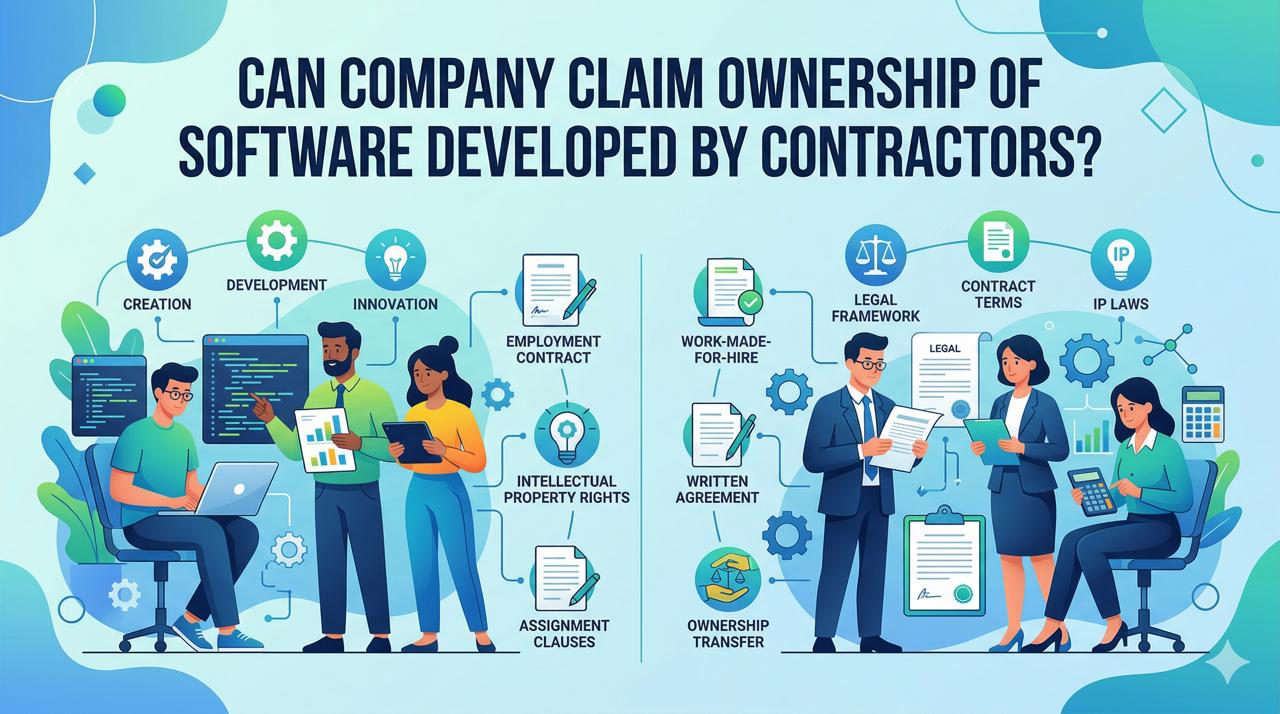
As contractors do not automatically vest rights with the hiring company, it is imperative to get these agreements in place. Section 19 of the Act stipulates that an assignment of a copyright must be in writing and signed by the assignor. This means that the contractor must explicitly assign their copyright to the company and do so in compliance with the provisions of the Act.
The following key contractual elements must be included:
• Scope of Assignment: It is imperative to ensure that an assignment of all code and documentation developed under the contract is included and to define the duration and scope of the assignment.
• ‘Work-for-Hire’ Clause: As there is no statutory provision for ‘work for hire’ under Indian Contract Law for contractors, companies may state that the code developed is a ‘work for hire’ to ensure an assignment of IP. This ensures that all rights vest with the company.
• Moral Rights Waiver: Section 57 of the Act says that authors still have the right to be credited and the right to object to derivative works even after they have given up their IP. Contractors must waive their moral rights and refrain from invoking them.
• Confidentiality & Non-Use: Add provisions that restrict the contractor from using the code for any other client.
• Indemnity: Add provisions that hold the contractor liable if any third party makes infringement claims on the code.
Key Case Laws
o Pine Labs Pvt. Ltd. v. Gemalto (Delhi HC, 2014): The court again held that customised software is a literary work, and it is clear that “copyright ownership… depends on clear contractual assignment.”
o Tata Consultancy Services v. State of Andhra Pradesh (SC, 2004): The Supreme Court of India again held that software, both canned and custom, is an intellectual property, and it “can be owned, transferred, and licensed.”
Eastern Book Company v. D.B. Modak (SC, 2007): This was a decision on editorial content, and it was again clarified by the Supreme Court of India that when an employee creates content as part of their employment, their employer is treated as having copyright, unless otherwise agreed.
o Stanford University v. Roche (U.S. SCt, 2011): Although this is a United States decision, it is often cited in India, and it was held that “agree to assign” is different from “hereby assign,” and it is only the latter which constitutes an immediate assignment.
o International Context: The U.S. work-made-for-hire doctrine (17 U.S.C. §101) treats employers of employees similarly to those of India, but for independent contractors. The copyright remains with the creator of the work. The UK Copyright Act of 1988 treats works by employees similarly to those of India. However, for independent contractors, they retain their copyright.
Practical Issues and Risks
Failure to secure the ownership of the IP rights may also cause serious issues for the company:
• Implied License Only: The company may end up with merely an implied license to use the software if the assignment is not formal. This may limit the company’s rights to the software (for example, it may not have the right to sublicense or modify the software), and the ownership may remain with the contractor.
• Due Diligence Concerns: The issue of ownership may also cause serious due diligence concerns for investors or acquirers who may question the company’s ownership rights over the software’s IP rights.
• Code Reuse Risk: The contractor may also end up using the same code for other clients if it is not contractually prohibited; therefore, a thorough contract should prohibit the contractor from using the same code for other clients.
• Moral Rights: Even after assigning the economic rights for the software, the author retains moral rights (the right to claim authorship and prevent distortion). Therefore, if these rights are not waived or addressed in the contract, serious issues may arise in the future (for example, if the company modifies the code).
Conclusion
Under the law, the company cannot claim any copyright on the software developed by the outside contractor, as the general rule is that the developer/contractor owns the software, and the special employee exception of Section 17(c) does not apply to independent contractors. Therefore, to assign the copyright to the company, the company has to be specifically assigned the copyright.
The best practices are as follows: The company must include an IP assignment clause in the contract, preferably using the words “hereby assigns” to effect the assignment of the IP. It is important that the contract specifically addresses the issue of IP assignment as well as compliance with Sections 18 and 19 of the Copyright Act. The company should also address the issue of moral rights by requiring the developer to waive the moral rights to the IP developed by them. The company should treat the software developed by the outside contractor at the same level as any other IP by including the assignment of the IP in the contract itself, as it is important to put everything in writing at the beginning of the contract.