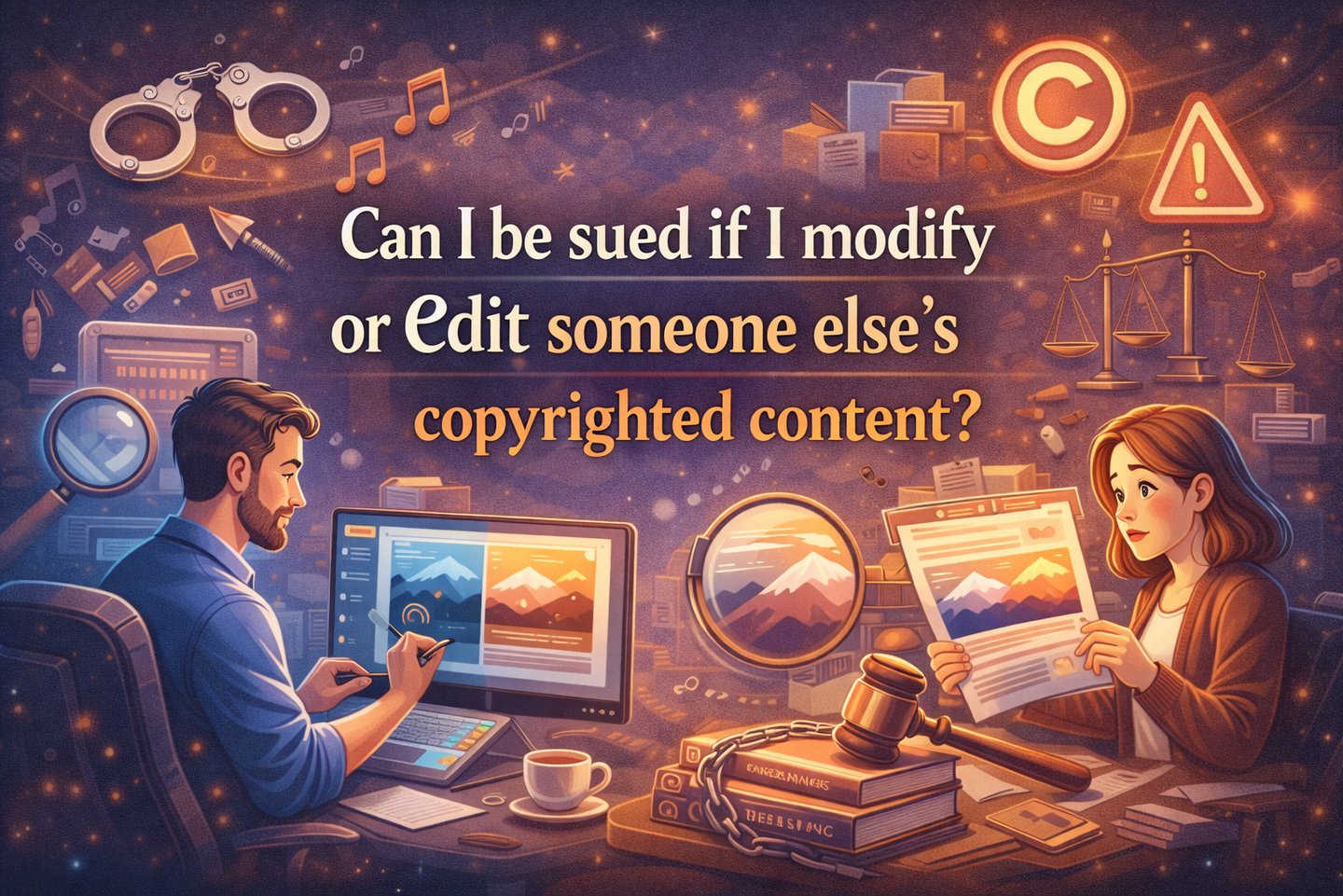
Can I be sued if I modify or edit someone else’s copyrighted content?
This article discusses all the different ways a person can get sued for modifying/editing an already copyrighted material through not following the rightful approaches as well as what these rightful approaches can be.
IPR
Gauran
2/28/20264 min read
INTRODUCTION
Nowadays the modern way of creativity is not only having a distinct creative material but also using already existing creative work to produce something innovative in itself. We are living in a time where we do not only watch original movies but also their creative fan montages. This may be creative to some extent, but majorly and ethically, it is failing on legal acceptability and copyright protections. A person can use and modify copyrighted material for various purposes, like for research purposes, making a critique or commentary on it, as well as for simple purposes like entertainment. Purposes can be many, but the ethical and legal integrity has to be maintained for the sake of actual creative expression to exist and receive its due credit in this world. It becomes difficult to say that editing or modifying an already protected material would constitute infringement and if a person would get sued for it.
WHAT CONSTITUTES MODIFYING/EDITING
Modifying refers to changing or transforming to some extent the idea, elements, or format of the original artistic work. Editing, on the other hand, is smaller in scope than modifying something and refers to minor tweaking in the sequence, text, images, etc. Both involve the use of some original protected material here in this context. For better understanding, here are the different examples that constitute modifying/editing:
● Changing vocals/pace of music or addition of new instruments in remixes
● Color grading/filtering
● VFX addition
● changing the sequences of events
● Face Swapping
● AI-related tools for idea reimagination, etc.
CONSEQUENCES OF MODIFICATION/EDITING
Section 14 of the Copyrights Act, 1957, grants exclusive right to the owner of the work to reproduce, adapt, and provide public distribution for the same. Therefore, when an original work is modified or edited, it leads to its infringement and suits, but it is not always the same. From editing and modification, the new work that is produced can be of the following types, and each type has its own likely legal consequences:
Derivative: this type of work involves making changes to the elements and format of the original copyrighted material. This type of work is protected, but it comes with its conditions. There must be exercise of skill and judgment, and there should be creative inputs for a work to be protected as a derivative work. It is the safest when this derivative work is done after authorization from the owner of the original work.
Case Law: Eastern Book Company v. D.B. Modak, AIR 2008 SC 809.
In this case only, it was held that for some work to be protected as derivative, it has to have elements of creativity, skills, etc. Mere mechanical changes cannot be counted as creative work.
Transformative: this type of work is different from derivative in the manner that it changes in great scope the idea, expression, and very purpose of creating some ingenious work altogether out of an already existing one. This type of work is such that even though it is from the original work, it creates a different value of its own. A good example of the same is a musical parody for criticizing any social phenomenon. But again, over here also there is no complete protection from not getting sued, as it depends upon genuine transformation of the work; if the degree of transformation is weak, then the claim of having produced a transformative work would fail.
Case Law: R.G. Anand v. Deluxe Films, AIR 1978 SC 1613
It was held that if the theme is the same but a person takes it to be presented altogether completely differently and ingeniously, such that it gets transformed into a different creative piece of work, it is not a violation.
Another important concept, which serves as an exception to copyright infringement, is
Fair use: this happens when the original work is used for the purposes of personal use, academic research, criticism, reporting of current events, etc., according to Section 52 of the same act. The same act acts as an exception, which prevents the person from getting sued, provided that the conditions of fair use are fulfilled. For example, if a student uses an article for a research paper, he then also further adds his own commentary and insights [not just tweaks the original work and reframes] such that his own work is and has transformed the original copyrighted work into something different/novel in his work.
Unauthorized Production: This type of modified/edited work firstly doesn’t fall under any of the above-mentioned types and does not have acquired authorization, which is required for legally valid use due to the absence of the above-mentioned categories of use.
NUANCES WHICH DETERMINE THE VALIDITY OF USING MODIFIED WORK
Other than the nature of the work so produced, some other nuances that determine whether there is infringement or not are:
● Purpose of using the modified/edited material: as mentioned, if it is under fair dealing, then the same is protected, but if the modified work is being used commercially for creating profits, then the likelihood of an infringement arising is higher.
● Expression is greater than idea: if the work modified and produced though depicts some other idea but in a similar expression, then the possibility of infringement can be there
● Using more factual content rather than creative content: if a person is using some factual content from copyrighted material, then the likelihood of infringement is less.
● Using content behind a paywall: if a person is editing or modifying content which is exclusive through a paywall and then putting it to use, it is even more of an outright infringement.
ETHICAL PRACTICES WHICH CAN SAVE FROM LEGAL LIABILITY
Even if there exists modification/edits, the right ethical practices can save a person from getting sued for copyright infringement. These include:
● Attribution: giving due credit to the original owner of the protected work.
● Transparency: nowadays AI is used as a tool for modifying and editing copyrighted content; the same is to be clearly tagged or mentioned for the usage of AI. Under the new IT rules, it has been mentioned to provide a clear disclosure of the usage of AI.
● Getting authorization: this is the best way of being able to legally modify and edit an already copyrighted material. For example, getting permission straight away or using material that is under a CC license.
CONCLUSION
Therefore, modifying and editing copyrighted material is a work that must be done by observing all the right measures. Not always; using editing/modification of copyrighted material can put a person into legal liability if there is an actual transformative, derivative, or fair-use-based work produced or outrightly there exists permission for usage.