
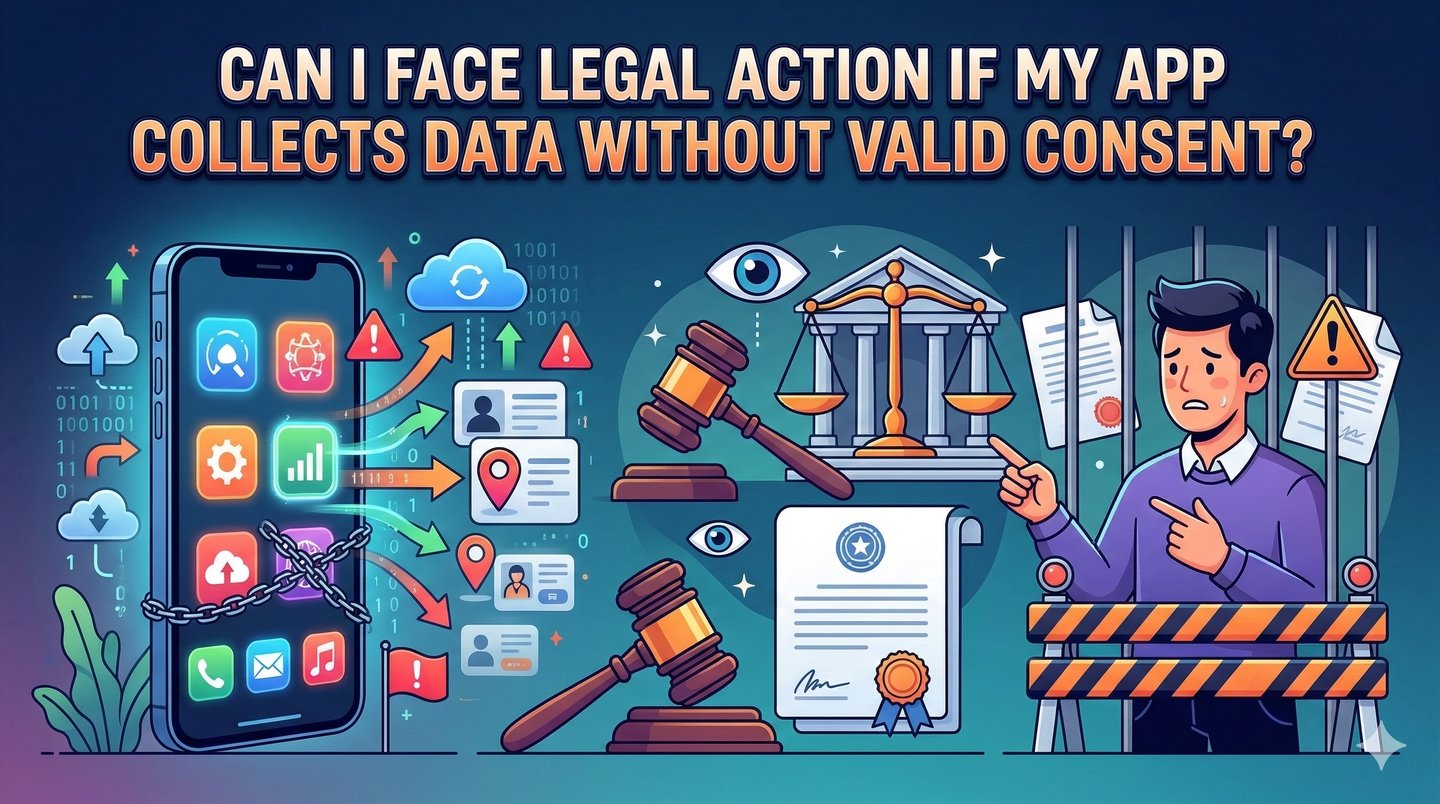
CAN I FACE LEGAL ACTION IF MY APP COLLECTS DATA WITHOUT VALID CONSENT?
This article examines whether mobile applications can legally collect user data without valid consent by analysing the framework under the Digital Personal Data Protection Act, 2023, the Information Technology Act, 2000, and the General Data Protection Regulation
IPRCORPORATE LAWS
Ayushi moudgil
3/20/20264 min read
Introduction
Imagine downloading a fitness app that claims to track your daily health habits, sleep patterns, and steps. In order to customize your experience, the app starts monitoring your location, activities, and even certain health-related data within minutes. A few weeks later, you begin to receive ads for insurance plans and medical products that seem remarkably tailored to your health and lifestyle. Over time, it becomes clear that the data you entered into the software has spread well beyond its confines. What started out as a straightforward effort to maintain fitness now raises an unsettling question: could an app developer be subject to legal repercussions for gathering and utilizing user data in this way? The following three frameworks help in answering the question.
DIGITAL DATA PROTECTION
Fundamentally, Section 4 states that personal data must only be treated for legitimate purposes and in compliance with the Act; it cannot be processed arbitrarily. This means that developers cannot only gather user data for mobile applications, even though it can be helpful for analytics or commercial objectives. The Act's legal structure must apply to the collection.Section 5 mandates that users receive a clear notice prior to the collection of their personal data, outlining the type of data being collected and its intended use, in order to maintain transparency. Section 6 is closely related to this. which defines the standard of valid consent. Consent must be free, specific, informed, unconditional, and unambiguous, expressed through a clear affirmative action. In practical terms, this means consent cannot be hidden within vague language or complex privacy policies that users are unlikely to understand. Even where consent appears to exist, it may still fail the legal standard if the user was not properly informed about how their data would be used.The seriousness of these obligations is reinforced by Section 33, which provides for penalties in cases of non-compliance, including significant monetary fines.
INFORMATION TECHNOLOGY ACT
Even before India introduced a comprehensive data protection law, certain provisions under the Information Technology Act, 2000 addressed concerns about how personal information is handled in the digital space. Section 43A makes a company liable if it handles sensitive personal data but fails to put in place reasonable security practices, leading to wrongful loss or gain. Although this provision mainly focuses on negligence in protecting data, it highlights an important principle that organisations collecting personal information through digital platforms must handle it responsibly and ensure that it is properly safeguarded. Alongside this, Section 72A provides for criminal punishment when a person who gains access to personal information while providing services discloses that information without the consent of the individual or in breach of a lawful contract. Further clarity was introduced through the Information Technology (Reasonable Security Practices and Procedures and Sensitive Personal Data or Information) Rules, 2011, framed under Section 43A. These rules require companies to obtain consent before collecting sensitive personal data and to clearly inform users, through a privacy policy, about what information is being collected and why. While this framework was relatively limited and focused mainly on sensitive personal data, it nevertheless reflected an early recognition in Indian law that digital platforms cannot freely collect or use personal information without following certain safeguards and responsibilities.
GENERAL DATA PROTECTION REGULATION
One of the most significant data privacy legislation in the world, the GDPR, places a similar focus on meaningful consent. According to the GDPR, organizations are not allowed to gather or handle personal data unless there is a legitimate reason, most often the individual's explicit and informed consent. Such consent must be freely provided, precise, and founded on accurate information about the data being collected and its intended use. Therefore, under the rule, ambiguous privacy policies, pre-checked boxes, or complex terminology that consumers cannot reasonably understand may not constitute valid consent.
The GDPR also places strong emphasis on transparency and accountability, requiring organisations to clearly inform individuals about their data practices. If a company collects or processes data without valid consent, regulators have the power to investigate, order the organisation to stop the unlawful processing, and impose significant penalties. In serious cases, companies may face administrative fines of up to €20 million or up to 4% of their global annual turnover, whichever is higher. These strict consequences highlight the regulation’s objective of ensuring that personal data is handled responsibly and that organisations cannot casually collect user information without proper legal justification.
When Can Data Be Used Without Consent
Although consent is generally the main requirement for processing personal data, the law recognises a few limited situations where data may be used without it. Under the Digital Personal Data Protection Act, 2023, Section 7 allows data to be processed without consent in certain cases known as ‘legitimate uses.’ These include situations such as complying with legal obligations, responding to medical emergencies, employment-related purposes, or when an individual voluntarily provides their data for a specific service. A similar idea exists under the General Data Protection Regulation (GDPR), which permits the use of personal data without consent when there is another lawful basis, such as fulfilling a contract or complying with legal duties. Likewise, under the Information Technology Act, 2000, and the Information Technology (Reasonable Security Practices and Procedures and Sensitive Personal Data or Information) Rules, 2011, data may be collected when it is necessary for a lawful purpose connected with the organization's activities. However, these situations are exceptions, and in most cases valid consent remains the key requirement for lawful data collection.
Does Clicking “I Agree” Really Mean Valid Consent?
A similar issue arose in Nguyen v. Barnes & Noble Inc. [1], where the website had terms of use available only through a hyperlink at the bottom of the page. The user made a purchase without ever clicking “agree” to those terms. When the company tried to enforce an arbitration clause, the court refused, holding that merely placing terms somewhere on a webpage does not establish consent unless the user has clear notice and takes some affirmative step to accept them. The importance of active and informed consent was further emphasized in Planet49 GmbH v. Bundesverband der Verbraucherzentralen [2]. In that case, a company relied on a pre-ticked checkbox to obtain permission for cookie tracking. The court ruled that such consent was invalid, explaining that consent must come from a clear and active choice by the user, not from default settings or passive acceptance.
CONCLUSION—
In conclusion, an application can indeed face legal consequences for collecting user data without valid consent. Modern data protection frameworks clearly emphasize that personal data cannot be collected or processed arbitrarily. Consent must be informed, clear, and meaningful, and users must know how their data is being used. Where applications collect data without proper consent, rely on unclear policies, or misuse user information, they may face regulatory action, penalties, and legal liability. Ultimately, the law aims to ensure that digital innovation does not come at the cost of individuals’ privacy and control over their personal data.