
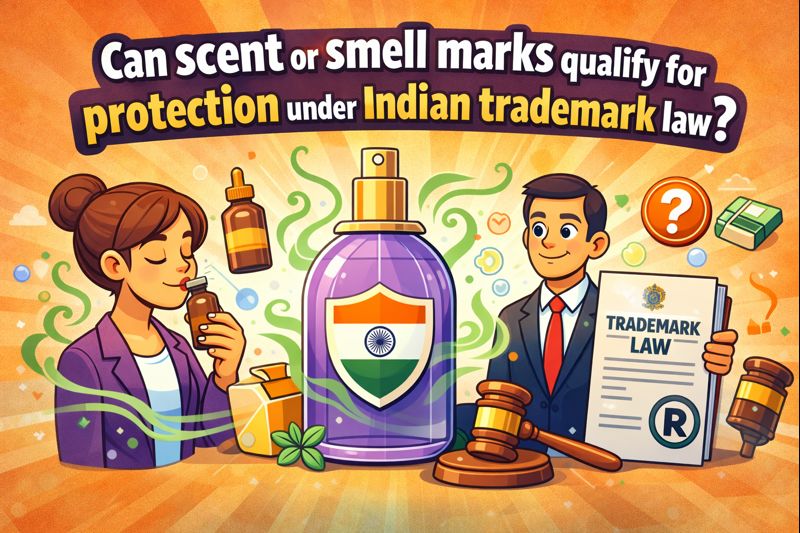
Can scent or smell marks qualify for protection under Indian trademark law?
India’s first registered scent mark signals evolving trademark law, recognizing non-visual marks where smells are distinctive, representable, and capable of identifying commercial origin.
IPR
Sakshi Arora
12/29/20254 min read
Introduction
As the world moves forward recognizing logos and brands as trademarks, the law has to similarly evolve and keep pace with how consumers actually distinguish products and services. Nowadays, consumers remember brands not only through their visuals but also through sounds, touch, and even scents. All this has raised an upheaval of questions in one's mind. Many people have started asking if the ability to smell is possible for a trademark. While Indian trademark law has traditionally focused on visual marks, recent developments, including the acceptance of India’s first smell mark, suggest that Indian courts are finally ready to accept non-traditional forms of branding as trademarks. This is really good for how brands can now distinguish themselves from other products using scent, color, and other different non-traditional factors.
Legal Framework for the Protection of Smell Marks under Indian Trademark Law
Under the Trade Marks Act, 1999, to understand whether something like a smell can be protected lies in how the law defines a “mark.” Section 2(1)(m) explains that a mark “includes a device, brand, heading, label, ticket, name, signature, word, letter, numeral, shape of goods, packaging, or combination of colors, or any combination thereof.” This definition has been worded carefully by the lawmakers and does not limit the list to these factors only. It is an open-ended list and does not limit protection only to what can be seen. This open phrasing shows that the law was designed to evolve with changing forms of branding rather than freeze trademarks into rigid visual categories.
Section 2(1)(zb), which defines a trademark, clearly states it as something that can be “represented graphically and which is capable of distinguishing the goods or services of one person from those of others and may include.” In simple terms, the law requires two things: first, that the mark must be represented in a clear way that is understood by laypeople; and second, it must act as a symbol, helping consumers identify where a product comes from. The law does not say that the mark must be visual, only that it must be representable and distinctive.
When read together, these provisions leave room for non-traditional marks such as smells, provided they meet these conditions. Even though a scent can’t be seen, it can still say a lot. When used consistently, a particular smell can become closely associated with a brand, allowing consumers to recognize where a product comes from almost instinctively. The real difficulty lies not in the idea itself, but in proving it in a way the law can clearly understand and rely upon. Still, the structure of the Trademarks Act leaves room for this kind of evolution. Rather than shutting the door on unconventional forms of branding, it allows the law to grow alongside changing business practices and consumer experiences.
India’s First Accepted Smell Mark
An important milestone in Indian trademark law was reached in November 2025 when the country's first smell mark was approved. Sumitomo Rubber Industries Ltd.'s application was approved by the Controller General of Patents, Designs, and Trade Marks for a “floral fragrance / smell reminiscent of roses as applied to tires” under Class 12, permitting it to proceed to advertisement under Section 20 of the Trade Marks Act, 1999. This decision is widely a complete turning point in Indian trademark law. Until now, Indian courts had not recognized any scent marks, mainly because these marks were legally hard to be represented and enforced. Despite the law itself never expressly banning them, the uncertainty surrounding smells made the law hesitant to accept them as trademarks. The acceptance of this application marks a clear shift in approach. It recognizes something very simple but important: that a smell can actually mean something to people. If a scent is strong and consistent enough for consumers to instantly connect it with a particular brand, then it deserves to be treated like any other trademark. In other words, if people can smell something and say, “This belongs to a particular brand,” the law is willing to take it seriously.
The significance of this development lies, first, in the Registry’s acknowledgment that a smell can function as a trademark if it fulfills the statutory criteria of distinctiveness and graphical representation. The acceptance of the Sumitomo mark confirms that olfactory signs are not excluded from trademark protection under Indian law. This aligns with the inclusive wording of Section 2(1)(m) of the Trade Marks Act, which defines a “mark” expansively, and reinforces the view that the law is adaptable to modern means of distinction that brands have now started undertaking. By recognizing that a fragrance, when used deliberately and consistently, can operate as a source identifier, the Registry has effectively broadened the definition of what marks can be protected when it comes to trademark protection.
What really makes this decision stand out is how the scent was explained to the court. Instead of trying to describe the smell in vague terms, the applicant used a scientific method developed by researchers at IIIT Allahabad. This method actually tried to explain the fragrance by breaking it into clear, measurable elements. This made it easier to understand the scent as a distinguishable smell. By accepting this approach, the Registry showed that it’s willing to think practically and move beyond rigid, old-school ideas of what a “representation” should look like. This model scientifically mapped the fragrance across multiple olfactory dimensions. The Registry’s willingness to rely on such scientific data reflects a significant shift away from traditional methods, which depended on visual forms of representation.
Finally, this helps India catch up with other jurisdictions that have already started recognizing non-traditional trademarks. In countries like the United States and the European Union, there has been an acknowledgment of scent marks under specific conditions, as seen in cases like In re Clarke and the European “freshly cut grass” registration. With the acceptance of the Sumitomo application, India is aligning itself with such changing global norms while at the same time maintaining its rigorous standards for registrability. As such, this development is not one of radical departure but one of measured progress, which indicates India’s willingness to adapt to changing branding practices while maintaining its doctrinal hardness in trademark laws.
Conclusion
The recognition of a smell mark in India is a significant step in trademark law, indicating a readiness to accommodate emerging trends in establishing a trademark. Through an extension of Sections 2(1)(m) and 2(1)(zb), it can be observed that trademarks are not strictly visible, but there can be invisible trademarks, such as smells. At the same time, this development does not open the door to unrestricted claims; only smells that are clearly identifiable, distinctive, and capable of objective representation can qualify. In doing so, Indian trademark law strikes a careful balance between encouraging innovation and preserving legal certainty.