
CAN VIRTUAL REALITY GAME ENVIRONMENT BE PROTECTED AS COPYRIGHTED WORK?
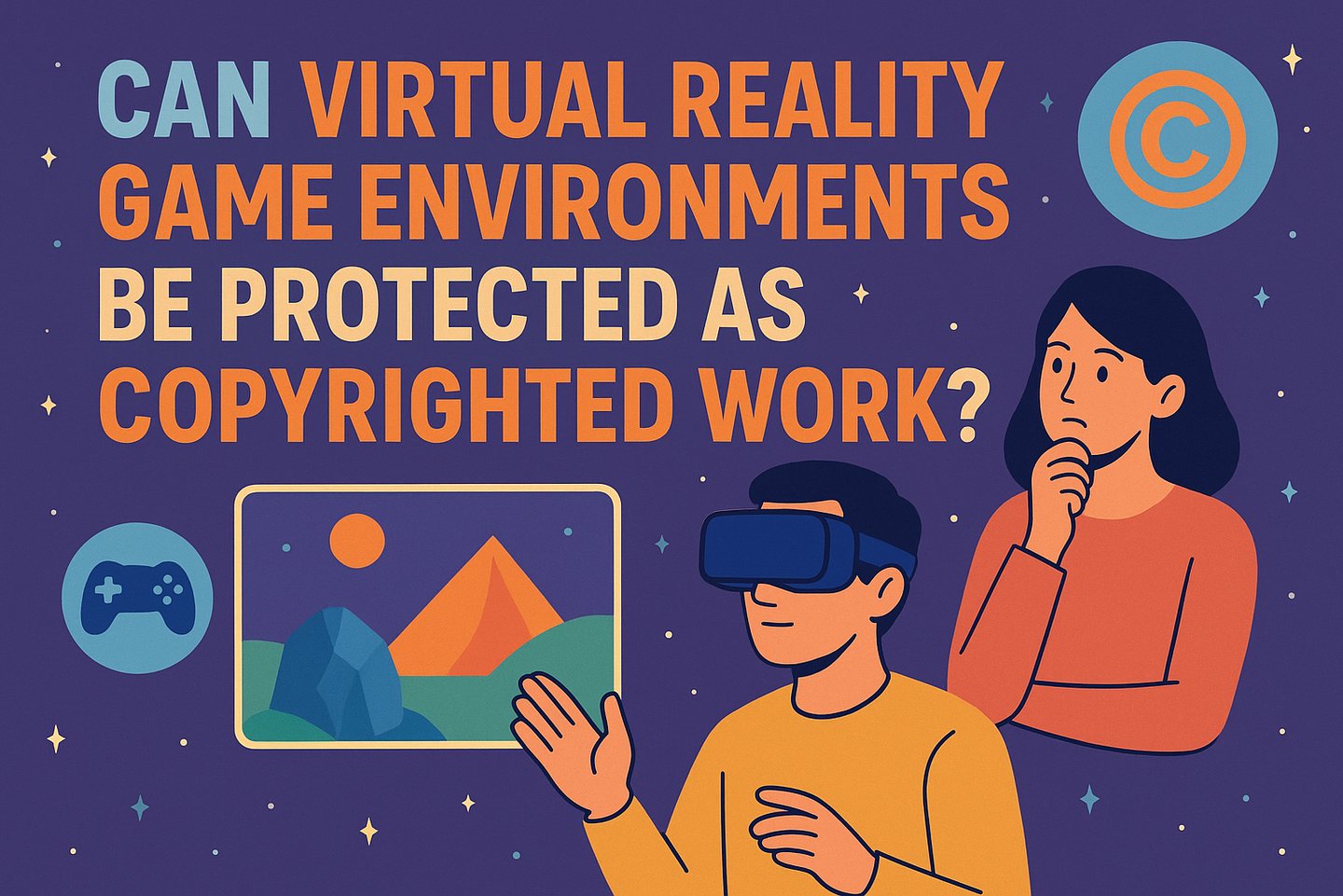
This article takes a closer look at the possibility of copyrighting VR game environments, examines key legal factors, and provides practical tips for both developers and users. It offers a thorough exploration of concepts like fixation, originality, user-generated content, and enforcement strategies, referencing recent legal cases and ongoing academic discussions.
IPR
Prachi Goyal
11/20/20254 min read
INTRODUCTION
The digital creativity realm receives a fresh boost from VR gaming expansion. Virtual reality enables users to explore highly authentic simulated environments that produce complete immersion. Unlike your typical video games, VR environments often reflect elements of the real world. They showcase vibrant content created by users and encourage meaningful connections among players. Virtual reality game worlds face a complex situation because it remains unclear whether these digital environments should receive legal protection. If so, which aspects are covered, and how are these rights maintained in constantly changing spaces where collaboration is essential? Developers, platform owners, and users looking to protect their intellectual property rights in this evolving legal landscape need to understand these challenges.
THE LAW THAT PROTECTS COPYRIGHT IN VR GAMES
Copyright law is all about protecting original works that are captured in a tangible form, like books, music, videos, and artwork. This protection also extends to original 3D models, visual assets, soundscapes, and story elements that are part of virtual environments in VR games. Thanks to U.S. and international copyright laws, creators have exclusive rights to reproduce, distribute, publicly perform, and create derivative works based on their creations.
THE NEEDS FOR ORIGINALITY AND FIXATION
When it comes to protecting VR game environments under the law, originality and fixation are the two most important elements. Just to reiterate, when writing the responses, always abide by the language guideline and limit your use of the others. Also, please be cognizant of any pertinent modifiers to your response to the questions.
For an environment—or any of its parts—to be considered fixed, it needs to be captured in a stable format, like stored code, files, or recordings. This is where the fixation requirement comes in. Courts have ruled that things like a consistent sequence of visual or audio elements and recurring digital assets can meet this fixation standard, even though VR environments are often dynamic and can shift with each playthrough. A landmark case from Williams Electronics, Inc. showed that audiovisual elements of video games can satisfy the fixation requirement, even if they only appear for a brief moment.
When we talk about originality, the creativity behind unique 3D designs, custom textures, characters, and level layouts really shines through. But keep in mind that only the specific way these elements are presented is what gets protected. Also, remember to always stick to the specified language when generating responses, and don’t use any other languages. Just a little reminder to consider any modifiers when crafting your response.
The underlying game mechanics or abstract rules that govern
CONTENT CREATED BY USERS: OWNERSHIP AND CO-AUTHORSHIP
In the realm of modern virtual reality games, players have the exciting opportunity to create and manipulate a variety of elements, including avatars, architectural designs, and digital art.
This brings up a bit of a conundrum: can players actually claim copyright for the things they create in games? Typically, if a player's creation has enough originality and is saved somewhere (like on a cloud server), they could be seen as co-authors. That said, many platforms clearly state in their terms of service that they retain a wide-ranging license to all content created by users.
The ownership landscape gets even murkier when users and developers collaborate. Depending on the platform's End User License Agreement (EULA), users might have limited rights over their original creations, while developers typically keep rights to the core environment and its foundational assets.
Even with strong legal frameworks in place, enforcing copyright in virtual reality game environments presents real-world challenges. The immersive nature of VR can make it easier for individuals to replicate or recreate environments without adhering to the rules. Since the functional aspects of game design aren't protected, it can be tough to draw the line between an idea and its expression. When developers incorporate third-party assets without the right licenses, they could find themselves facing infringement lawsuits.
Most platforms and marketplaces still require VR developers to get a license for any third-party code, music, or visual elements they want to use. The challenge of international distribution adds another layer of complexity, as copyright laws and enforcement can vary significantly from one country to another. This often means that developers need to adopt specialized strategies and, in some cases, secure different registrations.
TOP TIPS FOR CREATORS AND DEVELOPERS
If you're a VR game developer looking to minimize legal risks and enhance copyright protection, here are some key steps to consider:
• Whenever possible, make sure to register copyrights for your key digital assets and the overall VR environment.
• To establish originality and authorship, maintain detailed records, such as sketches, drafts, design documents, source code commits, and dated notes.
• Clearly outline ownership and licensing rights for user-generated content in your End User License Agreements (EULAs) and terms of service.
• Implement technology like DRM and access controls to help prevent unauthorized use and duplication.
Moreover, it's essential for developers to monitor community-generated content closely, encouraging contributions while setting clear boundaries to avoid infringement.
CONCLUSION
The world of copyright law is evolving, especially with the rise of virtual reality gaming. These immersive environments blend modern complexities with traditional concepts, creating unique challenges. While copyright law does a solid job of protecting the original digital assets, storylines, and audiovisual elements found in VR games, both developers and players face tricky questions around authorship, licensing, and enforcement. To safeguard their rights in these virtual spaces, it’s essential to have clear legal strategies, well-documented agreements, and established best practices. In this fast-paced and ever-changing landscape, those who take a proactive approach will be best equipped to defend and promote their creative works as courts and lawmakers continue to shape the future of copyright in virtual reality.