
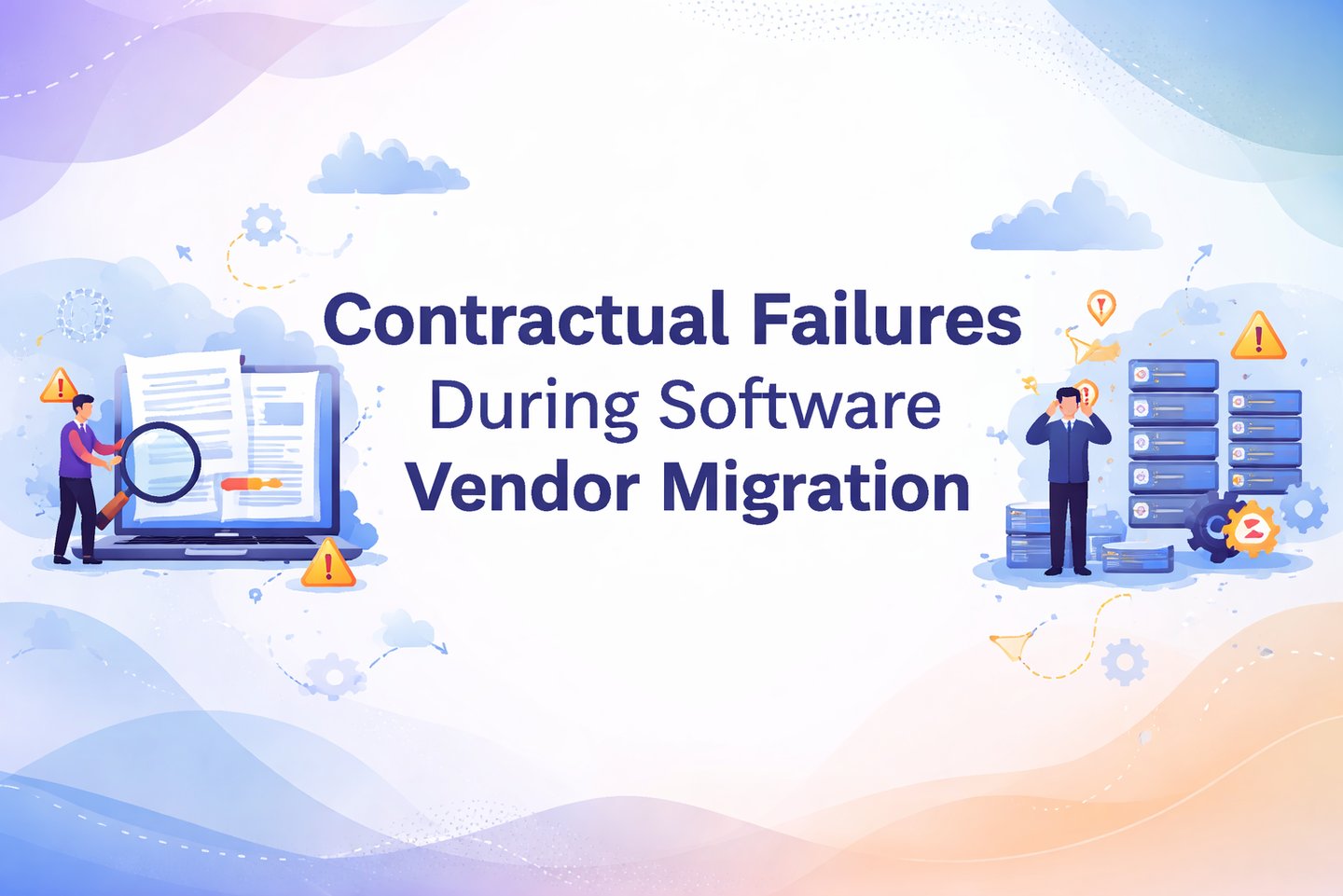
Contractual Failures During Software Vendor Migration
The foundation of contemporary corporate operations is now software. Businesses rely significantly on third-party software solutions to function effectively, from accounting systems to customer relationship management. However, what occurs if the vendor migration is done and causes failure to the company?
CORPORATE LAWS
Udita
2/28/20263 min read
Introduction:-
Moving systems, apps, or infrastructure from one environment to another is known as software migration. These shifts could involve using cloud platforms instead of on-premises deployments, replacing outdated systems with more contemporary stacks, or changing vendors for technology. Such migrations, in spite of their technical look, have an impact on organizational operations and workflows. When a service legal agreement is broken, the company and both new and existing vendors may be held accountable for the data transfer failure and agreement breach. This is covered under the Data Privacy Act, the IT Act, and the Contract Act.
Reason for changing vendor?
· Sometimes the vendor had a good start, but the quality declined when the initial crew left.
· Occasionally, as the business expands, the vendor is no longer able to scale or manage complexity.
· Occasionally, the provider prioritizes new customers over current ones.
· Occasionally, the vendor loses the necessary abilities when the project's direction changes.
· Sometimes a series of minor setbacks, unfulfilled promises, or imprecise communication causes trust to gradually erode.
The issue is frequently more than just technical. It is both cultural and organizational.
Consider things while choosing a new vendor:
1. Software Viability—The development and support staff of the vendor should be committed and efficient in responding quickly to urgent questions and problem fixes.
Determine whatever cloud computing service your vendor utilizes, then investigate the benefits and drawbacks of this service on your own.
Make clear the conditions, expenses, and plans for transferring your data when your contract expires or in the event of unforeseen changes.
2. Client Experience—What kinds of events the vendor hosts specifically for clients throughout the year. The vendor ought to give customers the chance to influence how the product or service is developed for future customers. A Client Advisory Board can help achieve this.
3. Program Management & Investment—An excellent vendor will determine how the program can be efficiently run throughout your project and will adequately and promptly address any RFP questions. Along with helping you and your team lay out the ROI and cost-benefit estimates, the vendor should be able to think of innovative ways to calculate ROI. Ultimately, the vendor must also fulfill the internal vendor risk due diligence standards of your business.
What causes contractual failure?
The cost type of the project is not supported by the agreement. The parties have the chance to ascertain all the needs and specifications of the required orderables through the Statement of Work (SOW), which is a description of the deliverables.
In the worst situation, if the vendor agreement does not include formal acceptance criteria, the vendor may attempt to claim that the invoice is correct at the time of delivery or even shipment without conducting the necessary acceptance tests.
Legal Remedies and Non-Legal Remedies
1. Strong documentation safeguards your company. Your records demonstrate that you acted appropriately and offered the vendor a reasonable opportunity to reply, in case you need to escalate.
2. If the vendor has proven to be untrustworthy, negotiation may provide a way forward. Maintain an open mind while being adamant about what went wrong. Resolving the problem while preserving the working relationship is the aim.
3. A structured approach to resolution is provided by mediation or arbitration when direct discussions break down. With these techniques, you can get a fair result without the expense and publicity of a lawsuit by working with an impartial third party.
4. In the event that a vendor's violation results in monetary loss, you might be eligible for reimbursement. In order to give you the benefit of the agreement, damages may be used to pay for direct expenses like additional shipment or product replacement. Your contract and the particulars of your case will determine the kind and extent of damages.
5. It is a big move to file a lawsuit. Usually, it is required when the vendor refuses to participate or when the breach causes significant operational and financial harm.
6. Section 56 (Doctrine of Frustration) states that a contract may be deemed void if a vendor migration results in an "untoward event" that renders performance of the agreement illegal or impossible, so long as the event was out of the parties' control.
Contracts typically include a force majeure clause to distribute risk, even though it isn't stated in the statute. The contractor may be temporarily released from responsibilities if the vendor change qualifies as a "force majeure" situation (such as a pandemic or civil upheaval).
Conclusion:-
A contract breakdown during a software vendor migration emphasizes how crucial it is to have explicit agreements, allocate risks, and secure data. To prevent disagreements, organizations must guarantee robust contractual provisions, careful planning, and efficient oversight. Sensitive data in digital transactions may be protected, company continuity can be guaranteed, and liability risks can be decreased with a well-balanced legislative framework and professional standards.