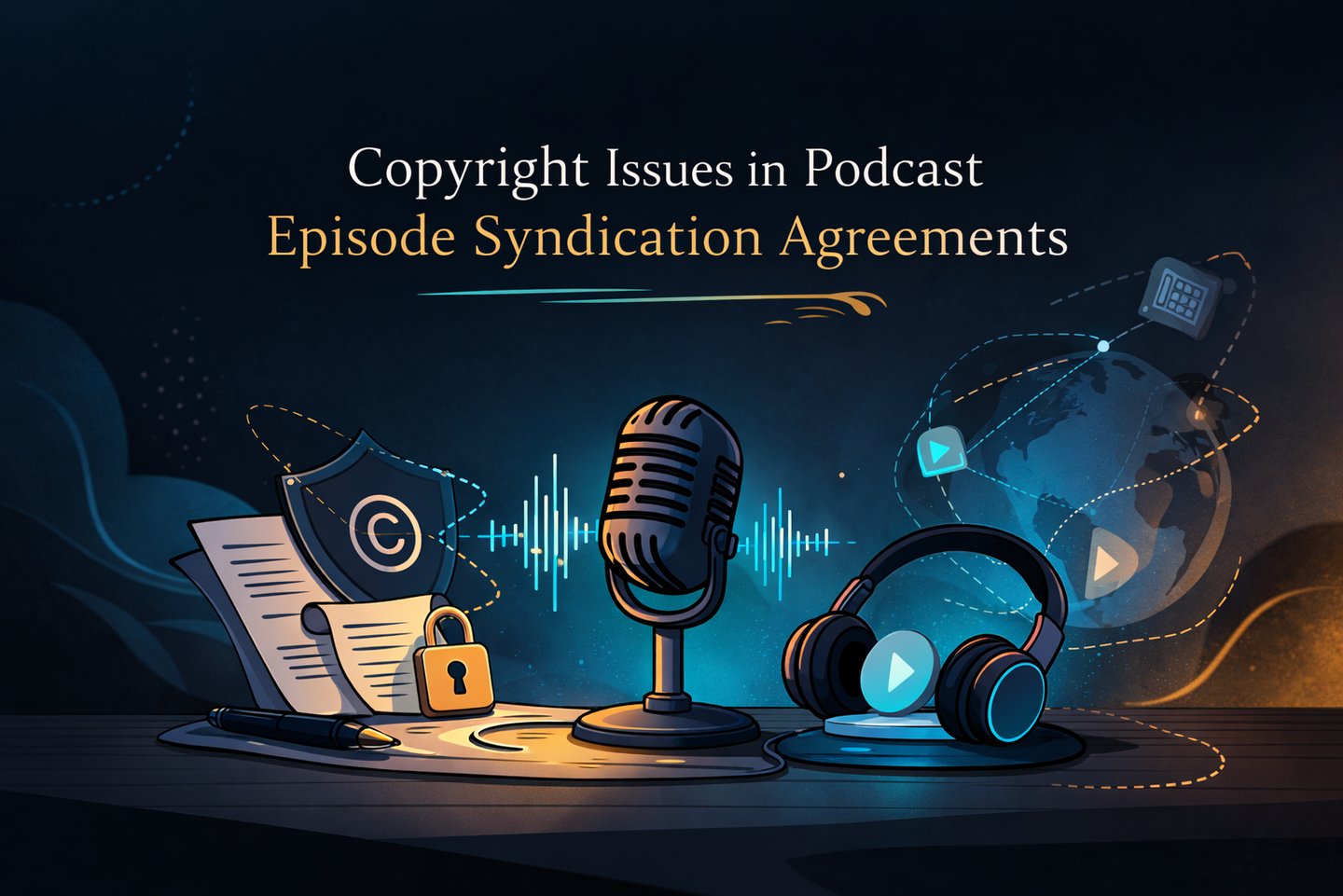
Copyright Issues in Podcast Episode Syndication Agreements
This particular article precisely examines copyright issues in podcast episode syndication agreements with reference to the Copyright Act, 1957, and the Copyright Act of 1976, emphasizing and focusing on the need for concise contractual drafting to prevent infringement and revenue disputes.
IPRCORPORATE LAWS
Khushi
2/28/20263 min read
Introduction
Podcasting has nowadays become a commercially influenced digital medium. To increase more monetization and visibility, creators often enter syndication agreements that allow third parties to distribute episodes across many platforms, international markets, and monetization. However, syndication includes transferring or licensing copyright interests embedded within the podcast content. Since a podcast episode involves many protected works, drafting that is unclear or ambiguous can result in ownership conflicts and liability exposure and unauthorized use.
1. Ownership of Copyright
Identifying ownership is the primary challenge in podcast syndication, as a single episode comprises multiple, often separate, intellectual property rights. A podcast episode may include scripted or spoken content, which is protected as a literary work. The actual audio file constitutes a distinct sound recording, while any music within the episode is protected as a musical composition. Additionally, intro/outro music used to brand the show represents another layer of ownership, often with licensed rights. The episode also includes visual assets, such as show artwork. Finally, guest contributions, such as interviews or spoken word, are distinct ownership components
Under the Copyright Act, 1957, separate copyrights subsist in literary works and sound recordings. The producer typically owns the sound recording, while authors retain rights in scripts unless assigned. Similarly, under the Copyright Act of 1976, copyright initially vests in the author unless it qualifies as a “work made for hire.”
If contributors have not assigned their rights in writing, the podcaster may lack authority to grant syndication rights, exposing both parties to infringement claims.
2. Scope of Licensed Rights
Syndication agreements must clearly define the scope of rights granted. Courts interpret licenses narrowly; unspecified rights remain with the copyright owner.
Essential license clauses must clearly define the scope and limitations of the rights granted to ensure legal compliance and prevent disputes.
The agreement must explicitly state whether the license is exclusive, meaning only the licensee can use it, or non-exclusive, allowing multiple users.
It is essential to define the geographical or territorial scope where the licensee is permitted to operate.
The contract must specify the exact duration of the license, including start and end dates or conditions for termination.
The clause should clearly outline authorized rights of reproduction and public communication, such as copying, distributing, or broadcasting the content.
It must detail the licensee’s rights to edit, adapt, or create derivative works from the original material.
For example, permission to “distribute” does not automatically include translation, adaptation into video, or promotional reuse. Ambiguity may lead to disputes or unauthorized exploitation. Therefore, contracts must explicitly address advertising insertions, edits, and international distribution.
3. Moral Rights and Editorial Changes
In India, Section 57 of the Copyright Act, 1957, protects moral rights, including attribution and integrity. Even after assignment, authors may object to distortion that harms their reputation.
In syndicated podcasts, edits for time constraints or advertising insertions could raise moral rights concerns. Agreements should therefore include consent for reasonable modifications and clarify editorial control. While U.S. moral rights protections are limited, contractual provisions addressing attribution and integrity remain commercially important.
4. Music and Third-Party Licensing
Music licensing is a major risk area. Many podcasters rely on limited-use licenses that may not extend to syndication. Music involves two copyrights: the composition and the sound recording. Expanded distribution may require additional mechanical or performance licenses. Syndicators typically require warranties confirming that all third-party content is cleared for the intended scope. Failure to secure proper licenses may result in infringement liability.
5. Territorial Scope and Governing Law
Because podcasts reach global audiences, syndication agreements must clearly define territorial limits, governing law, and dispute resolution mechanisms. Underlying licenses must align with territorial grants to avoid cross-border infringement.
6. Duration, Revenue, and Liability
The agreement should specify the license term, termination rights, and reversion of rights. Perpetual licenses may restrict creators’ future exploitation, while short terms may discourage distributor investment. Revenue-sharing provisions must ensure transparency through reporting and audit rights. Indemnity clauses allocate risk, requiring creators to warrant ownership and non-infringement while limiting disproportionate liability.
Conclusion
Podcast episode syndication combines creative opportunity with layered copyright complexity. Given the multiple rights embedded within each episode, precise contractual drafting is essential to define ownership, clarify licensed rights, secure third-party clearances, address moral rights, and allocate liability. Aligning syndication agreements with statutory frameworks under the Copyright Act of 1957 and the Copyright Act of 1976 ensures legal certainty and protects the commercial value of podcast content in an increasingly global digital marketplace.