
Copyright Risks in White-Label Content Arrangements
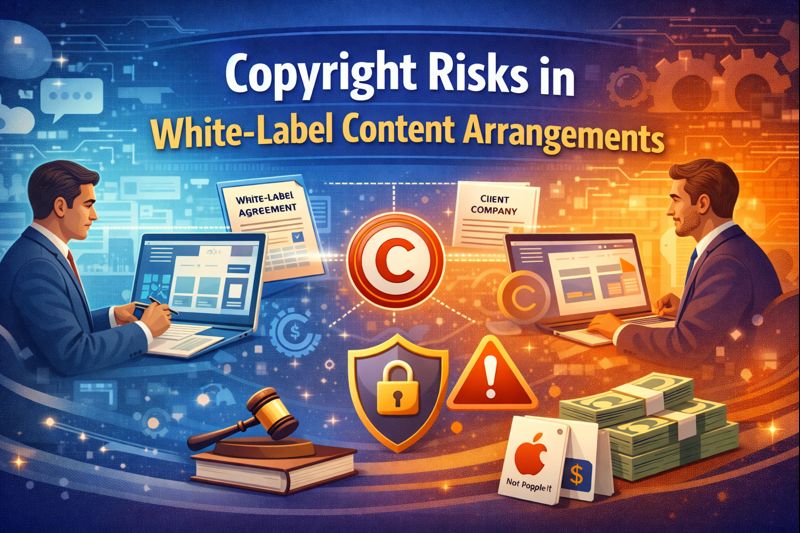
White-label content helps businesses save time and costs but often creates overlooked copyright risks. Under Indian law, misunderstandings about ownership and usage rights commonly lead to disputes without intentional wrongdoing.
IPR
Veeshan Musa
1/13/20263 min read
How White-Label Arrangements Actually Function
In everyday practice, different industries rely on white-label content in different ways. Marketing firms often purchase ready-written blogs or social media material. Ed-tech companies commonly use pre-designed courses. Software businesses depend on outside developers, while legal and research platforms obtain content from external contributors.
What I have consistently noticed in Indian transactions is that documentation rarely receives the attention it deserves. Agreements are often short, generic, or borrowed from unrelated commercial contexts. Important questions are left unanswered. Who owns the content after payment? Can it be edited freely? Can it be reused for multiple clients? These issues only surface when a dispute begins.
Ownership Is Not Automatic under Indian Copyright Law
One of the most common assumptions I encounter is that payment equals ownership. Indian copyright law does not support this belief. According to Section 17 of the Copyright Act of 1957, an author is the initial copyright holder, unless the provisions of the law or an agreement state otherwise.
When it comes to copyright, an assignment can only be done in writing and only in accordance with Section 19. Courts have consistently held that vague or implied transfers are insufficient to divest the author of ownership. If duration, territorial scope, or the nature of rights is unclear, the assignment may fail. In such situations, the business using the content often discovers that it never owned the rights it thought it had.
Licensing Problems in Commercial Use
Where ownership is not assigned, businesses rely on licenses. Licensing itself is lawful, but problems arise when licenses are drafted carelessly. In many white-label deals, licenses are silent on exclusivity, resale, or modification.
Indian courts usually interpret licenses strictly. Where an agreement does not expressly permit sublicensing, resale under a different brand name may amount to copyright infringement. This risk becomes more serious for businesses that distribute the same material to multiple customers or rely on recurring subscription-based delivery.
Hidden Risks Linked to Third-Party Material
A further concern arises from content elements that are sourced from elsewhere. Creators may incorporate images, fonts, software components, or data taken from third-party providers. These additions often go unnoticed until a dispute or takedown notice brings them to light. If these materials are not properly licensed, the infringement risk does not stop with the creator.
Under Indian law, liability does not stop with the person who created the infringing material. If a business uses that content for commercial gain, it may also be held accountable. Courts often assess who exercised control and derived commercial benefit from the use of the work. This is particularly risky for white-label resellers who often have very limited visibility into how the content was originally created.
Moral Rights and Rebranding Challenges
In India, copyright concerns, in relation to content, go beyond just the commercial aspects. It also recognizes that creators have a continuing personal interest in their work. Authors are entitled to be acknowledged and to object to changes that damage the character or quality of what they created. These rights do not disappear simply because commercial rights have been transferred.
In many white-label arrangements, the creator’s identity is removed and the content is reshaped to fit branding strategies. If the agreement does not clearly address these issues, friction is almost inevitable. Even without formal legal action, such disputes can strain working relationships and affect the credibility of the businesses involved.
Responsibility When Disputes Arise
When enforcement action is taken, attention usually turns to the party that presents the content to the public and profits from its use, rather than the unseen creator behind it. White-label resellers, not creators, usually face takedowns, notices, and lawsuits. The situation worsens when agreements lack indemnity clauses or clear responsibility sharing.
Beyond legal costs, businesses must also consider reputational harm and operational disruption. Platform removals and compliance investigations can undo years of brand building in a short time.
Practical Safeguards and Contract Discipline
The majority of these risks are manageable. Contracts are more effective when drafted clearly. Contracts should, in layman’s terms, specify whether rights are being assigned or licensed. If licensed, the terms of use should be clearly captured.
Warranties concerning originality, the identification of third-party materials, moral rights, and indemnity are not mere formalities and act as tools for managing risk. From my perspective, the cost of early legal intervention is far lower than the cost of damage control later.
Conclusion
White-label content can be both useful and commercially viable if handled correctly. It allows companies to rapidly meet market needs and expand their product/service offerings without needing to create everything in-house. However, legal guidance and ownership should be dealt with to circumvent assumptions. Such assumptions can lead to lawsuits and legal liability under the Copyright Act of 1957.
A company that defines its boundaries, complies with the legal framework, and reviews contracts before employing them strengthens its position. In the right circumstances, white-label content can help companies achieve steady, sustainable growth while avoiding legal and financial pitfalls.