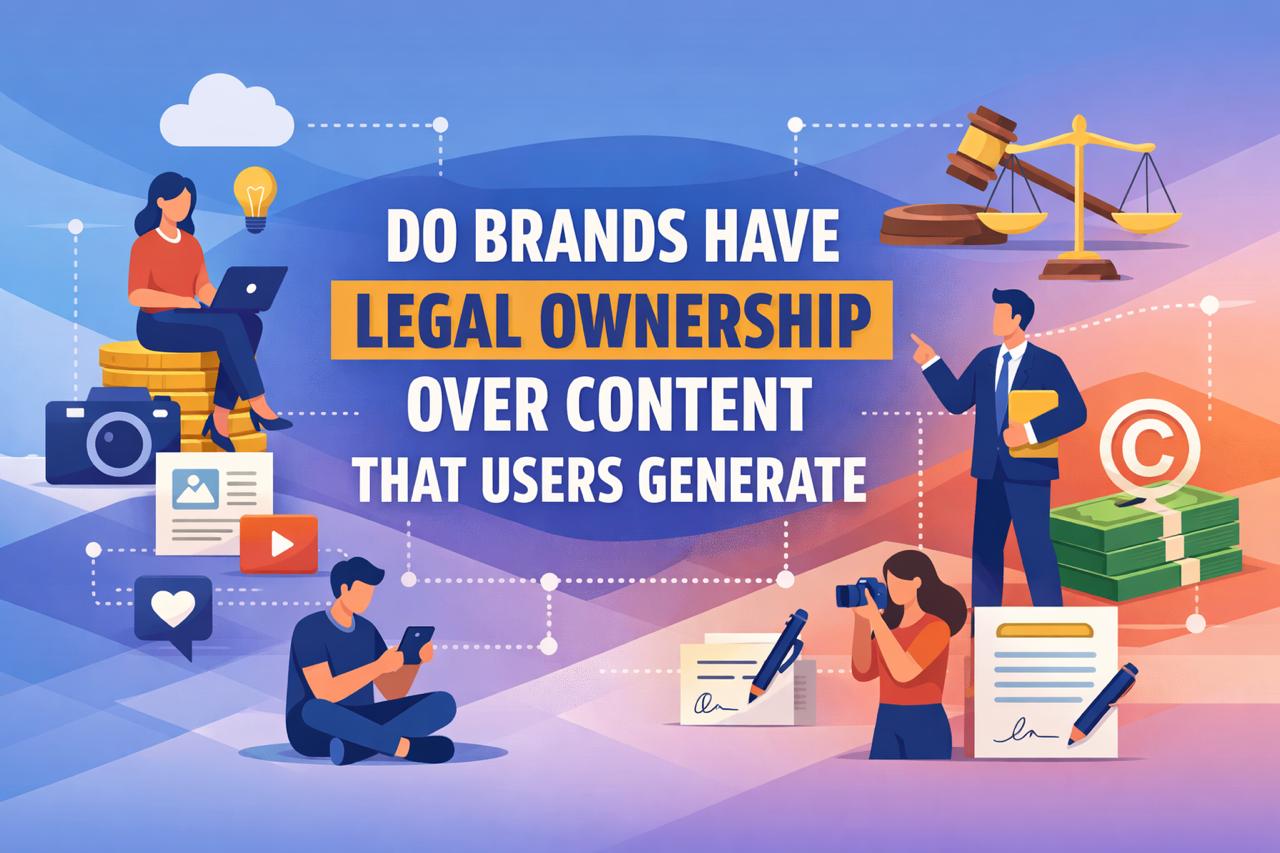
Do brands have legal ownership over content that users generate
For any modern business, a great online and offline presence is based on quality content. Compelling articles, interesting social media posts, complex video productions and advanced branding elements are the lifeblood of marketing campaigns. However, a large question tends to loom large often for companies who outsource these tasks: Who actually owns the content created by a marketing agency?
IPR
Khushi
4/20/20264 min read
Introduction
This question is not just about legal technicalities but gets to the heart of issues related to control, reuse in the future and potential dispute that can derail entire branding exercises. Misunderstandings concerning content ownership can produce unexpected costs, restrictions on how you are able to utilise your own marketing materials and, in worst-case scenarios, legal battles. This article will unravel this complex web of Intellectual Property (IP) rights, looking into the legal frameworks, practical considerations and standard IP practices that determine ownership when a company is engaging a marketing agency.
Understanding the Essential Idea: Work-for-Hire
At the very base of content ownership when it comes to agency relationships is the legal doctrine of Work Made for Hire. This is an important principle of copyright law (at least in places such as the United States). In essence, the "Work-for-Hire" doctrine states that when a work is created by an employee within the scope of his or her employment, the employer, in this case, the company, automatically owns the copyright.
The Agency Dynamic: Employee vs. Independent Contractor
Here is where it gets complicated. When a company hires a marketing agency, the agency usually works as an independent contractor, rather than an employee. Under common copyright law, independent contractors usually own the copyright to the work they create, unless there is a written agreement to the contrary.
Therefore, without a carefully drafted and legally binding contract that specifically addresses content ownership, a marketing agency may technically own the rights to the creative assets that they produce for your company.
This is a very important distinction that many businesses ignore. You might be paying for the service, the strategy and the time, but without the right clause, you might not be buying the absolute rights to the final deliverables. This can result in surprising restrictions on your ability to alter, reuse or even profit from the very content that you paid to have created.
The Client has the Initial Goal/Brand Guidelines Agency deploys their Creative Team and their Tools (Agency IP) to deliver the Final Deliverables. The most important step is "Deliverable Review & Approval," which, together with the Contract, determines whether the final arrow results in "Full Ownership" by the Client, or "Limited License/Co-Ownership."
The Power of the Master Services Agreement (MSA)
The solution to this potential conflict is proactive legal clarity, mostly achieved through a robust Master Services Agreement (MSA) or a detailed content creation contract. This contract has your relationship with the marketing agency act as the rulebook, and is where content ownership needs to be explicitly negotiated and defined.
A properly drafted contract should clearly cover some of the following areas:
Explicit Assignment of Rights: The simplest method of such an approach is to include a provision that states that once final payment (or other milestone) is made, the agency transfers and assigns all intellectual property rights in the deliverables to the client. This effectively creates a scenario similar to "work-for-hire", in which you, the company, become the outright owner. Wait, What About Background IP? Agencies use internal tools, pre-existing templates, methods and occasionally, stock assets when creating content. It's important to make this distinction:
New, Original Work created specifically for you (and assigned to you).
Agency Background IP: Pre-existing knowledge, code or tools that are used by the agency on multiple clients. The agency will (and should) retain ownership of this background IP, but will have to grant the client a perpetual, non-exclusive license to use it as it's incorporated into the deliverables.
Defining the Deliverables: Clarity is the Key. The contract should include a list of exactly what "deliverables" (i.e., final logo files, source code for the landing page, edited video footage, etc.) are considered approved to eliminate ambiguity in the future.
Warranties and Indemnification: The agency should warrant (guarantee) that the deliverables are original, do not infringe on third-party copyrights (like unlicensed stock images) and that they have the full right to transfer the ownership. An indemnification clause will protect your company in the event a third party sues, alleging that the content created by the agency violates their IP.
Rights to Third-Party Assets: If the content uses stock photography, licensed music, or other third-party material, the contract must spell out who is responsible for securing (and paying for) these licenses and who holds the user rights to these ultimately.
Alternative Ownership Models: It's Not Always an All-or-Nothing Affair
While complete assignment to the client is often the ideal (and standard) scenario, sometimes agencies push back or offer other models. It's very important to be familiar with the following alternatives:
Non-Exclusive License: The agency keeps ownership of the material but grants the client a license to use the material for certain purposes, and may have restrictions as to time, geographical area or modification of the material. This is generally not very desirable for core branding elements.
Exclusive License: Similar to a non-exclusive license, however, the agency cannot grant this same license to anyone else (for a specified time or purpose). Unlike with a non-exclusive license, you have more control than with a non-exclusive license, but you are still not the owner of the underlying copyright.
Co-Ownership: A joint ownership of copyright which is shared between the agency and the client. This can be complicated; consent is necessary for some of the uses or monetisation, and is often best avoided because of the possibility of future conflicts.
The Dangers of Ambiguity: What Happens If There Is No Clear Contract?
Relying on handshakes, vague emails, or standardised verbal agreements is a recipe for disaster. If it is not clearly defined who owns something, major problems can arise:
Restrictions on Reuse Imagine that you hire an agency to produce a series of videos to promote a particular product launch. Without full ownership, for instance, you could be prevented from legally adapting those videos to use in a different marketing campaign at some future date, or using still frames in other marketing materials.
disputes
The issue of content ownership when collaborating with a marketing agency is not a minor issue. By having a basic understanding of the work-for-hire doctrine and the importance of an independent contractor, businesses can approach these partnerships with the knowledge and power to be informed. A clear and well-negotiated Master Services Agreement (MSA) with explicit clauses around assignment of rights, definition of deliverables and management of third-party licenses is important. Don't let your brand's precious content - the face and voice of your company - be in a state of legal limbo. Take proactive steps to make sure that you don't just pay for the creation of content, but you are the fundamental owner of it.