Effective Contract Management Strategies
Discover how effective contract management can enhance your business outcomes through planning, drafting, negotiation, and execution. Learn about the importance of standardization, automation, clear communication, and risk management in the contract lifecycle.
CORPORATE LAWS
Shrutika
1/29/20265 min read
INTRODUCTION
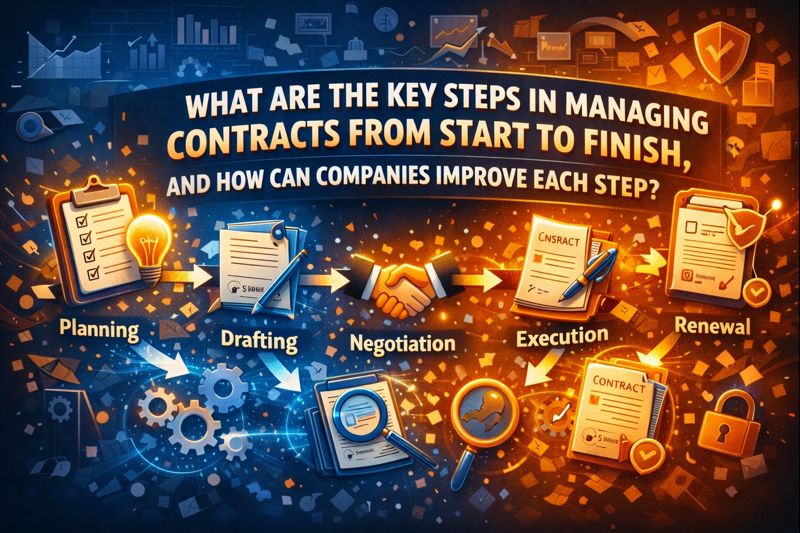
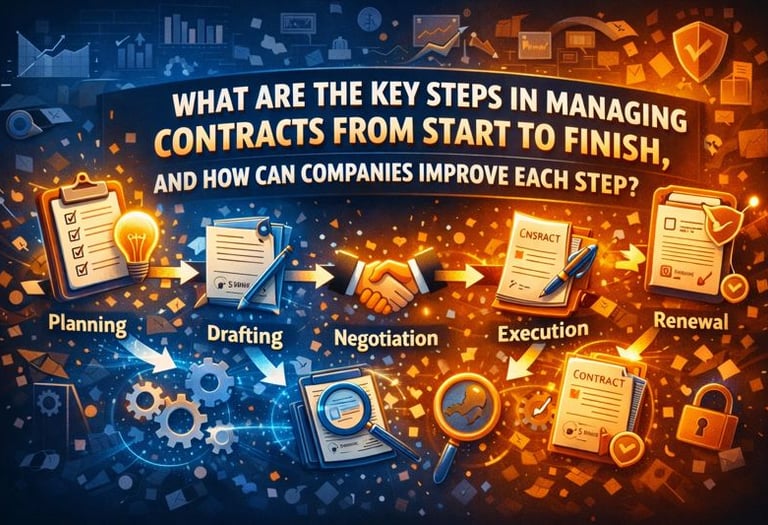
The contract management cycle is an organized procedure that can help optimize contracts to deliver maximum value with minimum potential for risk, litigation, and inefficiency. This is more significant in the current situation, as the world is experiencing turbulent times, and this process is important in the Indian context as well, as per the Indian Contract Act of 1872.
It includes important phases of planning and formation, negotiation and implementation, administration and management of performance, and amendment or renewal, as well as closure or termination. Understanding these phases leads to greater accountability, cost-effectiveness, as well as development of strategic partnerships.
8 STAGES OF CONTRACT LIFECYCLE MANAGEMENT
This article outlines each stage to help you manage contracts with greater efficiency.
Stage 1: Contract Request and Initiation
The contract lifecycle begins with a request that is a result of needs such as purchase or sale. Before the initiation of the process, the necessary information that should be submitted is:
· Requirements, objectives, participants, boundaries, and related documentation need to be gathered from all the interested parties.
· Risk-benefit analysis and obtaining approval.
· Make a formal request record for contract priority and initiation.
It’s imperative to note that this phase is effective for avoiding confusion, emphasizing the urgency of the matter, ensuring clarity, and engaging the involved team from the very start.
Stage 2: Contract Drafting and Authoring
Upon getting approval, the legal team will use templates and the request form itself to develop the document. Steps undertaken in this case include:
· Enabling the use of them by ensuring proper language, including all the agreed elements, to avoid confusion.
· Integrating the legal and regulatory requirements, such as the Indian Contract Act.
· Editing or reviewing draft work collaboratively with various business partners like legal and procurement and subject matter experts.
These improve efficiency by saving time, as the work is repetitive.
Stage 3: Contract Negotiation and Review
The contract is reviewed internally extensively in terms of the legal and finance departments before it is presented outside to ensure it is accurate and compliant with policies. After this process is done, negotiations with the other party are done by engaging in rounds of discussions and offers using online platforms that enable version control. Key terms need to be finalized concerning scope, price, terms, and responsibilities while ensuring approvals from the relevant stakeholders are addressed. This approach provides early identification of issues, compliance, and reduction of delays while aligning both parties' interests.
Stage 4: Contract Approval
Once the terms of the contract are agreed upon, it then proceeds to its internal approval procedure, which follows a well-structured course through internal legal, business, finance, and senior management. This way, the legal team examines the terms of the agreement and the compliance checklist, the business side verifies the relevance and viability, and the financial side approves the budget and timelines, and then the final go-ahead. This way, the approval process is multiple-tiered and thus ensures accountability and compliance.
Stage 5: Contract Execution and Signature
Upon approval, all authorized parties agree to sign off on the contract via e-signing or physical signing to indicate that the contract is finalized and ready. Upon this, the signed contract is warehoused safely in a contract repository, with all key teams notified of obligations, deliverables, and payments. At this point, all parties are bound by the contract, engaging the contract life cycle for performance management.
Stage 6: Contract Administration and Obligation Management
When this is achieved, the deliverables, milestones, SLAs, payments, and time factors related to contractual obligations are all monitored. Automation is used to track the deadline and renewal notifications and potential issues. Changes, disputes, quality issues, and regulatory compliance related to contracts are all actively addressed.
Stage 7: Contract Amendment, Renewal, and Optimization
As the business requirements keep changing, the contracts are formally modified. The performance metrics are also assessed before the expiration of the contracts for the purpose of determining the need for renewal or renegotiation, and the critical factors, such as the dates for renewal, obligations, compliance, and modifications, are closely tracked.
Stage 8: Contact Expiry and Archiving
After natural expiration, forced termination, or fulfillment of a contractual obligation, it is important to ensure that all final deliverables have been made. A performance review should be done to evaluate value for money received and changes in the market to facilitate a smooth contractual wrap-up. All contractual documents should also be appropriately archived.
The steps involved to perform this procedure are:
· Completion must be checked, and no loose ends should be left.
· Marks the contract as closed and stores it within the repository.
This will ensure a seamless wrap-up, prepare for any audits, and yield organized records for future analysis.
EFFICIENCY IMPROVEMENTS ACROSS STAGES
Stage 1: Request and Initiation
Major Challenge:
The main problem during the initiation of a contract is that there does not exist a standard mechanism of request, so information provided by business or operational teams is usually incomplete, vague, or inconsistent.
Solutions:
· Develop and implement pre-contract requirement checklists.
· Appoint one point of contact to serve as the coordinator.
Stage 2: Drafting and Authoring
Major Challenge:
Inefficiencies include having to redraft from scratch repeatedly and using various words to convey a similar meaning in different clauses across contracts.
Solutions:
· Adopt pre-approved templates and clause libraries.
· Engage AI-supported drafting for speed and compliance.
Stage 3: Negotiation and Review
Major Challenge:
The negotiation stage is usually stretched out because there are no well-defined limits concerning the negotiations, there is a need for internal consultations in seeking approvals, and multiple versions of contracts are moved around via email, causing a lot of confusion.
Solutions:
· Define negotiation authority and approval matrices.
· Use central collaboration platforms with version control.
· Prepare pre-approved negotiation instructions.
Stage 4: Approval
Major Challenge:
Sometimes, it is in this phase of contract execution review and approval where contract execution delays may be encountered. There are various individuals who are not structured.
Solutions:
· Establish hierarchies and approval processes.
· Automate approval routing with defined timelines.
Stage 5: Execution and Signature
Major Challenge:
Delays in execution occur due to reliance upon physical signatures, improper adherence to formalities of execution, and poor coordination among signatories.
Solutions:
· Integrate e-signature tools for real-time, auditable signing.
· Centralize final verification in a repository.
Stage 6: Administration and Obligation Management
Major Challenge:
Unfortunately, post-execution, these contracts are stored in highly fragmented systems, such as emails, shared drives, or even physical files, making their retrieval hard to access and increasing their possibilities of being lost, duplicated, or using versions that are not updated.
Solutions:
· Set up automated alerts over SLAs, payments, and compliance.
· Establish a centralized digital repository for contracts.
Stage 7: Amendment, Renewal, and Optimization
Major Challenge:
A major issue during the performance stage itself is the absence of positive monitoring of the conditions, milestones, and deliverables of the contract. Lack of coordination among legal, finance, and operational teams results in missed deadlines, lack of compliance by counterparties, and undetected contractual breaches.
Solutions:
· Adopt the use of proactive notifications and performance reviews.
· Standardize amendment procedures with versioning.
Stage 8: Expiry and Archiving
Major Challenge:
In the aspect of expiry and renewal of agreements, it is common for business entities to fail to address key renewal or termination deadlines because of the absence of mechanisms to monitor these activities. In many cases, business amendments occur without proper review by the relevant authorities of law.
Solutions:
Automate final confirmation and secure archiving.
Run automated audits on lessons learned.
CONCLUSION
Well-managed contracts throughout the entire life cycle help with regulatory compliance, risk mitigation, and business efficiencies. By creating efficiencies through process standardization, technology enablement, and coordination of activities across different functions, it is possible to get the best out of contracts, minimize disputes, and establish lasting business relationships.