
ENFORCEABILITY OF CONTRACT IN INADEQUATELY SIGNED AGREEMENTS
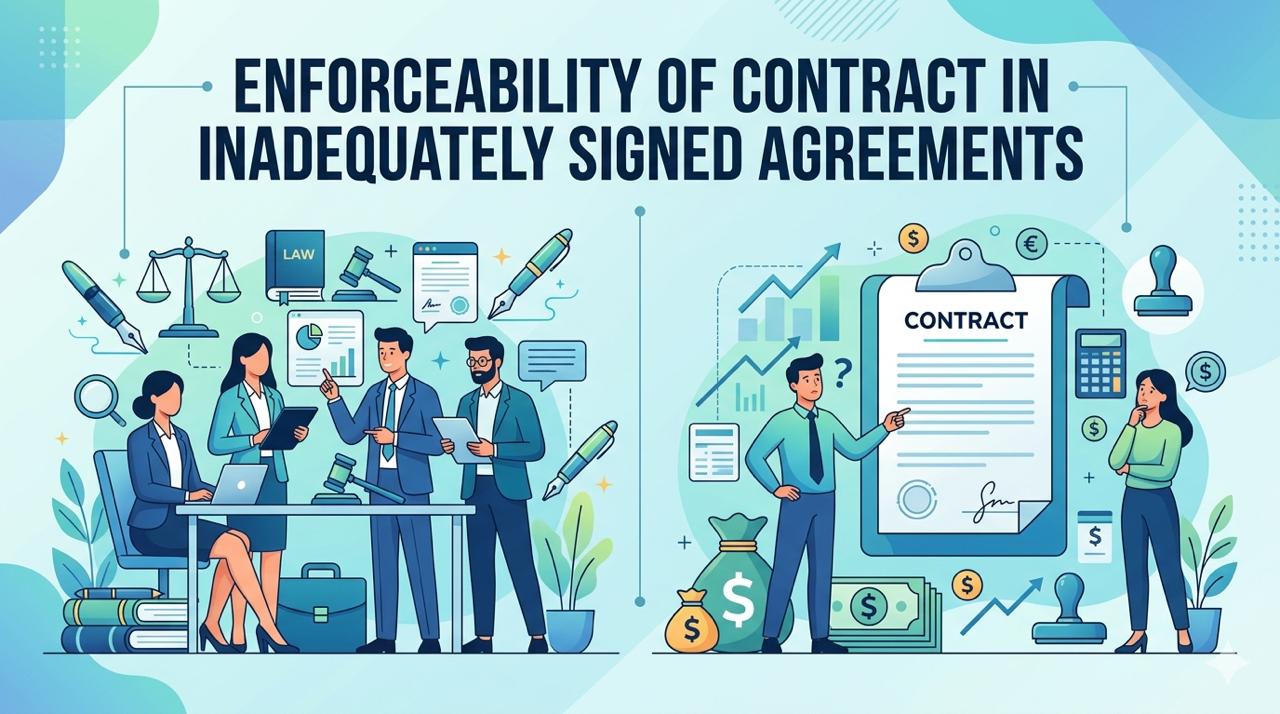
A contract remains enforceable even if one party fails to sign every page. Courts focus on an objective intention to be bound, not ritualistic initials. Proper execution and evidence of assent matter far more than page-by-page signatures.
CORPORATE LAWS
Atridev Pandey
4/2/20264 min read
Introduction
In over twenty-five years of drafting, negotiating, and litigating commercial contracts, I have lost count of the times a client has slid a multi-page agreement across my desk and asked, with a mixture of panic and indignation, “They only signed the last page—what happens now?” The question is understandable. We have all been conditioned to treat signatures like magic spells: the more pages they touch, the more ironclad the deal. But the law, at least in most common-law jurisdictions, is far more pragmatic.The short answer is almost always yes—the contract remains enforceable. A failure to initial or sign every page does not, by itself, render the agreement void or unenforceable. Courts look to the parties’ objective intention to be bound, not to whether ink appears on page 7 or page 12. Yet the practical risks are real, and they deserve careful attention.
The Fundamentals: What Makes a Contract Binding?
Let us start with first principles. Under English law, the law of most U.S. states, and other common-law systems, a contract is formed when there is an offer, acceptance, consideration, and an intention to create legal relations. A written document is merely evidence of that bargain. The signature on the execution page is powerful evidence that the signer has read, understood, and assented to the entire instrument—provided the document is presented and executed as a single, integrated whole.
Statutes of Frauds in various jurisdictions require certain contracts (land, guarantees, contracts not performable within one year) to be “in writing and signed by the party to be charged.” Crucially, those statutes have never been interpreted to demand a signature on every page. A signature at the end, coupled with clear identification of the document (page numbers, a recital that “this Agreement consists of X pages,” or even a simple staple), is sufficient.
Why Do People Initial Every Page Anyway?
The practice serves as a precautionary measure rather than a legal requirement. Its purpose is evidentiary: to make it harder for a dishonest party to substitute pages after execution. I once represented a manufacturer whose distributor attempted to assert that they had "slipped in" an onerous price-escalation clause on page 4 after signing. Because both sides had initialled every page and kept identical copies, the argument collapsed in mediation. Had there been no initials, we would have had to rely on witness evidence, page numbering, consistent fonts, and the parties’ subsequent conduct—still winnable, but messier and more expensive.
Courts routinely reject the “unsigned pages” defence. In the United States, decisions such as those interpreting mortgage and deed formalities (for example, Wells Fargo Bank, N.A. v. Gordon and 21647 LLC v. Deutsche Nat’l Tr. Co.) confirm that the absence of initials does not invalidate an otherwise properly executed document. English and Commonwealth courts take the same view: the signature page is the anchor. The pages that precede it are presumed to form part of the same instrument unless the party attacking the contract can prove otherwise—and the burden is heavy.
There are, of course, narrow exceptions. Certain formal documents—wills in some jurisdictions, notarial acts, or specific statutory forms—may carry explicit page-by-page requirements. Real-estate contracts in a handful of U.S. states sometimes attract stricter recording rules. But for ordinary commercial agreements, employment contracts, supply agreements, NDAs, or shareholder pacts, the law does not treat missing initials as fatal.
When Missing Initials Can Create Real Trouble
That said, a prudent lawyer never dismisses risk. If the non-signing party later alleges that a particular page was never shown to them, or that the document was altered, the absence of initials becomes ammunition. Judges are human; they dislike sloppy execution. In one memorable case I handled, a counterparty argued that an entire schedule had been added post-signature because it bore no initials. We ultimately prevailed on the basis of contemporaneous emails and performance, but the litigation dragged on for eighteen months and cost both sides six figures.
Even higher risk arises if the contract itself contains a clause stating “the parties shall initial each page” or “this Agreement shall not be effective unless executed in full.” Courts will then treat that language as evidence of the parties’ own intention. Failure to comply could be argued as a failure of a condition precedent—though even then, waiver or estoppel by conduct often saves the day.
Best Practices That Actually Matter
Over the years, I have developed a short checklist that I insist every client follows:
Number the pages consecutively and include a recital on the first page: “This Agreement consists of 15 pages, including this signature page.”
Use counterparts and electronic signatures where permitted. Modern e-signature platforms automatically embed audit trails that make page-substitution arguments almost impossible.
Initial alterations, not necessarily every page. If you make any handwritten amendments, please initial the change. That is far more important than initialising blank spaces.
Keep identical executed copies. Both sides should sign and retain complete sets at the same time.
Add an integration clause that expressly incorporates all pages and schedules by reference.
For high-value or high-risk deals, consider a short execution certificate or a covering email confirming that the signer has reviewed the entire document.
These steps cost nothing in time or money but can save a fortune in court.
The Human Reality Behind the Ink
Clients often tell me they “didn’t have time” to initial every page or that the other side was “in a rush.” I gently remind them that courts do not reward haste; they reward clarity of intention. In the end, the law is remarkably forgiving of technical imperfections provided the parties behaved as though the contract existed. Partial performance, payment, delivery, or even continued negotiation after signing can all cure formal defects.
I have enforced contracts where one party signed only the signature page and never touched the exhibits. I have also seen parties walk away from seven-figure disputes because the document looked sloppy and the judge simply lost patience. The difference was always evidence of genuine assent, not the precise location of ink.
Conclusion
So, is a contract enforceable if one party fails to sign all pages? In the overwhelming majority of cases, yes. The signature at the end is the legal keystone. Initialling every page is a useful custom, not a statutory commandment. That does not mean you should be careless. In commercial life, the best protection is not perfect formalities but clear communication, consistent conduct, and competent drafting.
Next time you are handed a twenty-page agreement and the other side has only signed page 20, do not panic. Read the document, confirm the pages match, keep your copy pristine, and if doubt remains pick up the phone and ask for the missing initials. Better still, build the habit of doing it right the first time. Your future self and your litigation budget will thank you.