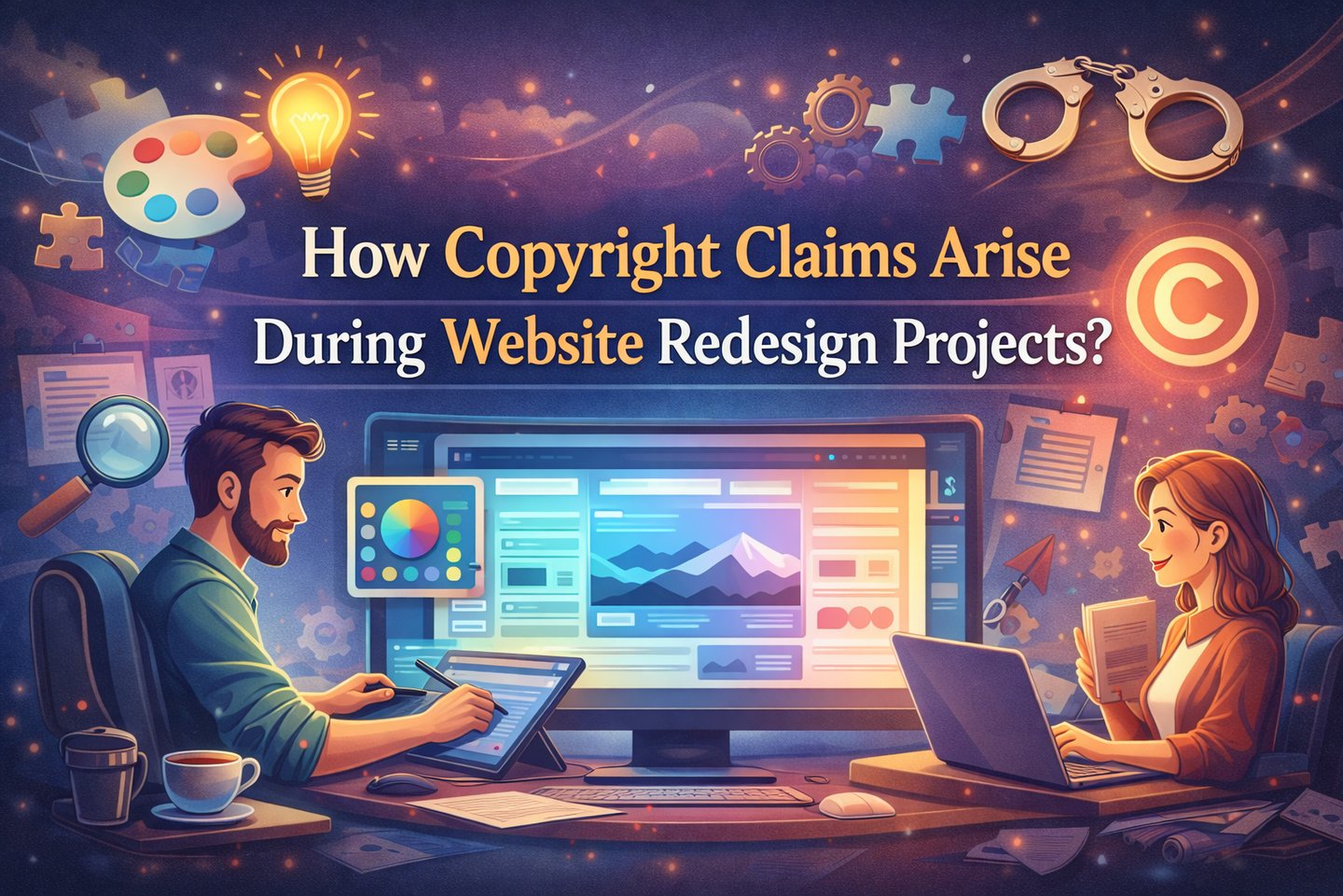
How Copyright Claims Arise During Website Redesign Projects?
This article examines the principal circumstances in which copyright claims emerge during website redesign projects, analyzes the legal principles governing ownership and licensing, and highlights the practical and financial consequences of infringement.
IPR
Lakshita
2/27/20265 min read
INTRODUCTION
Website redesign projects are often seen as purely creative or technical upgrades—new layouts, refreshed branding, improved user experience, and enhanced performance. However, beneath the surface, redesigns carry significant legal risks, especially in relation to copyright. Many organizations assume that because they paid for a website, they automatically own every element within it. In reality, copyright ownership and licensing arrangements can be complex, and misunderstandings frequently lead to disputes.
1. Understanding Copyright in the Context of Websites
Copyright protects original literary, artistic, musical, and dramatic works. In the digital environment, a website is not a single work but a collection of protected elements, including: Source code and object code, Written content (blogs, product descriptions, policies), Photographs, graphics, and illustrations, Audio and video materials, Database structures, User interface design
Under the Copyright Act, 1957, copyright subsists in original works once they are created and fixed in a tangible form. The author of the work is generally the first owner, unless the work is created in the course of employment or is subject to contractual assignment.
2. Absence of Clear Ownership Clauses
One of the most common triggers for copyright disputes during redesign projects is the absence of clear ownership terms in the original agreement. If the original website was built by an external agency and the agreement did not expressly assign copyright to the client, the developer may remain the copyright owner. In such cases:
· The client may only have a limited license to use the website.
· The developer may retain rights over design templates, code frameworks, or custom graphics.
· Reproducing or modifying the site during a redesign could constitute infringement.
When a new agency is brought in to redesign the website, they may unknowingly copy or modify protected code or design elements owned by the previous developer. This can lead to legal notices, takedown demands, or even litigation.
3. Reuse of Code Without Authorization
Modern websites rely heavily on code libraries, frameworks, and plugins. Developers often reuse code snippets from prior projects. While this improves efficiency, it may create legal risks if:
· The code was originally developed for another client.
· The code is proprietary and not licensed for reuse.
· The code contains confidential or trade secret elements.
For example, if a developer reuses backend architecture built for one company in a redesign for another company, the first client may claim copyright infringement or breach of contract. Open-source software adds another layer of complexity. Many open-source licenses (such as GPL, MIT, or Apache) impose conditions on redistribution. Failure to comply with these license terms during a redesign can expose the website owner to claims.
4. Use of Stock Images and Third-Party Content
During a redesign, marketing teams often introduce new images, fonts, or videos. Copyright claims may arise if:
· Stock images are used without proper licensing.
· The license does not permit commercial use.
· The license does not permit modification.
· The subscription used to obtain the content has expired.
Platforms like Getty Images are known for actively enforcing their rights. If a redesigned website uses unlicensed images, the company may receive a demand letter seeking compensation. Similarly, embedding copyrighted music or videos without permission can trigger claims. Even copying website text from competitors may amount to infringement.
5. Disputes Over Website Design and Layout
Although general ideas and concepts are not protected, original expressions of those ideas are. Unique layouts, custom graphics, and creative user interfaces may qualify as artistic works. In some jurisdictions, courts have recognized that “look and feel” can be protected if it reflects sufficient originality. If a redesign closely resembles a competitor’s website in structure, arrangement, or design elements, the competitor may allege infringement.
6. Content Migration Issues
During redesign, content from the old website is often migrated to a new platform. Problems arise when:
· The content was written by freelance writers without assignment agreements.
· The content was licensed for a limited duration.
· The content includes third-party contributions.
If freelance authors retain copyright, continued use beyond the agreed scope may constitute infringement. Even blog posts written years earlier can become contentious if ownership was not clearly assigned.
7. Moral Rights and Attribution Claims
Copyright law not only protects economic rights but also moral rights. Under the Copyright Act, 1957, authors have the right to claim authorship and object to distortion, mutilation, or modification of their work that harms their reputation. During redesign, substantial changes may be made to original artistic works. If the original designer believes that the modifications distort their work or remove attribution unfairly, they may assert moral rights.
8. Termination of Developer Access and Retaliatory Claims
In some disputes, a company may terminate its relationship with the original web developer and hire a new agency. If the termination is contentious, the former developer may claim unpaid dues, allege unauthorized use of proprietary code, withhold access credentials, and file copyright infringement claims. This situation is especially problematic when the client lacks full administrative control over hosting, domain registration, or backend systems. Ownership of the domain name itself is governed by separate principles. Disputes relating to domain names are often resolved under policies administered by organizations like the Internet Corporation for Assigned Names and Numbers.
9. Database and Backend Structure Claims
E-commerce websites and service platforms often rely on structured databases. In some jurisdictions, database structures may receive copyright or sui generis protection. If a redesign involves exporting data or replicating database architecture developed by a previous vendor, that vendor may assert rights over the structure or compilation. This is particularly relevant when proprietary CMS systems are involved.
10. Preventive Measures to Avoid Copyright Claims
To reduce the risk of copyright disputes during a website redesign, organizations must adopt structured legal and technical safeguards. First, every development agreement should contain clear written clauses specifying copyright ownership, assignment of rights, scope of license, and waiver of moral rights wherever legally permissible. Before appointing a new agency, the company should conduct thorough due diligence by reviewing the original contract, auditing ownership of existing code and content, and verifying the validity of third-party licenses. Proper documentation must be maintained, including records of stock image licenses, open-source compliance details, freelancer agreements, and employee contracts. It is also essential that freelancers and consultants execute formal copyright assignment deeds to prevent future claims. Open-source software should be used cautiously, ensuring strict adherence to license terms and required attributions. Finally, the organization should always retain administrative control over critical digital assets such as domain registration, hosting accounts, and content management systems to avoid operational and legal complications.
11. The Financial and Reputational Impact of Claims
Copyright claims can have serious consequences:
· Website takedown orders
· Injunctions
· Monetary damages
· Settlement payments
· Brand damage
For businesses relying heavily on online presence, even temporary removal of a website can result in substantial losses.
Conclusion
Website redesign projects are not merely technical upgrades; they are legally sensitive undertakings. Copyright claims commonly arise due to unclear ownership, unauthorized reuse of code, improper licensing of images, content migration issues, and contractual ambiguities. The root cause in most disputes is not intentional infringement but lack of documentation and due diligence. Organizations that treat copyright as a central legal issue—rather than an afterthought—can significantly reduce risk. In an increasingly digital economy, intellectual property compliance is not optional. It is an essential component of responsible business practice. Careful planning, strong contractual drafting, and legal awareness can transform a potentially risky redesign into a secure and successful digital transition.