
How Courts Decide Child Custody in India: Legal Guide
How does a court decide child custody in India? A guide to the Guardians and Wards Act, Hindu law, Muslim law, and the child welfare principle.
FAMILY LAW
Masooma Naqvi
7/16/20265 min read

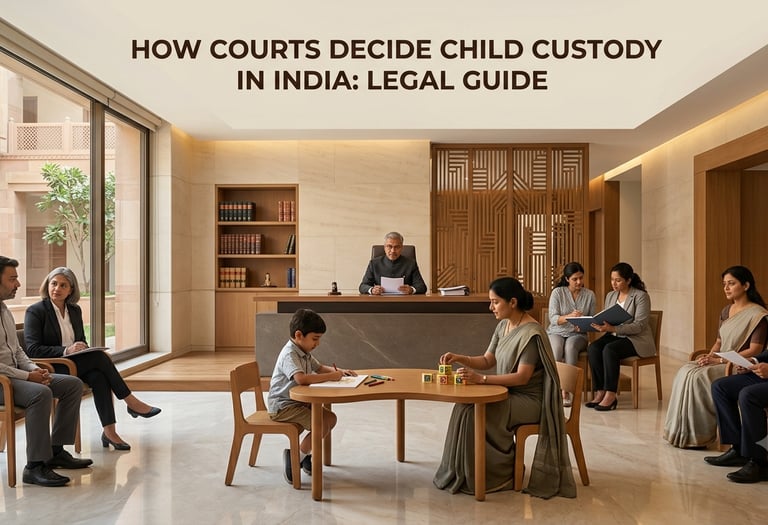
Introduction
A divorce is not merely the revocation of a marriage — it carries far-reaching emotional consequences, which intensify considerably when the custody of a child is in question. This places a critical responsibility on the judiciary to determine what happens to the child once the parents separate. The most common approach courts follow is to decide the matter based on the best interests of the child.
Under the Indian Majority Act, 1875, a child is any person who has not attained the age of 18. Children who witness their parents' separation are emotionally vulnerable, and courts must take due care in determining what serves their best interests. Several factors come into play in that determination. This article examines the process and the key factors courts weigh when deciding child custody in India.
Definition and Legal Framework
In common usage, child custody refers to a parent's right and responsibility to care for and control a minor child. Legally, the term carries a twofold meaning — it encompasses both physical custody (the right to have the child live with you) and legal custody (the right to make decisions about the child's welfare).
The main types of custody arrangements include:
Joint Custody — Both parents share custody of the child.
Physical Custody — One parent typically holds custody while the other receives visitation rights.
Third-Party Custody — Less common in India, this involves placing custody with someone other than a parent in exceptional circumstances.
Legislative Framework Governing Custody in India
This is the most uniformly applicable custody law in India, owing to its secular nature. Section 17 of the Act empowers courts to determine custody, with the welfare of the minor treated as the paramount consideration. The Act allows courts to appoint a guardian for a minor's person, property, or both.
The process begins with an application under Section 10, filed by the person claiming to be the child's guardian, before the court of relevant jurisdiction. The court then examines the application and reaches its determination.
Factors the court considers under this Act include the child's age, sex, ordinary place of residence, religion, the capacity of the proposed guardian, and the nearness of kin to the minor, among others.
Hindu Minority and Guardianship Act, 1956
This Act applies specifically to Hindus, including Sikhs, Buddhists, and Jains. Its key provisions include:
Under Section 6, the natural guardian of a minor boy or an unmarried minor girl is the father, and after him, the mother.
Custody of a child below 5 years of age is generally given to the mother, recognising her role as the primary carer.
For a minor illegitimate boy or an unmarried illegitimate girl, custody goes to the mother first, and after her, the father.
For a married minor girl, custody vests with her husband.
A person is disqualified from acting as guardian if they become a hermit or cease to be a Hindu.
As with the 1890 Act, Section 13 of this Act gives paramount importance to the welfare of the minor.
Muslim Law
Custody under Muslim law in India is largely governed by uncodified customary practice rather than statute. Under Sunni law, the mother ordinarily retains custody of a son until he turns 7, and of a daughter until she reaches puberty. Under Shia law, the corresponding ages are 2 for a son and 7 for a daughter.
Custody is referred to as Hidanat, while guardianship is called Wilayat. Custody concerns physical possession and day-to-day responsibility for the child, while guardianship concerns the broader care of the minor's person or property – and can also be conferred by the state under the Guardians and Wards Act, 1890.
Muslim law recognises three categories of guardianship:
Wilayat-e-Nafs — guardianship of the person
Wilayat-e-Mal — guardianship of the minor's property
Wilayat-e-Nikah — guardianship by virtue of marriage
The Principle of Minor Welfare
The single most important factor driving Indian courts in custody matters is the welfare of the minor.
In Devika Mehra v. Prashant Prakash Sahni, the Delhi High Court held that paramount consideration must be given to the child's welfare in deciding custody with the child's own wishes, where the child is old enough to meaningfully express them, weighed alongside the availability of a conducive and appropriate environment for their upbringing. Parental rights are treated as secondary to the interest of the minor.
In the landmark case of Gaurav Nagpal v. Sumedha Nagpal (2009) 1 SCC 42, the Supreme Court affirmed that significant weight must be given to the child's ordinary contentment, health, education, intellectual development, and favourable surroundings alongside physical comfort.
Other relevant factors courts consider include the child's age, sex, religion, ordinary place of residence, and emotional attachment to each parent.
Conclusion
The most important factor Indian courts consider when deciding child custody is the welfare of the minor. It is both the duty and the responsibility of courts to ensure that the child's comfort and well-being take precedence over the statutory rights of the parents.
Key Takeaways
A child, under the Indian Majority Act, 1875, is anyone under 18 years of age.
Custody in India is governed by multiple legal frameworks: the secular Guardians and Wards Act, 1890, the Hindu Minority and Guardianship Act, 1956, and uncodified Muslim personal law.
The Guardians and Wards Act, 1890, applies uniformly across religions and treats the welfare of the minor as paramount under Section 17.
Under Hindu law, custody of a child under 5 generally goes to the mother, though the father is the primary natural guardian under Section 6.
Under Muslim law, custody age limits differ between Sunni and Shia law, and custody (Hidanat) is legally distinct from guardianship (Wilayat).
Courts consistently prioritise the "welfare of the minor" principle over the legal rights of either parent, as affirmed in Gaurav Nagpal v. Sumedha Nagpal (2009).
Frequently Asked Questions
1. What is the legal definition of a child in India for custody purposes?
A person who has not attained the age of 18, as defined under the Indian Majority Act, 1875.
2. What is the difference between physical and legal custody?
Physical custody concerns where the child lives day-to-day; legal custody concerns the right to make decisions about the child's welfare, education, and upbringing.
3. Which law governs custody disputes regardless of religion?
The Guardians and Wards Act, 1890, which applies uniformly across religious communities in India.
4. Who is the natural guardian of a Hindu child under the Hindu Minority and Guardianship Act, 1956?
The father and, after him, the mother — though courts frequently deviate from this default based on the child's welfare.
5. Who typically gets custody of a child under 5 years of age under Hindu law?
The mother, as she is presumed to be the primary carer at that age.
6. What is the custody rule for children under Sunni Muslim law?
The mother generally retains custody of a son until age 7 and of a daughter until she reaches puberty.
7. What is the custody rule for children under Shia Muslim law?
The mother generally retains custody of a son until age 2 and of a daughter until age 7.
8. What is the difference between Hidanat and Wilayat under Muslim law?
'Hidanat' refers to custody — physical possession and day-to-day responsibility; 'wilayat' refers to guardianship — broader care of the minor's person or property.
9. What is the single most important factor Indian courts consider in custody cases?
The welfare of the minor consistently overrides the legal rights of either parent.
10. Do courts consider a child's own preference in custody decisions?
Yes, particularly where the child is old enough to meaningfully express a reasoned preference, though this is one factor among several, not determinative on its own.
11. What did the Supreme Court hold in Gaurav Nagpal v. Sumedha Nagpal?
That a child's ordinary contentment, health, education, intellectual development, and favourable surroundings are all central to the welfare determination, alongside physical comfort.
12. What is third-party custody, and how common is it in India?
Custody granted to someone other than a parent — relatively uncommon in India and reserved for exceptional circumstances.
13. Can a father lose his status as natural guardian under Hindu law?
Yes — for example, if he becomes a hermit or ceases to be a Hindu, he is disqualified from acting as guardian.
14. What section of the Guardians and Wards Act allows courts to appoint a guardian?
Section 17, which also establishes the welfare of the minor as the paramount consideration.
15. How does a custody application under the Guardians and Wards Act begin?
With an application under Section 10, filed by the person claiming guardianship, before the relevant court.