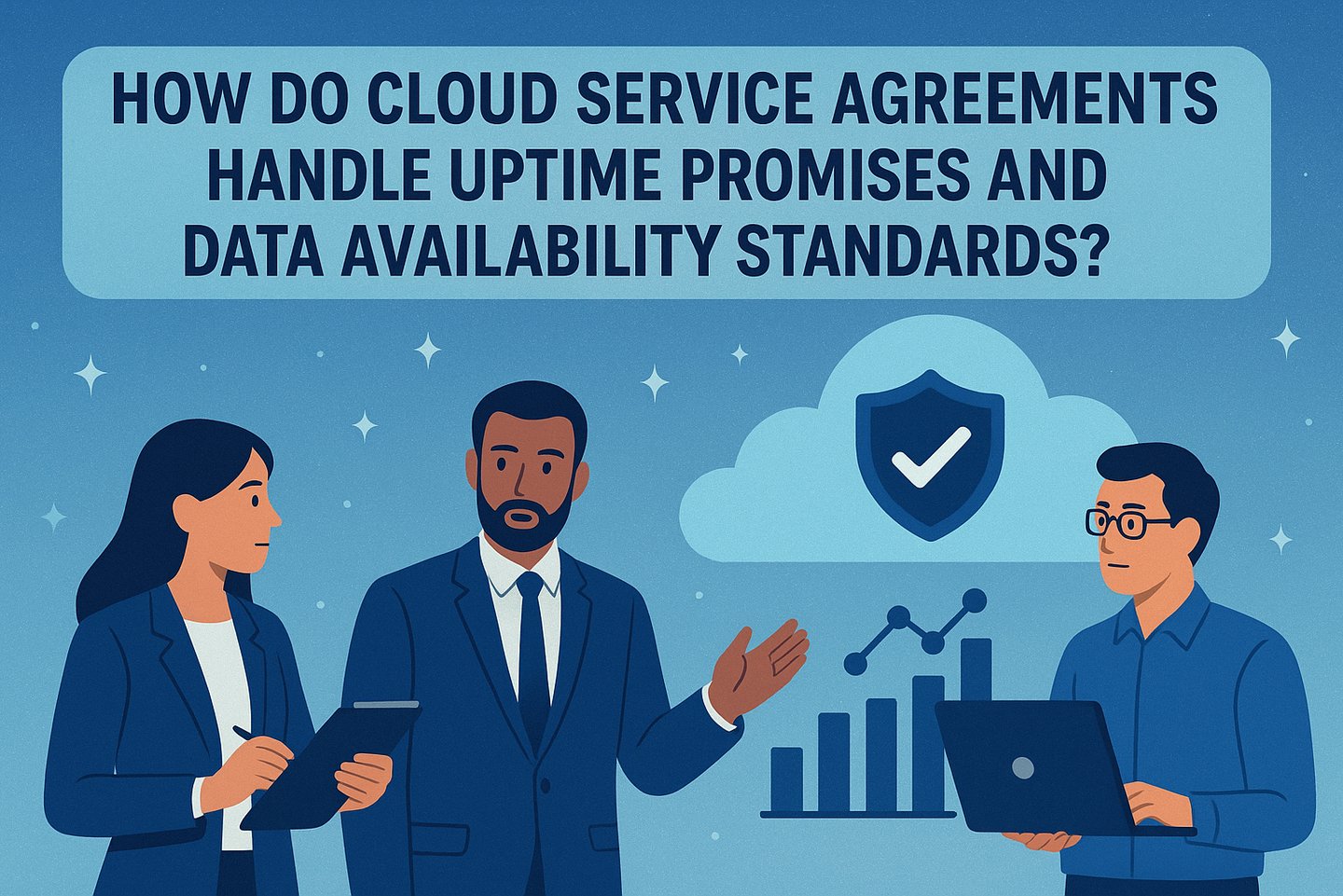
How do cloud service agreements handle uptime promises and data availability standards?
This research article delves into the intricacies of contractual instruments that deal with Cloud Service Agreements, determining their uptime guarantees and data availability. This research article endeavors to support the same through a blend of statutory, judicial, and regulatory frameworks.
CORPORATE LAWS
Shalwin Dutt
12/4/20255 min read
I. Introduction
Cloud computing has transformed the infrastructural backbone of modern business, enabling organizations to host critical workloads, process sensitive data, and ensure global accessibility of resources. The Cloud Service Agreement is placed in the middle of this stratum as the main contractual tool of establishing the standards of performance, roles and obligations of the parties and the possible legal remedies in case of service degradation.
Some of the most examined aspects of any CSA include uptime guarantees and standards of data availability, which define the level of continuity and reliability that a client is likely to obtain as a result of cloud services.
The legal impact of these commitments is significant, as advanced enterprises often rely on cloud platforms not only as an optional utility but as essential infrastructure. Cloud Service Agreements today showcase a mix of contractual drafting, industry standards, contemporary judicial interpretations, and regulatory obligations.
II. Purpose and Legal Character of Cloud Service Agreements
CSAs serve primarily to deliver functionality, safety, and continuity in the tasks negotiated between the cloud provider and the consumer. It operates as a performance agreement, a risk-sharing tool, and a data hosting and processing governance tool. In its performance aspect, the CSA establishes the quality of the services to be provided by guaranteeing uptime and assuring availability; in its risk-allocation aspect, it establishes the aftermath of service failure by providing remedies, limits on liability and exclusion; and in its governance aspect, it as codifies the duties pertaining to data protection, retention, portability, and compliance with regulatory requirements.
A CSA is not just a business agreement but a framework for business sustainability. The uptime and availability provisions of it give customers confidence in using cloud systems without interruption and legal assurance in the event of failure. Courts and regulators consider CSAs as tools that should be articulated and be of quantifiable standards instead of aspirational descriptions of services.
III. Legal Characterisation of Uptime and Data Availability
In the absence of statutory definitions in jurisdictions such as India, the United Kingdom, or the United States, uptime and availability are terms defined almost exclusively within the four corners of the contract. The common formulations used by providers include the percentage of total monthly time available and usable by the service as gauged by the monitoring tools of the provider or the time the service is available and in operation without any planned maintenance.
These definitions become determinative during legal disputes, because courts ordinarily defer to the express language selected by the parties. The availability of data is expressed in CSAs, as they guarantee that the data of customers will be available as per the agreed redundancy, replication, and retention conditions. Industry standards such as ISO/IEC 27001 treat availability as a core security requirement, which influences the drafting of these definitions even though the standard does not specify uptime thresholds.
IV. Legal Requisites for Enforceable Uptime and Availability Clauses
The only requirement is contractual certainty. The clauses under section 29 of the Indian Contract Act 1872 may be voided in the case of uncertain or ambiguous terms; therefore, the uptime clauses usually quantify the availability, define measurement methodology, and define the exclusions, like maintenance windows, force majeure, and customer-induced downtime.
CSAs universally adopt a shared responsibility framework, assigning operational continuity obligations to the provider while placing configuration-level duties on the customer. This structure ensures that liability is placed according to the actual control over the infrastructure. A third requisite is the defined limitations of liability clauses and remedies. These almost always take the form of service credits, exclusive remedies, disclaimers of consequential damages, and caps tied to the customer's preceding twelve-month spending. Courts generally enforce these provisions unless they violate public policy or doctrines of unconscionability.
Certain analogues are found in the Indian Contract Act, sections 73 and 74, and in the United States in the Uniform Commercial Code, S 2-719, which also allows limiting damages when limited in writing. Lastly, commitment to uptime and availability needs to be coordinated with the relevant regulatory requirements.
An example is the GDPR Art 32(1)(b) that openly states that controllers and processors must also provide “ongoing confidentiality, integrity, availability, and resilience of processing systems.” The RBI 2023 Directions on the Outsourcing of IT Services impose the same obligation on regulated entities, i.e., continuous availability and uptime.
V. Structuring of Uptime Promises within CSAs
Uptime guarantees in CSAs are usually set by a percentage of monthly availability, usually between 99.0% and 99.999%, each of which relates to a maximum period of downtime. The increase to five-nines makes the acceptable downtime material, which changes the risk profile of both the provider and the customer.
These guarantees are nearly always accompanied by enumerated exclusions, often drafted with considerable breadth so that only failures directly attributable to the provider trigger remedies. Monitoring is another important dimension. CSAs frequently specify that availability calculations shall be made solely on the basis of the provider's monitoring tools, which reduces evidentiary uncertainty but places customers at a disadvantage in disputes. Some enterprise-level agreements negotiate independent audit rights, but such provisions remain the exception.
VI. Data Availability Standards: Redundancy, Retention, and Continuity
Data availability guarantees are stated in terms of descriptions of redundancy architecture, including multi-availability-zone replication, remotely distributed backups, or fault-tolerant storage systems. There are also providers who state the frequency of backups and retention times, which they frequently leave to the customer to do more backups unless they have purchased a managed-backup service.
These standards are in close contact with termination and exit regulations, which define how long after termination customers can access their data and in what format data would be provided. Without such provisions, the threat of lock-in by vendors and unavailability of data become very high.
VII. Precedential and Regulatory Guidance
India does not have a direct jurisprudence on cloud-service uptime disputes; however, the directions can be based on IT-service cases in the technologically related jurisdiction. In GB Gas Holdings Ltd v Accenture (UK) Ltd, the Commercial Court imposed liability on a service provider over failures in the delivery of a mission-critical IT system and noted that the performance requirements of contracts in technology projects are enforceable.
Likewise, in BSkyB Ltd v HP Enterprise Services UK Ltd, the Technology and Construction Court imposed significant damages upon the determination that the provider had not provided a functional enterprise-level system, highlighting the readiness of the judiciary to impose IT performance requirements.
Regulatory guidance supports the needs of availability. The SP 800-53 framework of NIST recognizes the key security controls of availability, continuity, and resilience; the GDPR and the 2023 Reserve Bank of India IT Outsourcing Directions make the availability not a contractual requirement but a binding legal requirement.
VIII. Conclusion
The relationship between cloud service agreements and uptime and data availability is a complicated combination of negotiated obligation, contractual definitions, and remedial structures. Although providers offer percentages of high availability, they are often accompanied by expansive disqualifiers, harsh surveillance procedures, and liability limits that severely restrict recovery.
The judicial practice with respect to similar IT-service cases demonstrates an overall tendency in favor of enforcing such contractual frameworks when they are conscientiously written.
With cloud computing becoming a vital part of infrastructure, the law might need to establish statutory limits on availability, as it has done with security and resilience under the GDPR. This type of reform would help guarantee that uptime promises turn into enforceable rules that would maintain continuity, reliability, and economic stability.