
How do coexistence agreements prevent or create future trademark conflicts?
This article examines trademark coexistence agreements, analyzing how they prevent litigation through geographic and market limitations while exploring the risks of consumer confusion and breach that create new conflicts.
IPRCORPORATE LAWS
Aditi Goyal
1/8/20264 min read

Introduction
In the world of business, trademarks are really important. They help people know where something comes from. This is beneficial for companies and individuals who make purchases. Now, because the world is so interconnected and people buy things online, it is becoming increasingly difficult for companies to have names and symbols that are unique. Sometimes two companies will have names or symbols that are very similar, and they will sell similar things. When this happens, the companies often go to court to figure out who can use the name or symbol. This can be very expensive. Trademarks are still really important because they help people trust the companies they buy from. Trademarks are like a name tag for a company. They help people know what to expect.
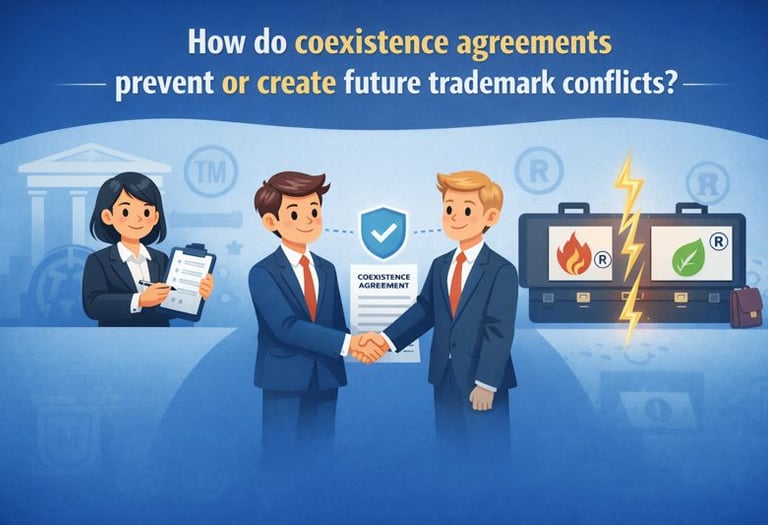
A "Coexistence Agreement" offers a pragmatic alternative. These are private contracts where two parties agree to use similar marks under specific, mutually agreed-upon conditions to avoid confusion. While designed to provide a "peaceful resolution," these agreements are complex instruments. If drafted with precision, they act as a shield against future litigation; if drafted poorly, they can become a catalyst for even more intricate legal disputes.
Preventing Conflict: The Mechanics of Resolution
Geographic and Channel Segregation
These agreements are really good at preventing fights. They do this by limiting where each company can operate. For instance, two companies can both use the name Delta. One company can use the name Delta in North America, and the other company can use the name Delta in Europe. This works because they agree not to operate in each other's area. This means that the companies using the name Delta will not have arguments over who was using the name Delta. The companies using the name Delta avoid problems by staying out of each other's territory. Companies can also decide to have ways of selling their products. One way is to sell to wholesalers. The other way is to sell to people who are buying the products for themselves. This means that the two groups of customers will not get mixed up and confused with each other. The companies do this so that the wholesalers and the retail consumers do not get confused about the products and the prices. This is a thing for the retail consumers and the wholesalers, because it helps them understand what they are buying and from whom they are buying the products.
Product and Service Limitations
Conflict is usually avoided when we limit the types of things that Brand X and Brand Y can sell. For example, they might make an agreement that says Brand X can use a logo on clothes and Brand Y can use a very similar logo, but only for computer programs. When they write down these rules, Brand X and Brand Y are solving a problem before it happens and that problem is people getting confused between Brand X and Brand Y, which is a major issue when it comes to trademark infringement with Brand X and Brand Y.
Formalized Dispute Resolution
Good agreements usually have something called escalation clauses. When there is a problem with a trademark, the people involved do not immediately go to court. The people who made the agreement say they will use mediation or arbitration to solve the problem. This way, the problem is kept quiet. The people who own the trademark do not have to spend a lot of money to enforce it. Trademark enforcement can be very expensive. Escalation clauses help with that. This makes trademark enforcement easier for the people who own the trademark.
Creating conflict is a problem. This happens when agreements do not work out as planned. Sometimes these agreements can actually cause more problems than they solve.
When we agree, we usually do so to avoid conflict and make things easier. What if the agreement itself becomes the reason for the conflict? This is what we mean by creating conflict.
The government office that handles trademarks, like the USPTO in the United States, can say no to letting a company register its name even if the companies have an agreement. This happens when the government thinks it is more important to help the public not get confused than to honor the agreement between the companies. This situation means that the parties get along with each other. They cannot get help from the federal government. This leaves both parties in a spot because other people can still cause them problems. The parties are still at risk from third-party infringers, which is a big concern for them.
Ambiguity in Digital Expansion
Agreements made in the 1990s did not think about the internet. If an agreement says a brand can do business in an area, does that mean a website or a social media handle is not allowed in that area? When a company's Instagram ad is seen by someone in an area where they are not supposed to be, it can cause a problem with the contract. These kinds of problems with agreements often come up years after the agreement was made because the internet and technology make the old rules about where a company can do business no longer matter. The internet and technology are changing the way agreements about territories work. This is causing problems for companies and their agreements.
The Role of "Good Faith" and Monitoring
To have an agreement that stops problems from arising, people must always act in good faith. This means they have to talk to each other. If one company wants to change its name or start a smaller brand, it should tell the other company first. This is what a lot of agreements say should happen. If they do this, they can avoid getting sued out of the blue. The agreement should be about faith, and the companies should always communicate with each other.
Conclusion
Coexistence agreements are really important in the world of property. They give us a way to handle things instead of just fighting it out in court, where one person wins and the other loses. When coexistence agreements work well, they help companies grow together in a way by setting clear rules about where they can operate and what products they can make. Coexistence agreements are not something you can just set up and then forget about.
The potential for these agreements to create conflict lies in their rigidity and the unpredictability of the future. To remain effective, they must be living documents that account for digital expansion and potential market shifts. Ultimately, the success of a coexistence agreement depends less on the similarity of the trademarks and more on the precision of the legal drafting and the mutual commitment of the parties to stay within their designated lanes.