
How do Comparative Advertising Rules Intersect with Trademark Rights?
This article analyzes the intersection of Indian trademark law and comparative advertising. It examines statutory "honest practices" and judicial standards that distinguish permissible commercial standards from actionable trademark disparagement and infringement.
IPR
Shalwin Dutt
12/26/20255 min read
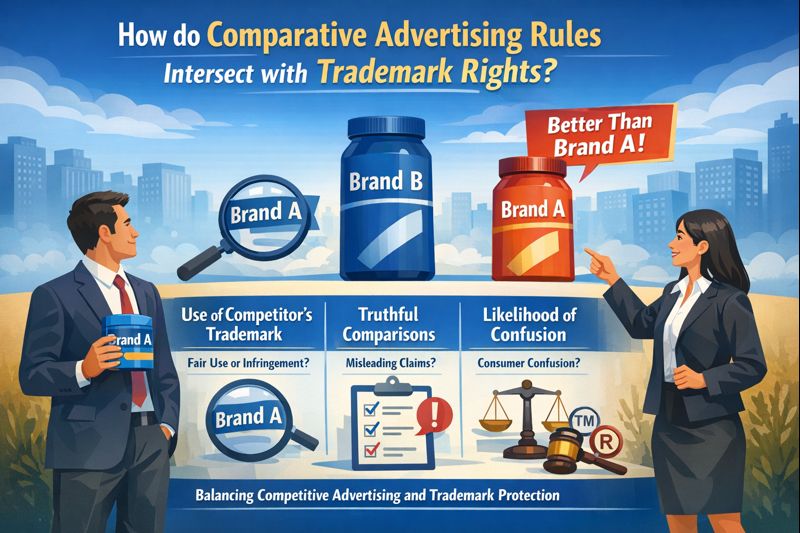
1. Introduction: The Commercial and Legal Paradox
In a free-market economy, trademarks are the “silent salesmen” of a brand, the goodwill, quality, and reputation that a company has established over decades. On the other hand, comparative advertising as a marketing tool that involves a brand relating its products or services with those of its rival is a critical element in consumer empowerment. It encourages competition and helps consumers to make an informed decision depending on the price, quality, or utility.
This, however, leads to a deep legal paradox: How does one trader use another trader’s registered trademark as an asset upon which the proprietor has exclusive rights without such use being an infringement? In India, this junction is regulated by the fine line of the statutes of the Trademarks Act 1999, the Consumer Protection Act 2019, and the constitutional right to commercial speech in Article 19(1)(a).
The essence of the research consists in determining a point at which comparison of trademark finishes and denigration commences. This article will discuss the legal safe harbors and the modern problems of visual trade dress and marketing.
2. Legal Framework: The Two Pillars of Indian Law
The main legislation that governs this horizon is the Trademarks Act 1999 (the "Act"). The 1999 Act, unlike the former Act of 1958, offers certain guidelines under Sections 29 and 30 to control the cross-section of proprietary rights and market competition.
A. Section 29(8): The Red Line of Infringement
Section 29(8) of the Act provides that a registered trademark is infringed when advertisement of the trademark is made by:
Taking unfair advantage of the mark;
1. Is opposite to honest practices in industrial or commercial affairs;
2. Is injurious to its unique nature;
3. Is prejudiced against the reputation of the trademark.
This clause serves as a protection to the trademark owner. It is to guarantee that although a competitor can mention a brand name, they cannot “free ride” on the reputation that is earned by the proprietor to help increase their sales by lying or acting maliciously.
B. Section 30(1): Statutory Exception
To identify the essence of fair competition, Section 30(1) offers a “Safe Harbor” to the advertisers. It provides that use of a registered trademark of another to identify goods or services of the proprietor is not infringement, provided that:
1. The application complies with the honest practices of industrial or commercial affairs;
2. Is not of such a character as to unfairly capitalize on or be detrimental to the unique character or reputation of the trademark.
3. The Judicial Doctrine of Product Disparagement
Since the Act of 1999 is not specific on what constitutes honest practices, case law has been used to fill in the gap by the Indian judiciary. The goal is to avert “trade libel” or “product disparagement.”
A. The “Kiwi” Principles: Puffery vs. Slander
In the case of Reckitt and Colman of India Ltd. v. Kiwi TTK Ltd., the Delhi High Court has developed various cardinal principles that form the basis of the Indian advertising law.
1. A tradesman is entitled to declare his goods to be the best in the world, even if the declaration is untrue.
2. He can state that his goods are better than his competitors, even if such a statement is untrue.
3. However, he cannot, while saying his goods are better, state that his competitor's goods are bad.
If a tradesman disparages the goods of a competitor, he can be restrained by an injunction. The court's rationale is that while you have the right to "puff" your own goods, you have no right to “rubbish” your rival's.
B. The "Average Consumer" and "Total Impact" Test
In Dabur India Ltd v Colortek Meghalaya Pvt Ltd, the court further refined the standard. It held that while evaluating an advertisement, the court must look at the intent, manner, and storyline of the commercial. The court observed that an “advertisement should be perceived through the prism of an “average consumer” with “imperfect recollection.” If the overall impact suggests that the competitor product is “dangerous” or “unfit for use,” it transcends permissible comparison and enters the realm of disparagement.
4. Governance Regulations: ASCI Guidelines.
The Advertising Standards Council of India (ASCI) is a self-governing organization, which ensures that ethical standards are maintained in the industry, apart from judicial mechanisms. The ASCI Code offers a realistic guide to advertisers on how to use trademarks without attracting legal action.
Chapter IV of the ASCI Code specifically addresses comparative advertising. It mandates that comparisons shall be permissible if:
1. Aspects of the products compared are clear, and the subject matter of comparison is not chosen to give the advertiser an artificial advantage.
2. The comparison is factual, substantial, and capable of substantiation.
3. It does not unfairly denigrate, attack, or ridicule other products, advertisers, or advertisements directly or by implication.
ASCI’s Fast Track Complaint Redressal (FTCR) often acts as the first line of defense for trademark owners, providing a non-litigious route to remove disparaging content that takes “unfair advantage” of a brand’s reputation.
5. Visual Disparagement and Trade Dress Protection
Contemporary advertising frequently refers to visual associations instead of naming. This can be done by advertisers through an “indirect disparagement” of a competitor’s product by providing a “generic” variant of that product. In the case of Beiersdorf AG v. Hindustan Unilever Ltd, that was presented before the Delhi High Court, it concerned an advertisement conducted by that company, which involved the use of a blue-colored tub of cream.
Though the brand name “Nivea” was never mentioned, the color and shape of the tub were synonymous with the trade dress of “Nivea.” The court considered the advertisement, in depicting the contents of the blue tub to be sticky and heavy, visually disparaged the trademark appearance of Nivea. The case illustrates that trademark protection is not limited to a registered “word” but also to the “distinctive character” of the product packaging.
6. Truth as an Absolute Defense
Truthfulness is one of the most important factors of “honest practice.” In Havells India Ltd v. Amritanshu Khaitan, the Delhi High Court ruled that an advertiser need not compare all the features of a product. The comparison of selective features is acceptable provided that it is a truthful comparison.
This ruling strengthened the doctrine of nominative fair use, under which the use of a mark is permissible when it is essential to indicate the product, and the same will not give the perception of a connection or recommendation between the two brands.
7. Conclusion
Comparative advertisement and trademark law in India give a subtle balance between healthy competition and brand protection. The trademarks under the Trademarks Act, 1999, and in particular section 30(1), do not provide absolute exclusivity and can be used nominatively in comparative advertising but in good-faith practices.
When comparison becomes disparagement, it crosses the legal boundary. Although the use of puffery and claims of excellence is acceptable, one cannot disparage a mark, trade dress, or visual representation of a competitor. The principle, which is reinforced by judicial trends and the ASCI Code, safeguards the consumer's interest and commercial speech, as well as protecting proprietary goodwill against misdirected or malicious actions.