
HOW DO EMPLOYEE STOCK OPTION PLANS (ESOP) OPERATE LEGALLY?
This article explores the concept of ESOPs legally and explains how it works and benefits the startups to participate in their future growth.
CORPORATE LAWS
MANASVI SUNIL MORE
5/25/20264 min read
INTRODUCTION :
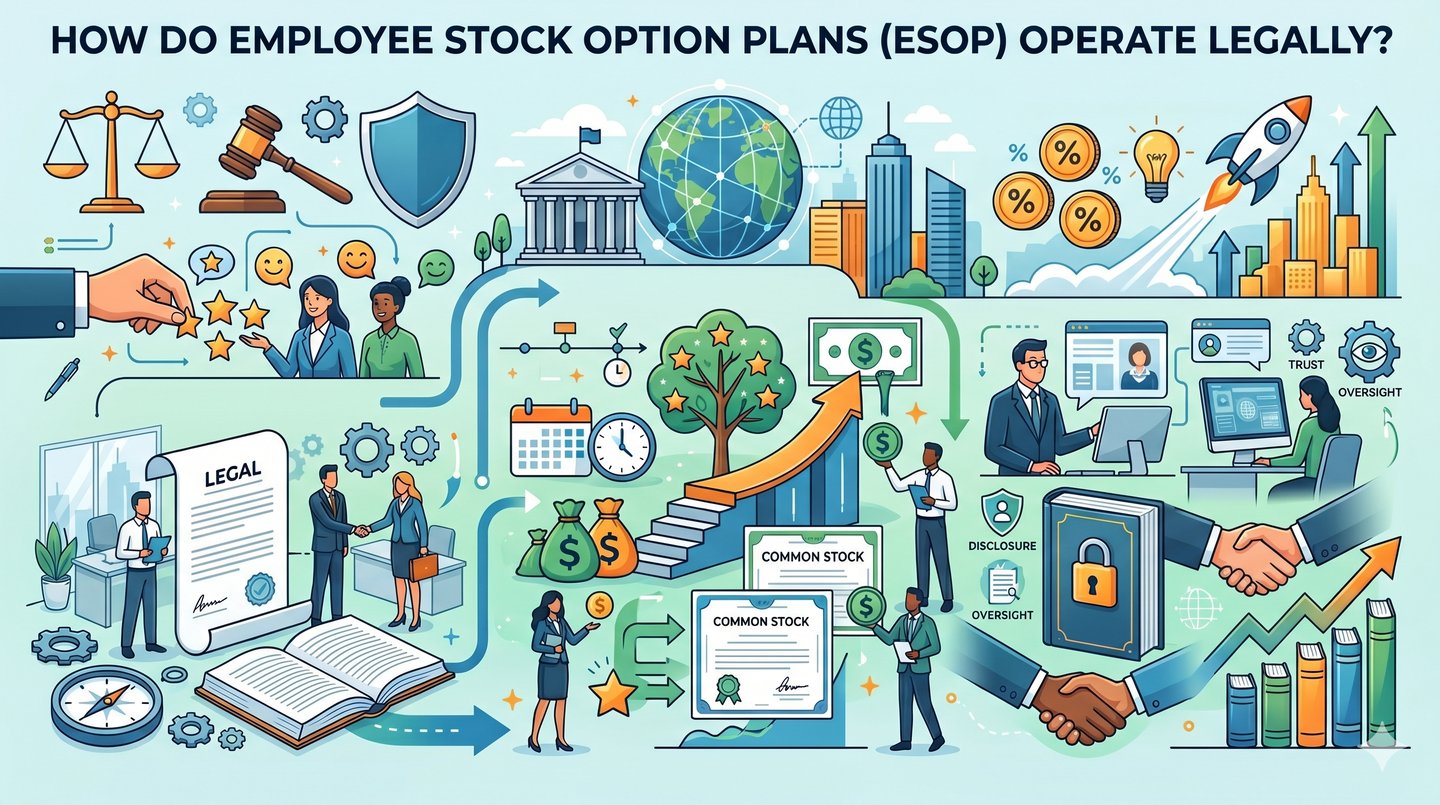
An Employee Stock Option Plan is a strategic benefit programme for the employees where they are granted the right to buy company shares at a fixed, predetermined prices after a specific period. This is to reward the employees and align their interests with the company’s success and improve motivation and retention.
Startups often operate on the limited setup and budget. The ESOPs allow them to offer them compensative packages so that they don’t drain their immediate cash reserves. Startups fails to match the salaries of the established corporations. ESOPs provide them with the a meaning equity stake which helps them to participate in the future growth. When employees hold stock, their financial success becomes directly tied to the company's success. This ownership culture naturally motivates the team to boost productivity, spur innovation, and drive up the company's valuation. Options do not vest instantly. Employees are typically required to stay with the company over a multi-year vesting schedule before they can exercise their options. This effectively reduces turnover and keeps core talent invested in long-term goals.
HOW DO THEY WORK?
1. The company offers the employees the option to purchase the shares at a strike price.
2. The employee earns these options over time.
3. Once vested, the employee chooses to exercise their right by purchasing the shares at the original fixed price.
4. The employee has the ability to sell the shares at the current, higher market price, securing the difference as profit later.
LEGAL FRAMEWORK GOVERNING ESOPs IN INDIA :
Companies Act, 2013 – The foundation of the administration of the ESOP in India is Section 62(1)(b) of the Companies Act, 2013. It regulates how a company can increase its subscribes share capital. New shares must be must first offered to the existing stakeholders under this section. This section creates a specific legal exception that allows a company to offer these new shares directly to its employees instead.
SEBI Regulations – SEBI permits a wider scope of beneficiaries compare to the unlisted rules. Under this, A listed company must form a Compensation Committee comprising independent directors to design, price, and formulate the ESOP policies. Schemes can be run directly by the company or via an ESOP Trust. If using a trust, SEBI enforces strict limits on secondary market share acquisitions to prevent artificial stock price inflation.
Income Tax Act – Under this act, the ESOPs face dual taxation framework, meaning they are taxed once as salary when you buy the shares and again as investment profit when you sell them. In the first stage, when you exercise your option, the tax is calculated on the pre-requisite value. n the second stage, when you eventually liquidate and sell those shares, you pay Capital Gains Tax on the absolute profit earned between your final selling price and the FMV recorded during the first stage.
FEMA Guidelines – The FEMA and RBI rules control the money flowing in and out of India.
In case of Foreign Shares for Indian Workers, when a foreign company gives stock to Indian employees, it counts against the worker's annual USD 250,000 global spending limit (LRS). The local employer must report these grants twice a year using Form OPI, and the employee must bring all cash profits back to an Indian bank account within the 180 days of selling the shares.
With regard to the Indian Shares for Foreign Workers, when an Indian startup gives stock to overseas employees, it is treated as foreign investment (FDI). The startup must submit Form ESOP to the RBI within the 30 days of giving out the shares, should follow official stock valuation rules, and get the required government permission if the worker belongs to a country which shares a land border with India.
ADVANTAGES AND CHALLENGES OF ESOPs :
Advantages :-
Startups can protect their immediate cash flow by replacing high upfront salaries with future equity.
Small companies can successfully compete with the corporate giants to recruit the top-tier, skilled employees.
Holding stocks transforms employees into shareholders, helping them to drive into higher motivation.
Challenges :-
Issuing new shares reduces the ownership percentage and control of existing stakeholders and early investors.
Setting a Fair Market Value (FMV) for unlisted startups is difficult.
Employees face steep salary taxes upon buying shares before they actually have the cash from a sale.
If a startup fails to reach an IPO or buyout, employees are left holding paper wealth they cannot easily convert to cash.
ESOPS IN INDIAN STARTUPS :
ESOPs have become an essential and a very significant part of the startup ecosystem in India, especially in the arena of the technology and emerging businesses. Since many startups may not have the capability initially to offer very high salaries, ESOPs help them to attract and retain top – tier and skilled employees by providing them an opportunity to become part owners of the company. This creates a sense of loyalty and encourages employees to contribute towards the long-term growth of the business. Several Indian companies such as Flipkart and Zomato have successfully used ESOPs as a key employee incentive mechanism.
CONCLUSION :
ESOPs have become an important part of modern businesses as they benefit both employers and employees by giving employees an opportunity to own shares in the company, ESOPs create a sense of belonging and encourage employees to work towards the growth and success of the organization. They also help companies attract skilled talent and retain employees for a longer period. In India, ESOPs are regulated under the Companies Act, 2013 and the regulations framed by Securities and Exchange Board of India (SEBI) along with the support of FEMA and RBI rules, which ensures that proper legal compliance and transparency is maintained. With the growing startup culture and increasing corporate competition in today’s world, ESOPs are expected to remain an important and valuable employee benefit in the future.