
How do government performance-based contracts differ from traditional contracts, and what are the benefits?
Performance-based contracts put the weight on clear, measurable results and give contractors real freedom to choose their methods. Unlike traditional contracts that outline every step, this approach has repeatedly demonstrated its value in reducing costs, fostering new ideas, and making accountability far more straightforward.
CORPORATE LAWS
Mishika Sharma
12/26/20255 min read

Introduction
For a very long time, whenever a government department needed work done, whether keeping buildings in order, supporting military equipment, or running social programs, it turned to contracts that left nothing to chance. The documents would set down exactly who should be hired, what materials were allowed, when everything had to happen, and the order in which tasks were to be carried out. The thinking was sound on the surface: detailed rules would protect public money and make it easy to check that everything was done properly.
Experience, though, told a different story. Those tight specifications often stopped contractors from using simpler or more modern ways of doing things. Money was sometimes wasted on steps that added little value, and the outcome could fall short of what was really needed once circumstances changed.
Performance-based contracts came about to deal with those weaknesses. Instead of laying down the route, agencies now describe the destination in precise terms, targets that can be checked and counted, and leave the choice of route to the contractor. Payment follows success in reaching the destination, often with an extra reward for arriving ahead of schedule or in better shape than expected.
The case for the change is hard to argue against. People who spend their working lives in a particular trade usually know it far better than civil servants writing specifications from a distance. Set them clear goals and sensible rewards, and better work tends to follow. What comes next in this article is a look at the chief ways the two systems differ and a review of the practical gains that have been shown where performance-based contracts have been put to use.
The Chief Ways the Systems Differ
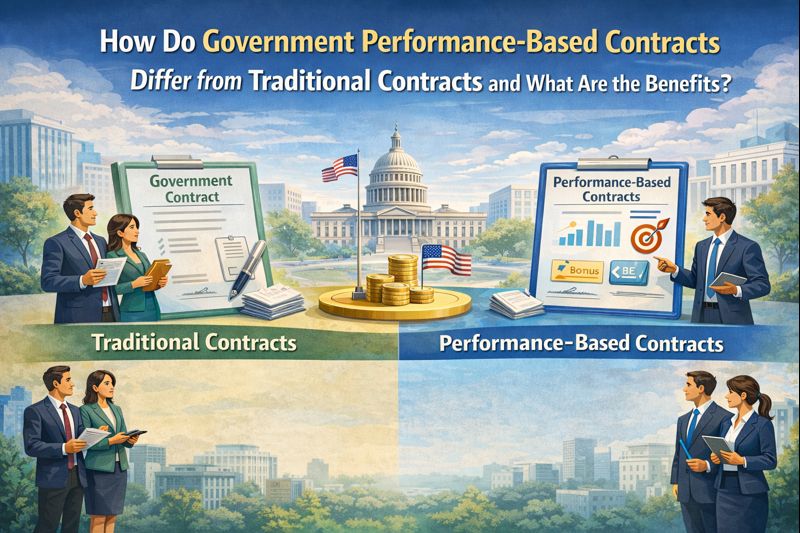
The heart of the matter is simple enough: traditional contracts buy the carrying out of specified tasks, and performance-based contracts buy the achievement of specified results.
Take building cleaning as an everyday example. A traditional contract would lay down that crews must turn up on fixed days, use named products, and work through a set list of jobs. Payment is made once those jobs are recorded as done. Officials then go around making sure the rules are kept.
A performance-based contract for the same buildings would say something like “the premises must pass surprise checks for cleanliness at least ninety-five times out of a hundred” and “occupants must report average satisfaction of 4.5 or higher on the standard survey.” How the contractor organizes staff, chooses tools, or arranges timetables is left entirely to them. They earn the full fee only when the checks and surveys confirm success; they may gain a bonus for outstanding figures or lose part of the fee if targets are missed.
Risk moves with the change. Traditional contracts, especially those that reimburse costs, often leave the public purse open to extra bills when difficulties arise. Performance-based contracts place the burden of unexpected difficulty on the contractor, who must find ways around it without extra payment.
Day-to-day flexibility improves, too. Traditional contracts usually call for formal amendments whenever anything departs from the written plan. Performance-based contracts allow contractors to alter their working methods whenever they like, provided the agreed results keep coming in.
Oversight changes character. Instead of watching every move, agencies now keep an eye on a handful of key measures and carry out occasional verification. The whole arrangement feels less like command and control and more like a joint effort aimed at the same end.
The Value That Has Shown Up in Real Use
When these contracts have been tried in the field, certain advantages keep reappearing.
Lower costs are perhaps the most obvious. Once contractors are released from having to follow steps that add little, they frequently find cheaper ways to reach the same end. Studies of federal work in the United States commonly report savings of between fifteen and twenty-five percent against similar jobs done the old way. One American Air Force base changed its grounds contract from rigid weekly mowing to standards of overall health and appearance. The firm that won the work brought in hardier grass and better water management, cut running costs noticeably, and left the place looking better than before.
Fresh thinking gets room to breathe. Contractors can bring in new equipment or techniques without asking permission to break the written rules. Many defense equipment programs now judge maintenance by how often the gear is ready for use rather than how many hours are spent fixing it. That shift has encouraged predictive repairs and smarter stockholding of spare parts.
Responsibility becomes easier to pin down. Success or shortfall appears in plain numbers instead of long arguments about whether every clause was observed. Officials, contractors, and the public all see more clearly whether money has been well spent.
Social programs have taken to the idea with success. Schemes that pay only for proven results—often called pay-for-success or social impact bonds—make sure public funds back only what works. Denver ran a program that gave stable homes and coordinated help to people caught in long-term homelessness. Hospital and jail visits dropped so much that the savings paid for the program itself. Utah widened access to good nursery education on terms that repaid private backers only when fewer children later needed special help at school. Massachusetts offered intensive guidance to young people coming out of custody, with payment tied to steady jobs and lower re-offending; the tailoring possible under outcome-focused rules made a real difference.
Paperwork and checking usually lighten. Agencies no longer chase every detail of the process and instead look at summary figures of results. Rows about technical compliance tend to fade when everyone’s attention is on whether the targets were hit.
Long-term road maintenance gives another clear picture. Several authorities now pay contractors according to how well the surface holds up over years rather than for each pothole filled. Contractors answer by choosing stronger materials and doing preventive repairs, so roads last longer and total spending falls.
Points to Watch
The approach is not a cure-all. Good measures are hard to craft; they must capture what truly counts without tempting people to game the system. A measure that focuses solely on the numbers filled in can divert effort away from more challenging yet important objectives.
Some things, like quick response to complaints or building a genuine safety outlook, are not easy to turn into figures and need carefully balanced sets of indicators.
Competition matters. When several strong firms are bidding, risk passes smoothly to the contractor. In narrow specialist fields, firms may ask for higher fees to accept responsibility for results.
Departments themselves must adjust. People who used to tick boxes on procedures need training in watching trends and talking about results.
Conclusion
Performance-based contracts amount to a serious step forward from the older, rule-heavy style. They treat contractors as knowledgeable partners, line up rewards with public needs, and keep everyone’s eye on the outcomes that count for ordinary citizens.
Work in defense support, road care, and help for vulnerable people has repeatedly shown lower spending, higher standards, and inventive answers. When measures are chosen with care and staff are ready for the new way, public money goes further.
With budgets under pressure and public tasks growing harder, thoughtful, wider use of performance-based contracts gives governments a reliable means to deliver more of what people need from the resources they have.