
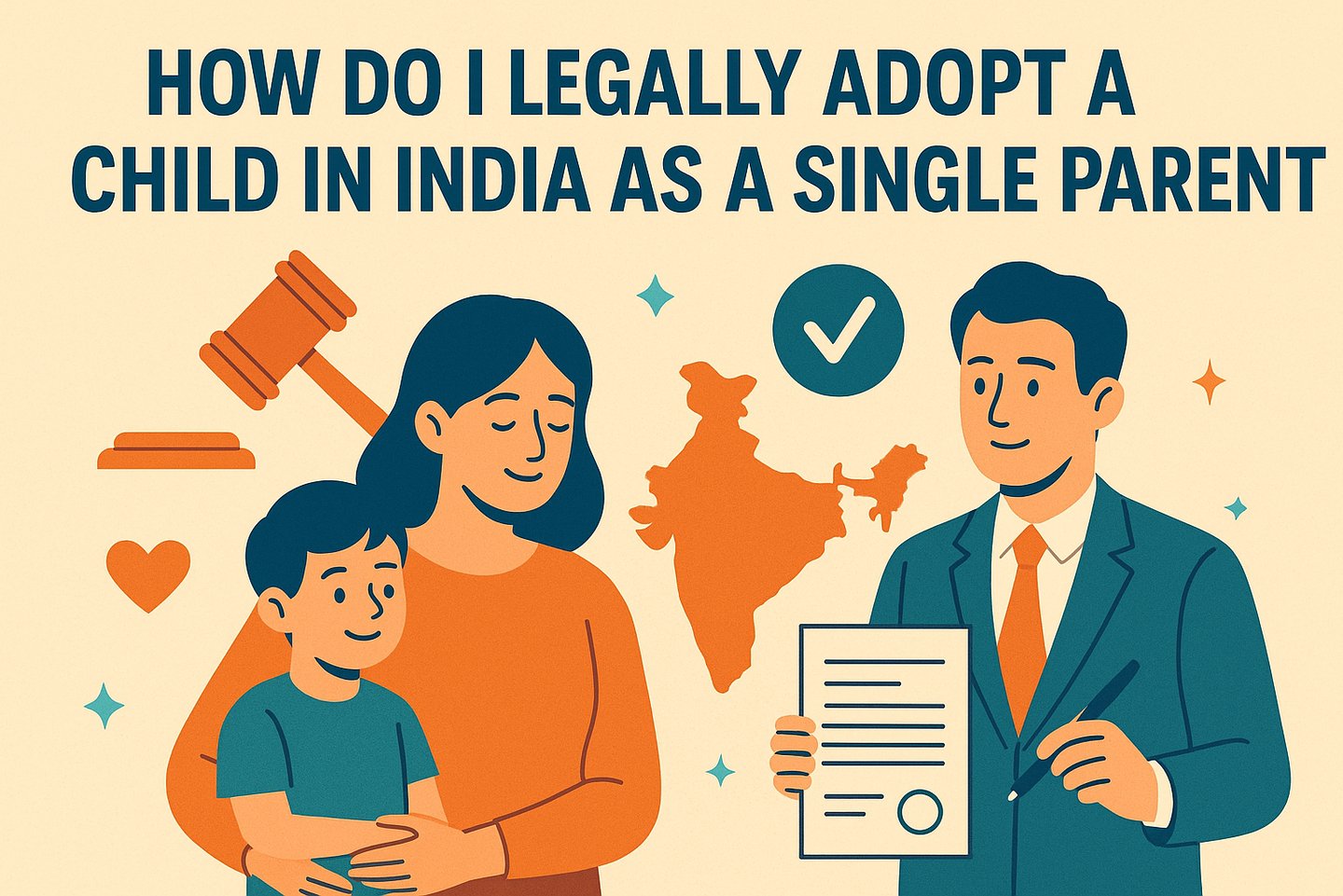
How do I legally adopt a child in India as a single parent?
Adopting a child in India as a single parent is growing at a massive speed because of several reasons. In this article I will mention all the processes, laws for males and females, and challenges faced by them. In this article I will cover every aspect of adoption and the procedure to adopt a child as a single parent.
FAMILY LAW
Ketaki Pawar
12/18/20253 min read
INTRODUCTION
Adoption: - Adoption means legally taking another person’s child and raising the child as their own child in every manner.
Adopting a child plays a massive role in India. Earlier, due to stereotypical reasons, adopting a child was considered bad, as the child will not have family lineage and blood. But now, adopting a child as a single parent has become essential because:
1. People find a will to live because of children.
2. After losing their partner or family, a person can still create their own family.
3. They don’t have to marry just to produce a child; now a child can be legally adopted before marriage, and a single person can also have a child.
4. Some people cannot produce children due to medical reasons, so adoption plays a crucial role.
5. To provide good living conditions to a child.
LEGAL FRAMEWORK FOR SINGLE-PARENT ADOPTION
Legal framework includes the combination of different personal laws and other legislation. There are many laws that mention single-parent adoption. The Juvenile Justice Act, 2015, provides a correct set of rules and regulations for all single male and female parents. There is an authority for this, namely the Central Adoption Resource Authority (CARA), which helps to regulate the process of adoption under this act.
1. Guardians and Wards Act, 1890
A Muslim person can take a child under guardianship. But the child does not automatically acquire inheritance. It can be granted only via. Will but up to one-third of the estate, and consent of legal heirs is necessary. Guardianship under Muslim law is supplemented by the Guardians and Wards Act, 1890 (GWA), which allows courts to appoint or remove guardians based on the welfare of the child.
A Christian in India does not have any of the personal laws. They follow Guardians and Wards Act, 1890
2. Hindu Adoption and Maintenance Act, 1956
This act is followed by Hindus, which include Sikhs, Buddhists, and Jains. This act doesn’t mention a single parent, but it mentions “any person,” which can be interpreted. A Hindu male or female can adopt if they are of sound mind and not a minor. Under HAMA, an adopted child acquires the same legal status and inheritance rights as a biological child.
3. Juvenile Justice (Care and Protection of Children) Act, 2015
This Act applies to every person in India because this is a uniform law. Any person who is a single male or a female can adopt a child, subject to some conditions.
A single male cannot adopt a girl child. The child gets the full legal status and inheritance rights.
ELIGIBILITY CRITERIA
CARA governs the eligibility. Regulation 5 outlines these requirements.
The parent must be:
Sound mind, i.e., mentally and physically capable of taking care of a child.
They should not have any medical conditions.
They should not be a criminal or accused of any crime.
A single female can adopt a child of any gender.
A single male can only adopt a boy; he cannot adopt a girl child.
There should be a 25-year age gap between the child and adoptive parent.
PROCEDURE FOR SINGLE PARENT ADOPTION
The procedure is given under CARA to ensure transparency and the welfare of the child and parent. The steps to be included are:
1. Registration
Registration should be made on the CARA online portal or through the district child protection officer (DCPO). The details of the parent, the documents, the information, the address, the income, and the photograph need to be submitted.
2. Report (HSR)
A social worker conducts a detailed search of the adoptive parent to examine his living conditions, capacity both emotional and financial), stability, family and associates, bank details, and balance.
3. Child Referral
The adoptive parent may view the child’s photograph, profiles, and all the medical records after the approval of the parents profile. A child can be reserved for 48 hours for consideration.
4. Matching/Bonding
The agency evaluates the bonding and compatibility of the child and parent. The parent interacts with the child under supervision. If the match is perfect, the child’s reports and medical exams continue. If not suitable, the search continues.
5. Legal procedure
The adoption agency files a petition before the competent court. The court examines:
The welfare of the child.
The suitability of the adoptive parent.
Compliance with statutory norms.
Upon satisfaction, the court issues the adoption order.
6. Post-adoption
The agency visits the house even after the adoption of the child to ensure the welfare of the child, if the child is in proper hands, and if the child is able to adjust.
It is the duty of the authority to ensure that the child is in proper hands and take the necessary actions.
CONCLUSION
Adopting has become a very easy task in India. Adoption can be done by single parents also, and there are very few restrictions for them. Adopting is very helpful for the people who don’t have the capacity to bear a child. To conclude, I would like to say that adoption is very essential for a single parent to have a legitimate child.