
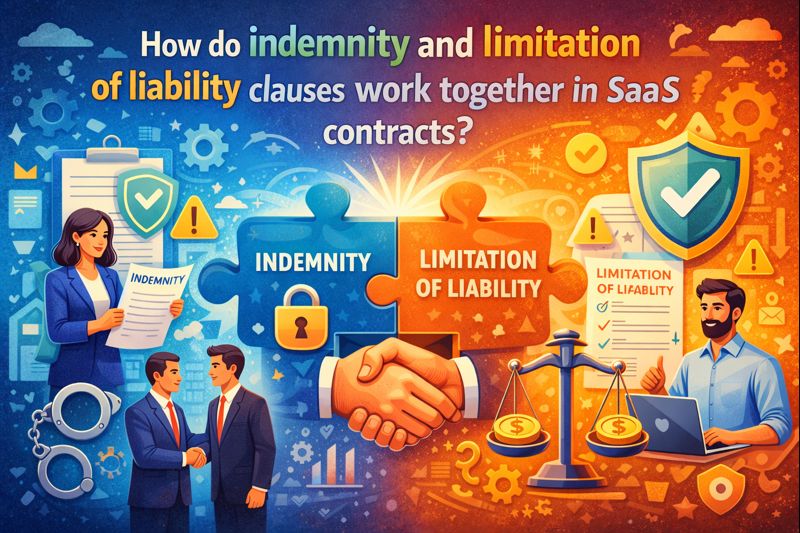
How do indemnity and limitation of liability clauses work together in SaaS contracts?
In the world of the commercial era, clever risk management in contracts is very important. Among other legal tools and safeguards that are available to the parties, indemnity and limitation of liability clauses are necessary to control and balance risk and financial exposures. Therefore, it is essential to understand the practical impact and consideration when drafting these revolving clauses.
CORPORATE LAWS
Matangi
1/15/20263 min read

Understanding SaaS Contracts
SaaS stands for Software as a Service, in which clients are offered software to use and access on license- or subscription-based models. SaaS contracts are fundamentally about risk allocation. Unlike the traditional software licensing arrangement, SaaS contracts govern an ongoing service relationship, which is critical to the business operations of the customers.
The two most important and most negotiated clauses in a SaaS contract are indemnity clauses and limitation of liability clauses.
Understanding Indemnity and Limitation of Liability?
Section 124 of the Indian Contract Act, 1872 (ICA), defines a contract of indemnity as “a contract by which one party promises to save the other from loss caused to him by the conduct of the promisor himself or the conduct of any other person.” For example, it is an indemnity contract if the promisor agrees to indemnify the promisee against the consequences of any proceedings that a third party may take against the promisee due to acts or omissions of the promisor. Thus, indemnity is a contractual promise to transfer the risk allocation between parties to a contract, and it operates if a specific event occurs as stipulated for in a contract. The most common SaaS indemnity is intellectual property infringement, i.e., the design and software.
Further, Section 125 of the ICA supplements the legal framework on indemnity by entitling a promisee to certain rights that the promisor is obliged to fulfil, including (i) the right to recover damages paid by the promisee; (ii) reimbursement of legal costs incurred by the promisee; and (iii) the right to recover sums paid as part of a compromise or settlement of a lawsuit by the promisee.
Limitation of liability clauses serve a distinct purpose that complements the purpose of the contract. The purpose of this clause is to restrict the quantum of damages caused by a party to the contract. Liability is important, as the quantum of risk cannot be calculated. This clause goes along with Section 74 of the ICA, which states that when a contract is breached and a sum is named in the contract as the amount to be paid in case of such breach, then an aggrieved party is entitled to the reasonable compensation not exceeding the amount stipulated for, whether or not actual loss is proved. Additionally, Section 74 only awards a reasonable compensation subject to review of the court.
The Key Interaction: Are Indemnities Subject to Liability Limits?
The most important issue in a SaaS contract is whether the indemnity obligations are subject to the limitation of liability clause. This helps determine unlimited risk or predictable exposure.
There are three approaches that can be applied. First, some contracts completely exempt indemnities from the liability cap, which means that indemnity obligations are exempted from the liability limitation. This is typically preferred by clients and is most frequently observed with IP infringement indemnities. However, it is strongly opposed because it exposes the providers to unlimited liability.
Second, indemnity payments may be subject to the general liability cap, which means that they are subject to the same financial cap as other claims. Customers frequently perceive this strategy as insufficient protection for high-risk third-party claims, despite the fact that it is provider-friendly and guarantees that overall exposure stays predictable.
The most common compromise is a separate or higher cap for specific indemnities. For example, IP infringement indemnity may be limited to three or five times annual fees, whereas general contractual liability may be limited to one time annual fees. This strikes a balance between the provider's need to control risk and the customer's need for significant protection.
Importance of Indemnity and Limitation of Liability in SaaS Negotiations
Limitation of liability and indemnity clauses in SaaS contracts must be read together, not in isolation. If an indemnity is tightly capped, it may provide little actual protection, whereas an uncapped indemnity may put the provider at disproportionate risk.
A number of variables, including the value of the deal, regulatory exposure, bargaining power, and insurance availability, are usually reflected in the final structure. While smaller clients accept standard terms, enterprise clients frequently negotiate larger indemnities and higher caps.
Conclusion
Indemnity and limitation of liability clauses are the core risk-allocation mechanisms in SaaS contracts. Limitation of liability establishes the financial limits of that transfer, whereas indemnity establishes which risks are transferred. The commercial and legal equilibrium of the SaaS relationship is ultimately determined by their interaction These provisions are aligned clearly and consistently in a well-drafted SaaS contract, which guarantees that the risk is distributed equitably and openly and is proportional to the value of the service.