
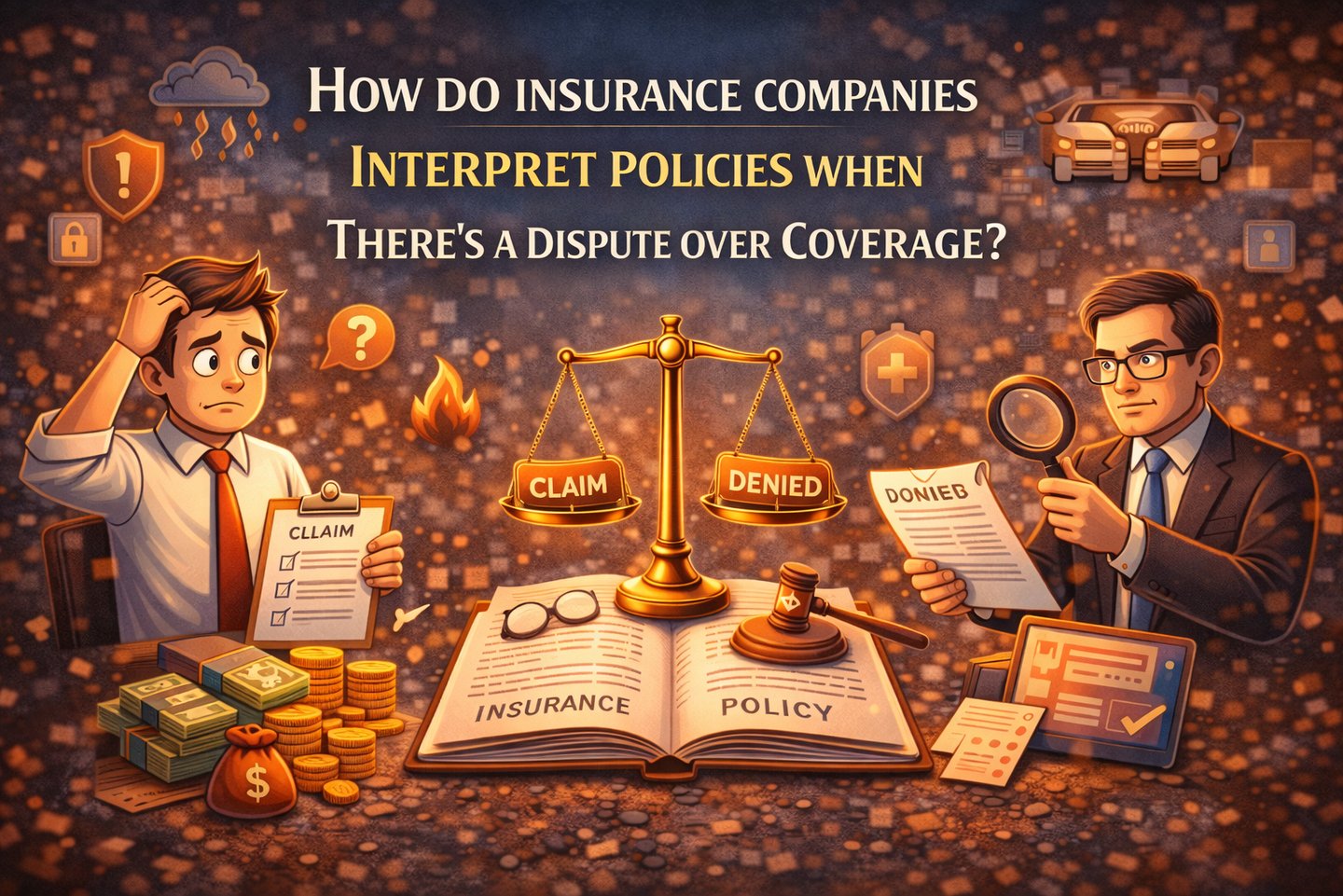
How do insurance companies interpret policies when there's a dispute over coverage?
This article investigates the legal principles governing insurance policy interpretation in India, with a focus on the transition from strict literal construction to the consumer-centric doctrine of contra proferentem in coverage disputes.
CORPORATE LAWS
Halata
2/19/20265 min read
Introduction
Insurance contracts are distinct legal instruments known as uberrimae fidei—contracts of the highest good faith. Unlike standard commercial contracts, which allow parties to negotiate terms on an equal footing, insurance policies are typically "contracts of adhesion" or standard form contracts drafted unilaterally by the insurer. This power disparity frequently leads to disputes when a claim is filed, as insurers may attempt to limit their liability by interpreting exclusionary clauses or technical definitions.
The Indian Contract Act of 1872 governs the interpretation of these contracts, as does a strong body of precedent established by the Supreme Court of India and the National Consumer Disputes Redressal Commission (NCDRC). The challenge for the judiciary is to strike a balance between the "Plain Meaning Rule" and the "Main Purpose Rule" while ensuring that policy technicalities do not undermine the protection for which the insured paid.
The Basis: The Rule of Literal Construction
The concept of literal construction is the basis of all insurance interpretations. This rule states that if the policy's language is clear and unambiguous, the courts must apply the words' ordinary meaning. In the name of interpreting them, the court cannot amend or make a new one for the parties.
Case law: Suraj Mal Ram Niwas Oil Mills (P) Ltd. v. United India Insurance Co. Ltd. (2010)
Ratio decidendi: The Supreme Court clarified that when it comes to insurance contracts, the rights and obligations of the parties are to be governed strictly by the wording of the policy itself. Courts cannot relax contractual conditions on grounds of fairness and equity. In fact, the judgment emphasized that the words in the contract must be read exactly as they are written, and if the terms are unambiguous, no outside evidence can be used to challenge or reinterpret them.
Practical Application: Take a look at an insurance policy dealing with housebreaking and burglary; one will often find that “burglary” is defined quite narrowly as requiring “forcible and violent entry.” The insurer will probably reject the claim if there is no physical damage to the locks or the property and the thief enters using a duplicate key. Since the policy language specifically demands evidence of force or violence, the courts have generally upheld such denials. In fact, in the Suraj Mal case, the precedent confirmed that unless those qualifying words are satisfied, the claim won’t stand.
The Contra Proferentem Doctrine: The Protection of the Insured
The contra proferentem doctrine is used by the courts when a provision in an insurance policy is deemed ambiguous or open to different interpretations. This Latin maxim means "against the offeror." Since the insurance company drafts the policy, any lack of clarity is held against them and in favor of the insured.
Case Law: Sushilaben Indravadan Gandhi v. New India Assurance Company Limited (2020)
Ratio Decidendi: The Supreme Court reaffirmed the need to give the benefit of the doubt to the party that did not draft a standard form contract. The court noted that insurance companies often use legal and technical jargon that is hard for the average consumer to understand.
Practical Application: This doctrine is applied when an insurer tries to apply a broad exclusion to a specific event. The court will interpret the term narrowly to give the insured the benefit of the doubt if the exclusion for “pre-existing diseases” is not clearly defined.
Using the Main Purpose Rule to Interpret of Exclusionary Clauses
Exclusionary clauses are designed to reduce risk for insurers. They may negate the purpose of the entire insurance policy if they are read too widely. To prevent this, Indian courts apply the "Main Purpose Rule."
Case Law: Texco Marketing Pvt. Ltd. v. TATA AIG General Insurance Co. Ltd. (2022)
Ratio Decidendi: The Supreme Court held that an exclusion clause cannot be so ambiguous that it contradicts the very basis of the policy. The court created a "doctrine of transparency," which mandates that when an exclusion is proposed, insurers must notify the insured of its implications.
Practical Application: If an insurer issues a fire insurance policy for a warehouse located in a high-risk chemical zone, they cannot later rely on a standard exclusion clause that prohibits the storage of "hazardous chemicals" if they were aware of the nature of the business at the time of issuing the policy. To do so would frustrate the commercial purpose of the contract.
The Test of Materiality and the Disclosure Obligation
The topic of "non-disclosure of material facts" is frequently the subject of dispute. A common tactic used by insurers to reject claims is to argue that the insured concealed information. However, proving that the suppressed fact was "material" to the risk being covered is essentially the insurer's burden.
Case Law: Manmohan Nanda v. United India Assurance Co. Ltd. (2021)
Ratio Decidendi: The Supreme Court ruled that an insurer cannot reject a claim later on because of a condition that was disclosed or could have been found with reasonable diligence once they have accepted a premium and issued a policy (typically following a medical examination by their own employing physicians).
Practical Application: This has shifted the burden of "investigative diligence" onto the insurer. In modern practice, if an insured mentions "occasional chest pain" and the insurer issues a life policy without further inquiry, they cannot later deny a claim for a heart attack by claiming suppression of a heart condition.
The Impact of the Consumer Protection Act, 2019
The Consumer Protection Act, 2019, has introduced a significant shift by defining "unfair contract terms." Section 2(46) of the Act allows Consumer Commissions to declare terms null and void if they result in a significant imbalance in the parties' rights.
Unjustified Punishment: Clauses imposing excessive punishment on the insured for minor errors.
Unilateral Expiration: Terms allowing the insurer to terminate the policy without cause while the insured remains obligated.
Evidentiary Barriers: Terms that require the insured to meet an impossible burden of proof in order to claim coverage.
A synopsis of Judicial Principles
Uberrimae Fidei | Concept: Utmost Good Faith | Legal Interpretation: Both parties must disclose all material facts honestly.
Plain Meaning | Concept: Literal Interpretation | Legal Interpretation: Clear terms are enforced even if they seem harsh.
Contra Proferentem | Concept: Interpretation against the drafter | Legal Interpretation: Ambiguous issues are always resolved in favor of the insured.
Rule: Main Purpose | Concept: Protecting the Core Object | Legal Interpretation: Exclusions cannot override the primary reason for the policy.
Conclusion
In India, the old principle of caveat emptor (buyer beware) has gradually given way to a more consumer‑friendly approach rooted in uberrimae fidei, where the insurer carries the heavier responsibility of clarity. While the contract's literal wording remains the foundation, insurers cannot hide entirely behind it.
Professionals must understand that coverage disputes are often determined by how the policy is worded rather than the accident itself. Ambiguities can be challenged, exclusions must be examined, and doctrines such as contra proferentem provide effective tools for contesting unfair claim denials.
Insurance is increasingly viewed by the Indian judiciary as a form of social security rather than a private bargain. Its role is to protect the policyholder's reasonable expectations and keep them from being caught up in technicalities, ensuring that insurance delivers on its promise of security.