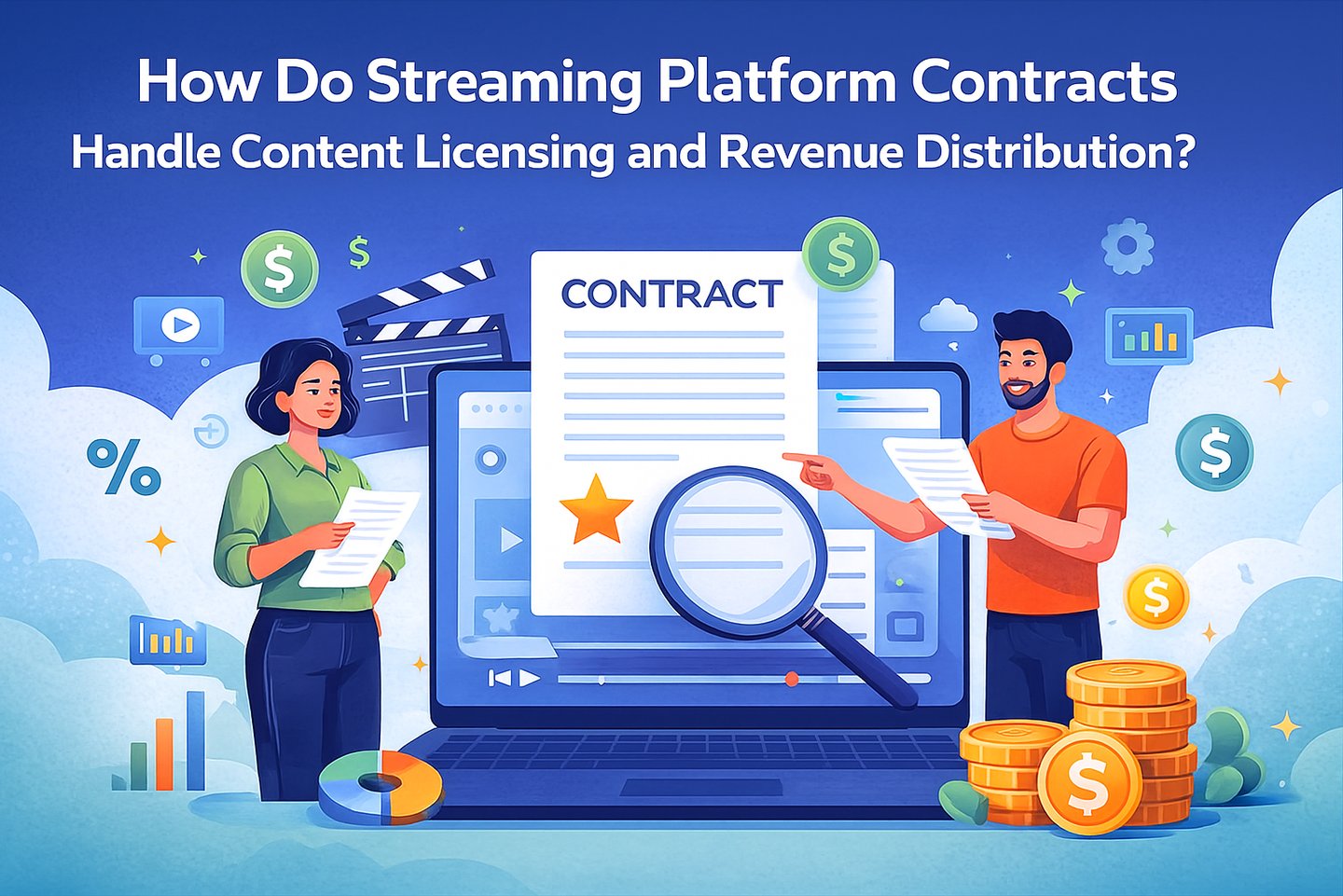
How Do Streaming Platform Contracts Handle Content Licensing and Revenue Distribution?
This article examines streaming platform contracts, covering content licensing routes (third-party, commissioning, co-production), key clauses like grant of rights and warranties, and revenue models (SVOD, AVOD, hybrids).
CORPORATE LAWS
Ayush Gupta
12/5/20254 min read
I. Introduction
The streaming revolution has radically changed the way we consume entertainment. Netflix, Disney+, Amazon Prime Video, and Hulu are household names that together claim to have more than 500 million subscribers around the world. But behind every show you binge-watch is a complex network of contracts—intricate legal agreements that determine who owns what, how much creators make, and where content can be viewed.
The backbone of this ecosystem is content licensing. While Netflix and Disney+ create their own original content, they also heavily rely on licensed material. This article covers the functioning of these streaming platform contracts, the key provisions safeguarding the various stakeholders, and the income models sustaining the entertainment sector.
II. Understanding Content Acquisition: The Three Main Routes
Mainly, there are three contractual mechanisms by which streaming platforms acquire content; each has different implications for intellectual property ownership and revenue distribution.
1. Third-Party Licensing Agreements
The most popular option is licensing pre-existing material from studios, networks, and production businesses. The Netflix catalog is full of these: The Office from Universal, The Crown from Sony, and How to Get Away with Murder from ABC—all these shows are licensed. They aren't owned by the platform; it pays for the right to stream them to subscribers.
In the context of these agreements, intellectual property rights are held by the licensor, or owner of the content, while a limited distribution right is given to the licensee, in this case, the streaming platform. Netflix negotiates different terms based on the preferences of the content owner. As one licensing industry expert explained, "Netflix is always updating consumers on what will soon be available and also what will soon disappear"—a reflection of time-limited licenses that expire.
Real-world example: When Netflix acquired the streaming rights to The Office, a reported $100 million deal was struck, but the exclusivity of that deal ended after the first term. The show can then move to other platforms, such as Peacock, which it did in 2021.
2. Commissioning (Original Content) Agreements
Platforms increasingly invest in original content, entering into commissioning agreements where the streaming service funds production and often retains significant intellectual property rights. Under such deals, Netflix produces Stranger Things, The Crown, and Bridgerton. While production companies and creators in such cases may retain ancillary rights—for example, merchandising—the platform usually obtains the worldwide distribution rights in perpetuity.
3. Co-Production Arrangements
There is, of course, a middle ground where both the platforms and studios share production costs and IP rights. For instance, Netflix partners with famous studios to co-produce content, a win-win situation where both sides put up money and divide profits. This strategy is gaining significant favor in India's streaming market, where places like Netflix and Prime Video are partnering up with local production companies.
III. The Anatomy of Streaming Contracts: Key Clauses Every Creator Should Know
Behind every piece of content on your favorite streaming platform sits a contract with dozens of clauses. While these agreements might reach 40-60 pages, there are few very significant clauses across the world.
· Grant of Rights: Defines scope, including territories, duration, and exclusive/non-exclusive streaming (e.g., Netflix's 2-5 year agreements for Friends)
· Compensation Models: Fixed fees, revenue splits (30-50% creator cut in AVOD like Hulu), or hybrids dependent on views/subscriptions.
· Territory & Term: Geographic constraints (such as India-only) combined with deadlines and renewal choices.
· Content Delivery and Specifications: DRM, metadata, and quality criteria to prevent piracy.
· Representations/Warranties: Chain of title showing clear IP ownership, no infringement.
· Revenue Reporting: Audit rights, payment schedules, performance bonuses.
· Restrictions & Moral Rights: Bans on modifications, advertisements placement; creator attribution preserved.
· Termination Clauses: What constitutes a violation and how terminations are handled when they expire. Pulling content when Netflix agreements expire is one example.
IV. Revenue Distribution Models: Who Gets Paid and How Much?
Understanding how streaming platforms earn money—and share it—reveals the economic incentives driving the industry.
Subscription Video-on-Demand (SVOD) Model
The core model of Netflix relies on subscribers paying a monthly fee, depending on the subscribed plan and region (Rs.149/- to Rs.649/-), and splitting its revenues between content acquisition costs and operational costs.
How creators get paid: Through licensing fees negotiated upfront. The more popular a show, the higher the fee. Netflix paid significantly more to license Friends, $250 million for five years, than it would to license some kind of niche documentary.
Ad-Supported Video-on-Demand (AVOD) Model
Hulu, YouTube, and emerging platforms like Peacock Free use this model. Revenue comes via advertising, and content creators share in ad revenue.
How it works: Take for an instance, An ad brings in Rs.800 CPM. On an hour-long show, with 1 million viewers, this can be Rs.8,00,000 in ad revenue. A platform and the creator may split that money 50/50, meaning the creator receives Rs.4,00,000/-.
Why it matters: Why it matters: AVOD is cheaper for consumers, but it usually pays artists less per watch than SVOD does. However, the fewer barriers to entry make AVOD services more accessible for independent filmmakers.
Hybrid Models: SVOD + AVOD
Disney+ and Hulu use mixed techniques. Disney+ announced a lower ad-supported tier, allowing it to grab price-sensitive viewers while keeping premium members. Revenue from adverts and subscriptions also comes into the content pool; however, allocation between platforms is a complex internal accounting process.
V. Real-World Contract Scenarios: Case Studies
Case Study: Bollywood on Streaming Platforms
Indian OTT platforms have their own set of practices. When Disney+ Hotstar licenses a Bollywood film, in most cases, the contract includes:
· Territorial exclusivity: includes Exclusivity in India and South Asia, usually for 7-10 years
· Language rights: There are separate terms for Hindi, English, Tamil, Telugu, and Kannada versions
· Windowing provisions: Clauses on when the film can stream relative to the theatrical release (often 30-90 days after such release)
· Revenue Sharing: A combination of fixed fees and a percentage of Hotstar's India subscription revenue from the film's genre category. For filmmakers, this has become a significant revenue stream. A Bollywood film that underperforms theatrically might earn substantial licensing fees from Hotstar, Amazon Prime, or Netflix.
VI. Conclusion
Streaming platform contracts balance creators’ rights with platform innovation and consumer expectations in a rapidly changing landscape. To creators, the message is clear: “Don't treat licensing agreements as commodities.” These contracts determine not just what you're paid today, but what rights you retain for tomorrow. Precision in drafting matters. As one licensing expert aptly noted, "The grant of right is the most important and distinct clause in the content license agreement." Get this right, negotiate hard on reversion clauses and audit rights, and you protect not just current revenue but future opportunity. The real battle is fought in conference rooms, over contracts—where the next generation of entertainment economics is being written.