
How Missing Survival Clauses Weaken Post-Termination Claims?
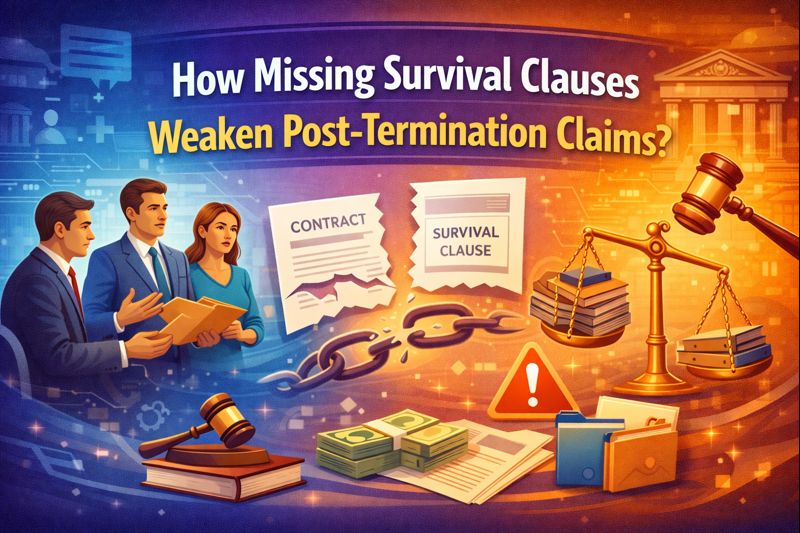
Survival clauses determine which contractual obligations continue after termination. When omitted, they often weaken post-termination claims by introducing uncertainty, limiting enforceability, and narrowing the remedies available to affected parties.
CORPORATE LAWS
Neelam Soni
1/15/20264 min read
Introduction
Contracts do not take their departure as well as they start. The post-termination disputes arise frequently and concern the issue of misuse of confidential information, unpaid indemnities, or intellectual property ownership.
Most of the parties believe that some duties are automatically transferred once they have terminated a contract. Regrettably, this supposition is not always watertight in the court. It is the place where survival clauses come in. These are clauses that precisely indicate the components of a contract that are alive once it is terminated.
Although they are important, they are frequently ignored, vaguely composed, or even considered as a common language. This is a serious oversight when it comes to legal claims in the future in case of conflicts.
This article examines how the absence of survival clauses impacts the enforceability, judicial interpretations, and remedies and the importance of taking caution in drafting so as to safeguard your rights after the contract is concluded.
The Intention and Use of Survival Clauses
A survival clause refers to the duties or rights that remain in existence despite termination of a contract. It is not planned to keep the entire agreement alive permanently—just that which makes sense to retain.
Such typical clauses are common in terms of confidentiality, indemnity, dispute resolution, governing law and intellectual property. In an ironical situation, such conditions usually turn out to be the most imperative following termination.
In case a contract has no survival clause, the courts are required to establish whether the parties wanted certain duties to persist. That’s rarely a simple matter. In the absence of clear language, post-termination claims may rely on interpretation rather than guarantee—that is dangerous.
Dismissal Does Not Presume the Preservation of Obligations.
Termination of a contract typically halts any further performance and does not imply that all obligations are eliminated. Courts tend to make a distinction between rights acquired and those that are meant to continue even after termination.
Where the contract is silent, the judges can decide that some obligations were only intended to be effective during the time the contract was being executed. This ambiguity may be detrimental to the claimant, particularly when the other party claims that there was no enforceable obligation at the end of the agreement.
The result—even good claims may fail prematurely, not due to the content, but because the contract was ambiguous.
Confidentiality and Restrictive Covenants: Trouble Spots
There is a high likelihood of disputes following termination due to the provisions of confidentiality and restrictive covenant. Numerous parties believe that they are in effect by default. Courts do not hold that supposition.
When a confidentiality provision does not expressly say that the obligation persists upon termination, then a defendant can contend that obligation expired with the contract. Judges tend to be reluctant to sentence current responsibilities without a delimiting time or expressly stated wording.
Non-compete or non-solicitation restrictions are even more severely scrutinized by the court. Judges are hesitant to suggest that trade or work should be limited following the termination of a contract. In the absence of definite language on survival, the existence of such clauses is usually non-binding, and the vulnerable party is not in a position to protect themselves.
Indemnity and Risk Allocation after the Contract Ends
Indemnity provisions aim to distribute risk, and they usually foresee prospective claims. Paradoxically, these protections are subject to disappearance lacking a survival clause. Unless it is mentioned in the clause that it is not subject to termination, the court might be unwilling to enforce it against those events occurring after it.
Likewise, the limitation of liability may cease to have an effect after the termination of the contract, and a party will have to bear a greater financial risk than anticipated. An omitted survival clause does not merely create confusion it can alter the sharing of risks and responsibilities.
The Interpretation of Judicial Review & the Issue of Uncertainty
The lack of survival clauses between courts does not follow a consistent approach. Common sense is applied by some judges to determine survival; some take the letter of the law. This inconsistency brings uncertainty.
They have to interpret, not the apparent intent of the contract, and this increases the cost and risk of litigation. In the meantime, the ambiguity is frequently exploited by the defendants, as it can be used to postpone or fight the enforcement.
The lesson is simple: writing things down will save time, money, and bargaining power in the future.
Effect on Remedies and Enforcement
Absence of survival clauses may restrict the remedies that a party can get. Courts may also limit damages to the pre-termination breaches and prevent damages to post-termination losses. That might be missing on major recoveries in the case of a confidentiality or intellectual property abuse.
Fair remedies such as injunctions are also more challenging to access where the court does not identify an existent duty. In brief, even a strong claim may not have an impact in the absence of a survival clause.
Survival Clause Drafting: Tips
· Be clear and specific when writing survival clauses.
· Avoid boilerplate language.
· Determine precisely what provisions survive and, where appropriate, state what the duration is.
· Periodically update contract templates with the changing business relationship. Maintaining your survival provisions with your commercial aims will ensure that you do not have conflicts in the future.
It is not only that precise drafting makes claims stronger; it also prevents the unnecessary legal wars.
Conclusion
Survival clauses are not considered special; however, they play a very important role in securing protection after a contract has lapsed. Their absence or inappropriate phrasing makes parties susceptible, places courts in interpretation dilemmas, and undermines existing remedies.
The law does not usually presume that obligations remain after termination, other than what the contract expressly states. That is, silence can barely be good. The inclusion of a properly written survival clause is not merely a technical consideration—it is the best line of defense in maintaining rights even when the contract is completed.