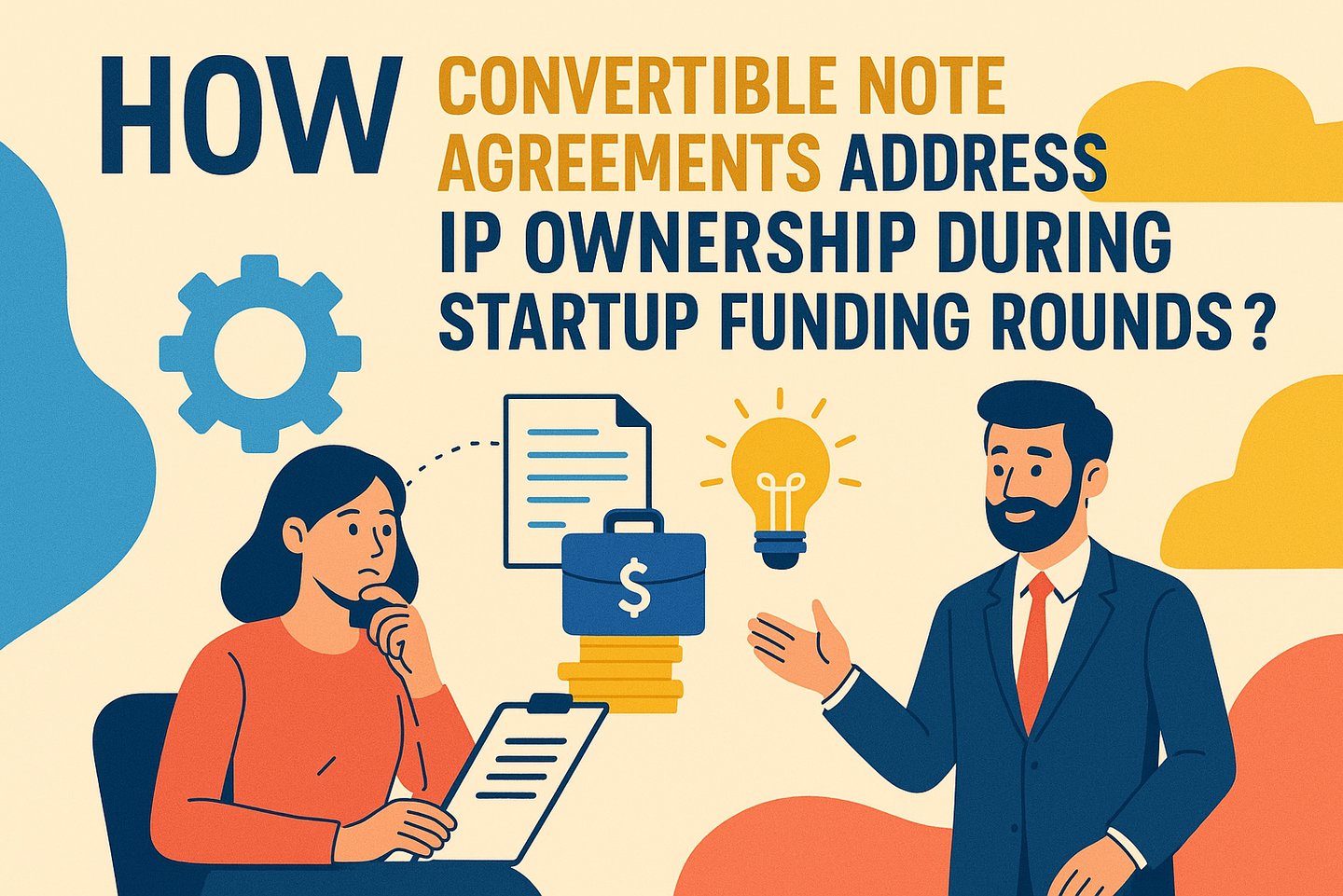
HOW SHOULD CONVERTIBLE NOTE AGREEMENTS ADDRESS IP OWNERSHIP DURING STARTUP FUNDING ROUNDS?
A Convertible Note is a short-term debt which, at a later stage, converts into equity. This conversion happens during the future funding round. Since India is a home to numerous startups who use these Convertible Notes as a financing option, the use of Convertible Note Agreements come into picture and how their IP Ownership plays a role in these Startup Funding Rounds is what this Article aims to discuss.
IPRCORPORATE LAWS
Sharvari Sutaone
11/27/20253 min read

INTRODUCTION
Convertible notes are a type of financing for investors that does not require an initial valuation report. A latest example could be Dunzo. Dunzo is a delivery startup that chose convertible notes for its initial funding. Dunzo managed to quickly get vital cash by avoiding immediate stock valuation through the issuance of convertible notes. The notes smoothly turned into equity as Dunzo reached significant milestones.
Considering the increasing use of these convertible notes, it is important for us to analyze the implications of these convertible note agreements on IP ownership, since most of these startup companies hold a lot of intellectual property rights like trade secrets, trademarks, copyrights, patents, etc. In startups, IP ownership influences valuation.
IMPORTANT CLAUSES IN A CONVERTIBLE NOTE AGREEMENT
1. Conversion Discount—Conversion Discount compensates the investors for their early risks by allowing them to convert their loan into equity at a lower price than the valuation of the subsequent round.
2. Valuation Cap—The valuation cap establishes the highest value at which the note can be converted, preventing investors from being unduly diluted in the event that the company's value rises quickly.
3. Interest Rate—The interest rate aligns investor returns with company growth timeframes by calculating the annual interest accrued on the note until conversion or payback.
4. Date of Maturity—Date of Maturity ensures that investor exit options are clear by specifying the date by which the note must either be repaid or converted into equity.
5. Conversion Price—Conversion price is the price per share at which the debt turns into equity.
6. Qualified Financing—Qualified Financing determines which next funding cycle or occasion will cause the note to automatically convert into shares.
7. IP Ownership Clause—The IP Ownership Clause makes sure that all current and future IP is owned by the company and not by the individuals. This clause safeguards the company's worth and avoids IP rights issues after conversion.
IP CONCERNS FOR CONVERTIBLE NOTE AGREEMENTS
1. Clear assignment of IP by founders and employees—Before taking investment, it is important to ensure that all relevant IP is assigned to the company (not left with a founder or contractor). The Convertible Note Agreement should reference that the company owns or holds licensed rights to all existing and future IP. This ensures that when conversion occurs, the equity reflects ownership of the business’s IP assets.
2. Representations and warranties concerning IP—The Conversion Note agreement (or a side letter) should include statements by the company about the status of its IP that it is owned or exclusively licensed, that there are no known claims, encumbrances, or infringement suits, and that all necessary filings have been made. For convertible note terms, these representations give comfort to the investor converting into equity.
3. Effect of Conversion Notes on IP Ownership—The Convertible Note Agreement must mention all events in cases of all kinds of risks to the valuation with respect to mergers, acquisitions, or dissolution of the company. This ensures that the IP valuation is not harmed in any way and the IP owner can enjoy his ownership without any worry.
4. Carve-outs for upcoming innovations and advancements—There may be new inventions and new IPs (trademark, trade secret, patent, etc.) invented and registered by the company during the tenure of the convertible note. A clause for this will not only help the current IP but also any future IPs generated by the company. This also prevents value leakage, and the conversion note holder also remains satisfied.
5. Control post conversion—After the conversion note converts, the investor becomes a normal shareholder with all voting and other rights. There may be cases that IP-related decisions like assignment or licensing were made before this conversion. To avoid any kind of disparities, it is better to include a clause regarding the IP ownership of the conversion note holder after conversion. This can impact the control and equity value of the company.
6. Exit rights—In the event of exit (sale, acquisition, merger), the IP may be the most valuable asset being sold. Convertible Note Agreement Clauses should address what happens to the IP and how the noteholder would be treated with respect to IP rights, whether they convert, share in proceeds, or receive priority. Clarifying these terms early avoids disputes later.
CONCLUSION
Hence, convertible note agreements have a huge impact on any startup’s IP ownership as well as on their control. Making sure that there are clear IP clauses in this conversion note agreement during startup funding rounds would safeguard the company’s core assets, which are IP. Considering the example of boAt, who had issued Convertible Notes, it is safe to say that startups like boAt who are planning to come up with an IPO must approach the Convertible Note Agreements with caution and include IP Clauses for their own business protection.