
How should service contracts handle insurance, liability, and who pays if something goes wrong?
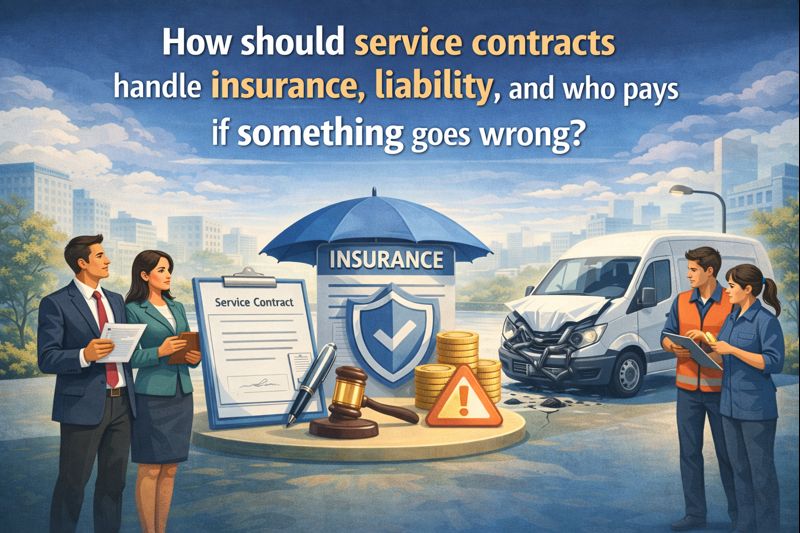
The article analyzes the three strategic 'danger' factors related to service contracts, namely liability, indemnity, and insurance. It is done to examine the implications of each of the three factors and to provide a means of effectively allocating risk to promote continuity of commerce and financial stability.
CORPORATE LAWS
Manasvi Jain
12/26/20255 min read

Introduction
Effective contract management is not bothered with what might happen tomorrow, but rather it is more about planning to deal with the volatility of the future. Although the commercial aspect of a service contract may be anchored on deliverables and payment timelines, the legal foundation thereof lies within the strict handling of uncertainty—the procedure termed as risk allocation. This mechanism spreads the burden and possible liabilities, and in case of contingencies, there is a ready-made pathway of the resolution. Effective allocation can be considered a viable way of turning a fixed document into a living tool to reduce conflict and ensure the continuity of the business. But reaching this balance does not just happen on a drafting exercise but requires a structural framework otherwise known as the trio of dangers.
Although the legal basis of business partnership is contracts, it is a fundamental omission to suppose that all agreements are equal. Some are benign, whereas others are full of significant risks that have the potential to affect financial stability and legal reputation. In turn, to manage it efficiently, one must be able to identify different levels of risks: between high-risk areas (e.g., unlimited liability, IP transfer, or data privacy) and low-to-middle-risk areas (e.g., standard payment terms). A team can mitigate these risks only after it has attained transparency and cross-departmental visibility to discover them.
The management paradox
One of the most prominent issues with this process is the conflict between efficiency and security, which is the ability to proceed with contracts as quickly as possible and the level of control needed to maintain the management of risk. Rushing is usually the enemy of critical evaluation. To overcome this gap, contemporary organizations utilize contract intelligence and standardization. These tools increase the pace of the contract lifecycle and minimize risk because they involve the consistent use of the pre-approved, legally sound language that would strike a balance between the need to be fast and the need to be safe.
After identifying the operational risks, it should now focus on the legal mechanisms used in allocating risks. This assignment is based on the limitation and interaction of three essential terms, namely, limitation of liability, indemnification, and insurance.
1. Limitation of Liability: The Strategic Boundary
A limitation of liability provision in contractual situations acts as the critical boundary to define the level at which a party can assume financial liability in the case of breach or failure. Although this definition is simply a statement of this limit in the first enactment, its usefulness goes far beyond the simplistic definition. A carefully written provision mitigates uncertainty and enhances openness, hence being an imperative component of a well-organized system of fair risk distribution. It makes sure that the exposure would be within the expectations of parties even in the case of unexpected disagreements.
The main aim of this provision is to align the financial risk with the economic worth of the contract. Without such a provision, the parties can face unlimited liability for the violation of contract that can often be far out of proportion to the profitability of the transaction and can cripple the business or destroy the business relationship. It fosters equitability and corporate confidence so that the parties can be able to make deliberations weighing risk and benefit.
Finally, a limitation of liability clause forms a strategic tool and not a legal frivolity. It brings ambiguity into formal governance. If the risk is made measurable, manageable, and aligned to business objectives at large, then organizations are enabled to contract with a lesser perception of risk. This clause promotes innovation and trade by creating a stable and fair system of risk allocation. The ability to limit possible financial risk due to unexpected losses, which can significantly exceed the amount of the contract, allows companies to form partnerships knowing what is commonly called the downside will be well managed.
2. Indemnification: The Protection and Defense Mechanism.
Indemnification is a legal tool of risk transfer whereby the party of the first part (the "compensator") undertakes to defend a second party (the "indemnitee") against financial loss, which is usually because of third-party actions. This course of protection is tactical to set up: it can be unilateral, as is the case with service contracts where the provider bears those stated mistakes, or mutual, as is the case with construction agreements where both the contractor and the employer mutually protect each other. The ability to comprehend this difference can help an organization to properly tune its risk appetite before it is executed.
Indemnity has five strategic advantages that can be realized when leveraged properly. First, it shifts the risk to the party that is most adequately positioned to handle it. Second, it defends and indemnifies the legal costs and revenues lost. Third, it creates a limitation of exposure, paradoxically, by specification of circumstances in which the liability will be in existence. Fourth, this transparency encourages business trust and allows the involved parties to focus on business activities and avoid the fear of litigation. Fifth, the hierarchical structure eases the monitoring of compliance and performance evaluation during the life cycles of contracts.
3. Insurance Clause: The Financial Safety Net
Assessment of risk requires clear goals; however, the risk cannot be identified and risk assessment mechanisms cannot be created without the means to fund possible losses. In theory, parties can simply use the indemnity and limitation of liability to define responsibility. The said model, though, presupposes that the party that is liable is liquid enough when a crisis occurs, a scenario that is not normally the case in commercial practice. This solvency gap is filled in the insurance clause. It helps the non-insuring party to be sure that he or she has not been put at risk of financial loss so that there may be a situation where the wrongdoer is rendered judgment-proof.
This means that parties need to carefully analyze the insurance requirements and the body that will take care of such coverage. Standards must be fair, clear, and proportionate to the risks involved. In a bid to have an effective safety net, it is recommended that businesses review the specifics of the policies and certificates to ensure they cover three key areas:
i. particular obligations, acting as the insuring party;
ii. rights to coverage and benefits, acting as the non-insuring party; and
iii. exhaustive scope of risk coverage to preclude coverage gaps.
Strict due diligence on the areas transforms a theorized legal right into an actual monetary instrument.
Conclusion
Effective contract administration requires more than just having a keen eye for detail when reviewing the contract but also requires a proactive approach to identifying and managing risk. Through a repetitive process of identifying and understanding the intrinsic risk associated with the contracts that will be executed, the entity may take proactive measures to mitigate the risk of the events occurring prior to the event happening. Such proactive measures not only protect the organization from unnecessary risk but also result in the continuous fulfillment of operational commitments and an enhanced relationship with business partners and customers from whom they derive revenue. The signing of the contract does not signify the conclusion of the process. Continuous and clear communication between parties, diligent examination, and ongoing monitoring are crucial to ensure that the deal remains intact. These continuing and proactive means of management, in combination with the legal protection of liability limitations, indemnification, and insurance, create an evolution of the contract from a fixed, non-viable document into a dynamic instrument of growth.