
IN INDIA, WHAT IS ADVERSE POSSESSION AND IS IT POSSIBLE FOR SOMEONE TO CLAIM YOUR LAND AFTER 12 YEARS?
This article explains adverse possession under Indian law, the 12-year limitation rule, essential legal conditions a claimant must meet, key Supreme Court rulings, and actionable steps landowners can take to protect their property.
SERVICES
Sairamdommetti
5/7/20264 min read

Introduction
Property ownership in India is rarely as watertight as a title deed suggests. A doctrine called adverse possession — embedded in the Limitation Act, 1963 allows a person who occupies someone else’s land openly, continuously, and without permission for a prescribed period to eventually assert a legal claim over it. The idea sounds alarming to most landowners, and rightly so. Yet courts have repeatedly upheld it, and Parliament has not repealed it. This article unpacks what adverse possession truly requires, what the 12-year rule actually triggers, and how an owner can prevent a claim from ever getting off the ground.
What Is Adverse Possession?
Adverse possession is the law’s answer to a long-standing gap between paper ownership and physical occupation. When someone takes over land without the owner’s consent, uses it as their own, and maintains that occupation without interruption for the legally prescribed period, the law begins to treat their factual control as stronger than the dormant title of the absent owner. The doctrine is not a licence to steal. Its logic is utilitarian: land that is actively used contributes to society, while land that sits neglected by an indifferent owner does not. The law therefore incentivises owners to stay engaged with their property and penalises prolonged abandonment.
Legal Framework
Adverse possession in India is governed primarily by the Limitation Act, 1963 :
Article 65 — Private Land: A suit to recover possession of immovable property must be filed within 12 years from the date the occupier’s possession became adverse to the true owner. Once this period lapses without a suit, the owner’s right to sue is permanently extinguished.
Article 112 — Government Land: The state has a far larger window of 30 years to reclaim its land. Several states have further enacted laws that make government property immune from adverse possession claims entirely.
Transfer of Property Act, 1882 & Specific Relief Act, 1963: These statutes interact with adverse possession disputes, particularly concerning the nature of possession and the remedies available to a dispossessed owner.
The Five Conditions That Must Be Proven
An adverse possession claim is not easily made. Indian courts insist that all five of the following elements be established simultaneously by the claimant, and the burden of proof rests entirely on them :
Actual possession : The claimant must be physically using the land cultivating, constructing, fencing, or exercising clear dominion over it.
Open and visible : The occupation cannot be concealed. The true owner must have had a reasonable opportunity to notice and challenge it.
Continuous and uninterrupted : Any break in possession resets the 12-year clock entirely. Steady, unbroken use is non-negotiable.
Hostile to the owner : Possession must be without the owner’s consent. A tenant, caretaker, or anyone who acknowledges the owner’s title cannot satisfy this condition.
Exclusive possession : The claimant must control the land to the exclusion of both the true owner and the public at large.
What the 12-Year Period Actually Means
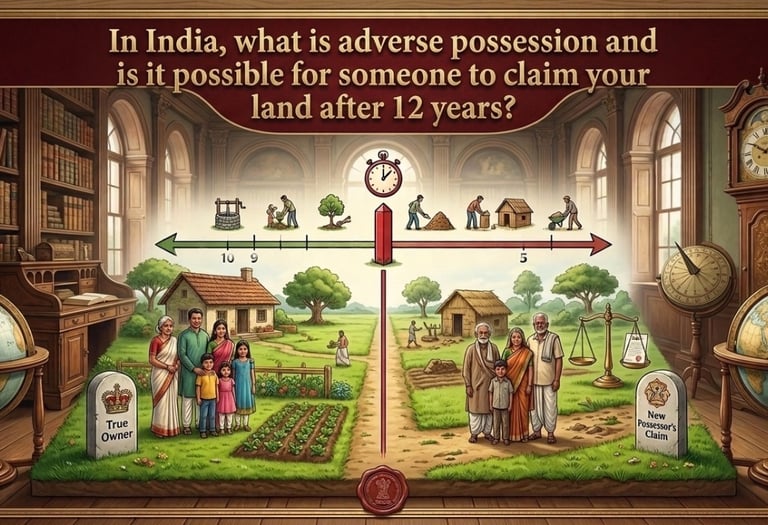
The most common misunderstanding about adverse possession is that 12 years of occupation automatically transfers ownership. It does not. What the 12-year period does is bar the original owner from filing a suit for recovery. Ownership does not shift on its own. The possessor must then go to a civil court and obtain a formal declaration of title. Until that court order is granted, the possessor cannot register the property in their name, cannot sell it, and cannot obtain a clear entry in revenue records. The 12 years closes the owner’s door to court it does not open a new one for the possessor automatically.
Key Supreme Court Judgements
Hemaji Waghela v. Bhikhabhai (2009) : The Supreme Court called adverse possession “a highly archaic and irrational law” and urged legislative reform. The doctrine nonetheless continues to operate.
Kesar Devi v. Dharma (2009) : The Court confirmed that the entire burden of proving all conditions falls on the claimant, with no presumption operating in their favour.
State of Haryana v. Mukesh Kumar (2011) : The Supreme Court recommended reversing the burden of proof in adverse possession cases to better protect original owners.
Ravinder Kaur Grewal v. Manjit Kaur (2019) : A landmark ruling held that adverse possession can be pleaded not just as a defence against eviction, but also offensively by a plaintiff filing suit to recover land they have possessed adversely.
How to Protect Your Property
A vigilant owner is the strongest defence against any adverse possession claim :
Visit and inspect regularly : Even one documented annual visit can demonstrate that the property has not been abandoned.
Pay property taxes consistently : Unbroken tax receipts in the owner’s name are powerful evidence of continuing ownership.
Challenge encroachment immediately : Filing an eviction suit the moment unauthorised occupation is spotted interrupts the adverse possession clock before it can run to completion.
Document all permissions in writing : Any caretaker, relative, or temporary occupant on your land should have a signed written agreement confirming that their presence is with your consent.
Keep revenue records updated : Ensure the property is mutated in your name and all title documents are current. Outdated records leave gaps that claimants can exploit.
Conclusion
Adverse possession is not a theoretical risk it has been litigated across India’s courts at every level and upheld where the conditions were genuinely met. The law does not make it easy for a claimant: every single condition must be proven on evidence, and courts apply these standards strictly. But the window is real, and it opens for any landowner who remains absent and disengaged long enough. The solution is straightforward stay connected to your property, keep your documents in order, and never delay action when encroachment occurs. Ownership on paper must be matched by ownership in practice.