Hybrid Employment Models & IP Disputes
Explore the challenges of hybrid employment models that blend remote and office work. Understand the potential for intellectual property disputes and the importance of clear contracts to protect your rights and mitigate risks in this evolving work landscape.
IPR
Neelam Soni
1/29/20264 min read
Introduction: The Rise of Hybrid Work and Its Hidden Pitfalls
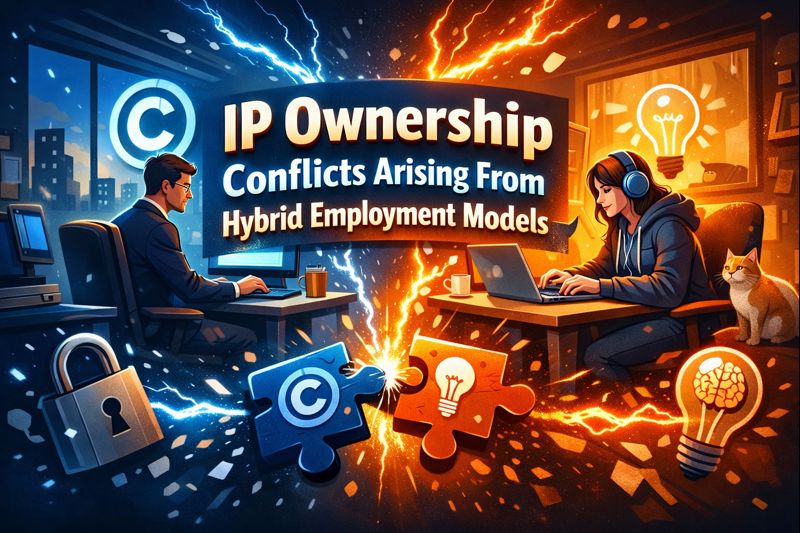
The transition to hybrid work has changed the manner of doing business. Things that started as a pandemic measure are now a norm in most teams. Employees have been divided into two days of in-office work and a concentration of remote work at home, which has provided them with enhanced work-life balance as companies tap into broader talent pools. However, such malleability is associated with concealed dangers—particularly on the ownership of intellectual property (IP).
Who is the one who owns that breakthrough algorithm that was coded late at night on a personal laptop? Or the brainstorming idea generated in a home office? They are no longer edge cases. With such blurred lines of work time and personal time, IP conflicts are on the increase, posing a threat to innovation, trust, and bottom lines.
We can deconstruct the reasons behind why hybrid models cause these tensions, the response by laws, and the actual examples, as well as actions that can be taken by organizations to reduce disputes.
The reason why hybrid work is a source of IP conflicts
The IP rules in the conservative office environment were quite simple: company time, company devices, and company ownership. Hybrid configurations are the difference. The workers adopt personal computers, domestic Wi-Fi, and flexible work hours. A developer could work on code after hours at home, or a designer could work on a tablet on the road. Was this contribution during the course of employment?
There is complexity of device mixing. Switching between the company-supplied equipment and personal phones creates a gray zone—particularly when personal projects and work equipment overlap or the other way around. Home use of open-source code may result in controversies of derivation and ownership.
Time and place are also important. The remote norms undermine the test, which is used traditionally by the courts and involves the consideration of whether work was performed in the course of employment. An idea scribbled in a personal notebook during off-hours can be connected to the job requirements—ownership conflicts.
Cross-border headaches are created due to collaboration tools, such as Slack, Notion, or Zoom. In the case of an involvement of freelancers or contractors in another country, through remote contribution, conflicting national laws may conflict with each other unless IP is explicitly allocated in the contract.
Human factors play a big role. Working at home fosters loneliness or bitterness. A low-estimated employee may end up owning an idea that they consider to be a personal one. Ownership lines can also get even more mixed in group living situations where family members overhear conversations or even casually hint at making some changes.
The danger to trade secrets also increases. Unprotected home networks or common devices in the family have a higher chance of accidental leakage or data breach of confidential data.
The Legal Picture
The default of IP ownership takes many forms. In the vast majority of jurisdictions, creations originating in the course of employment are the property of the employer under work-for-hire regulations (copyrights) or invention-assignment regulations (patents). But the boundaries are challenged by hybrid setups.
In the U.S.A., broad assignment provisions are frequent, but they are restricted by states such as California—in inventions that have no relation to the work performed or to inventions created completely on personal time/equipment. The Defend Trade Secrets Act assists in the fraud against misappropriation, though it is hard to establish remote leaks without solid documentation.
Unless crystalline contracts are involved, the EU and UK will tend to give preference to employees in non-core inventions. The work across the borders complicates this even more: an Indian developer working in a U.S. company may be subject to different default regulations.
Rules of patent venue have also changed, as well, as remote employees place their homes in locations that are sometimes used to determine where a dispute gets litigated, affecting the results indirectly.
Conclusion: Companies are at risk of default regulations having a one-sided, employee-focused nature unless their contracts are updated and made hybrid.
Real-World Snapshots
The level of anonymized cases demonstrates the stakes. One of the remote software engineers developed a core in his home and was not given a signed invention assignment. The engineer claimed that he had worked during off-hours to have personal ownership when the startup attempted to patent it. The case was resolved out of court at a heavy price.
In another case, a marketing department lost its exclusive campaign information to a home computer, which was used to browse at work and also do personal browsing. Accidental exposure by any family NDA was converted into a trade-secret breach.
The reports available after the pandemic indicate that claims of IP concerning hybrids are on the rise, particularly in the technological and creative industries.
Real-life Risk-Minimizing Measures
It is much cheaper to avoid lawsuits than to defend. Here are proven steps:
a. Update Contracts
Develop hybrid-designed IP clauses. Make it clear that any work-related productions, wherever they are, on whatever device, at whatever time of day, are all the property of the company. Demand side projects to be disclosed and insist on hard work-for-hire copyrights.
b. Tech Controls
Require VPNs to access the company remotely, offer standardized devices where possible, and document tracking/watermarking. The logs of access assist in proving the point of contribution should there be any contention.
c. Training & Transparency
Conduct frequent IP-awareness trainings so that employees are conversant with rules. Support early sharing of ideas—developing trust will spare future conflicts.
d. Dispute-Resolution Mechanisms
Contain mediation/arbitration clauses in agreements. Swift, nonjudgmental action prevents aggravation.
e. Culture First
Even salaries, praise, and mental security are important. Employees who feel valued would hardly struggle to establish ownership.
Policy reviews on a yearly basis ensure that all is in line with the changing laws and work patterns.
Conclusion: An Enlightened Future
There are tremendous advantages of hybrid models, but they are challenged by IP issues, which are likely to eliminate the advantages of the hybrid models. This can be done by companies being aware of the risks, such as blurred boundaries, legal variances, and human factors, and then guarding against them in advance. It is all about clear contracts, smart technology, and open communication. With the changing nature of work, our attitude to IP needs to change. Adopt hybrid, and use possible traps as a source of innovation. In a flexible world, finding ideas guarantees success after all.