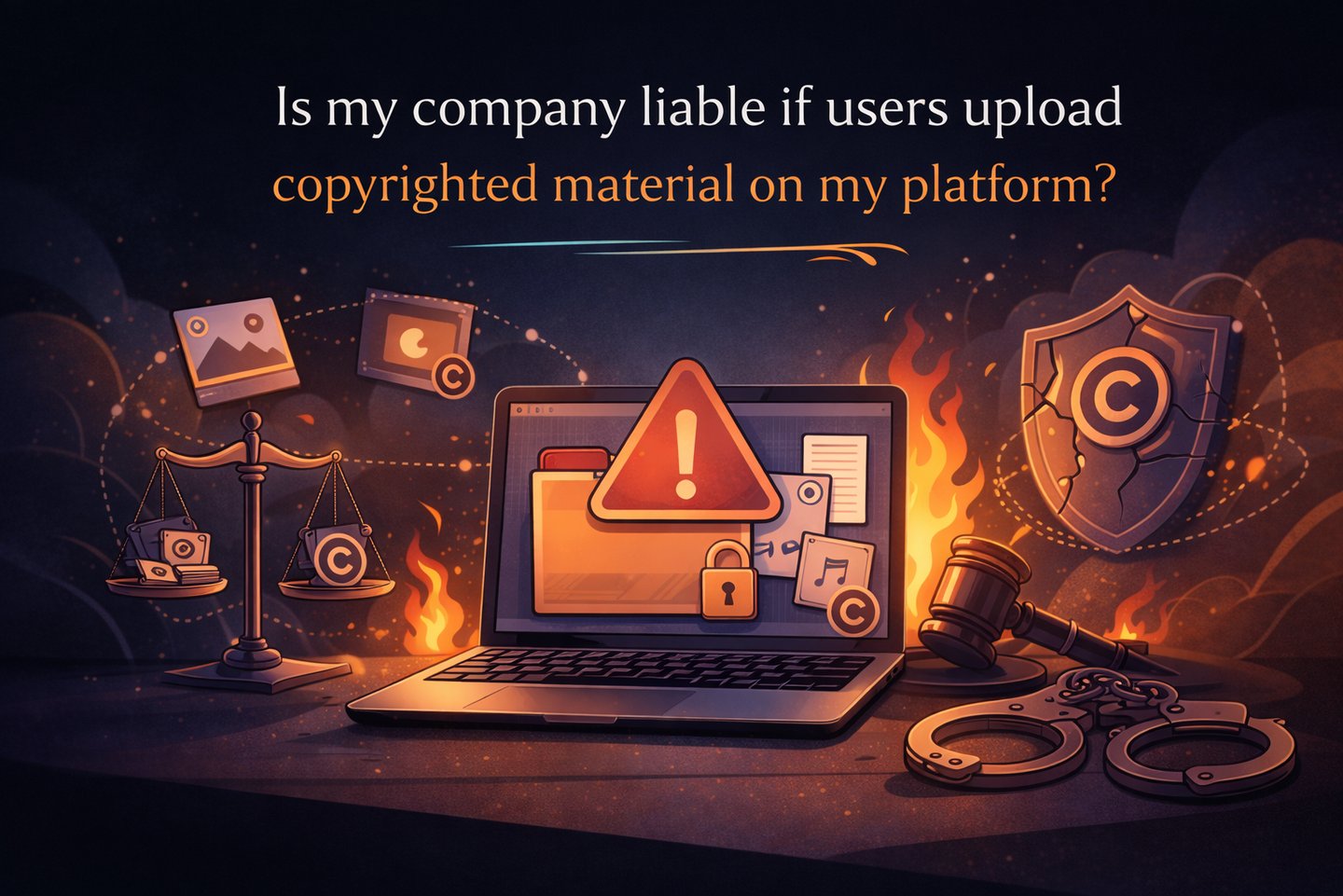
Is my company liable if users upload copyrighted material on my platform?
This article examines intermediary liability in India, explaining safe harbor, copyright infringement risks, sections, and compliance measures for user-generated platforms.
IPR
Tanishqa
2/28/20264 min read
Introduction
As digital platforms grow rapidly, user-generated content has become important to the business models of social media, e-commerce, and content-sharing websites. However, it also raises legal risks for businesses that operate platforms when users upload protected materials without permission. Businesses that constitute popularly used platforms ask whether they will be responsible for infringement by their users. Many factors influence this question, including the type of platform, adherence to applicable regulations related to the platform, and how courts have interpreted intermediary liability. This article will review the Indian law regarding liability for infringement of copyright by an intermediary, including the extent of the safe harbor from liability, obligations of the intermediary, and recent decisions of the judiciary interpreting such obligations.
Legal Framework Governing Platform Liability
In India, there are two main laws that govern the use of the internet and copyright:
1. The Information Technology Act (2000) provides legal protections for online intermediaries who provide a neutral technological platform for the flow of information and where users upload content to.
2. The Copyright Act (1957), which addresses what will be deemed to be copyright infringement and the remedies available for copyright owners.
A platform such as YouTube (owned by Google) or Facebook (owned by Meta Platforms), which simply provides the technology but does not create any content or control the content of others, may qualify as an "intermediary." If the platform meets the statutory requirements to qualify as an intermediary, then it should have a safe harbor (no liability) against claims by third parties for the actions of its users.
Safe Harbour Protection Under Section 79 of the IT Act
Section 79 of the Information Technology Act exempts from liability any intermediary who hosts user-generated third-party content on the intermediary's web platform if:
1. The intermediary acts merely (i.e., as a "passive conduit") or (i.e., being unable or unwilling to perform an action) as a neutral platform;
2. The intermediate does not initiate or control the transmission;
3. The intermediary does not choose the individual receiving the transmission;
4. The intermediary does not change the information contained in the transmission in any way; and
5. The intermediary has exhibited due diligence and complied with all the guidelines/requirements issued by the government.
There are, however, limitations on the protections provided by Section 79. Section 79 exemptions will be forfeited if an intermediary (a) has actual knowledge of unlawful conduct but fails to remove it, (b) acts in concert and/or conspires, abets, and/or facilitates a third-party infringement action, or (c) fails to respond to the legitimate notice request of a copyright owner's request for removal of materially infringing material from the intermediary's website.
Accordingly, upon receiving notice of the unlawful uploading of a copyright owner's work, the intermediary must take action to remove or disable access to the infringing materials promptly.
Copyright Liability: Direct vs Secondary Liability
Infringement occurs when a person commits the following acts without authorization: reproducing, distributing, communicating, or adapting (copyrighted work) under the Copyright Act. Liability typically arises in two ways for platforms:
1. Direct Liability—If a platform uploads, promotes, or monetizes infringing content, which would go beyond just being a passive host, it could be held liable as a direct infringer.
2. Secondary/Contributory Liability—A platform could also be liable if it knowingly allowed infringement to take place while receiving the benefit of the infringement financially and also has sufficient control over the infringing conduct.
In determining if a platform has knowledge of and/or control of the infringing content, courts in India generally look at whether the platform had both.
Key Judicial Developments in India
Super Cassettes Industries Ltd. v. MySpace Inc. is an essential case in the area of intermediary protections and establishes three principles for intermediaries: (1) To qualify as an intermediary, (2) intermediaries must remove infringing content after being notified, and (3) they have no duty to proactively monitor all content but must take reasonable steps after being notified.
The Supreme Court of India clarified that under the IT Act, “actual knowledge” derives mostly from either court orders or government notifications but will also usually follow the receipt of a private notice. Ultimately, these decisions confirm that the Indian legal framework seeks to balance innovation and copyright protection through providing conditional immunity instead of absolute protection.
Due Diligence Requirements for Platforms
In order to reduce potential liability risk, all platforms operating in India should implement the following:
1. Clearly Defined Terms of Service: Users must agree not to upload infringing content to any platform.
2. Notice-and-Takedown Procedure: There must be an operational procedure creating transparency for copyright holders to report infringement of their copyrights.
3. Appointment of Grievance Officer: The Grievance Officer is required to handle consumer complaints as per the intermediary guidelines established.
4. Repeat Infringer Policy: Repeat infringers of copyright infringement are subject to suspension/termination of their accounts.
5. Content Moderation Tools: While not a statutory requirement in every case, automated content recognition tools can significantly reduce this risk of liability.
If all five of these things are not implemented, then the platform may lose its ability to establish a safe harbor defense.
Practical Business Implications
Intermediary protection is essential to provide startup businesses or technology-based businesses with an option to avoid substantial liability for user-generated content models. The compliance costs incurred, whether through hiring legal teams, developing moderation technology, or undertaking other regulatory processes, are part of doing business in the digital economy. It should also be noted by companies that copyright owners may file civil suits against companies for seeking civil remedies (e.g., injunctions, damages, and account blocking orders) even if criminal liability is not imposed.
Conclusion
Safe harbor protection is granted based on the condition that once an intermediary learns about copyright infringement (such as through notice), they must act promptly to remove the infringing content and demonstrate that they have taken reasonable care to comply with applicable laws and regulations. Thus, the conclusion is clear: an intermediary that acts in good faith and meets its obligations to act timely and appropriately in relation to copyright infringement will likely be protected from liability, while an intermediary that does not meet those obligations and/or emphasizes copyright infringement will likely be subject to liability.