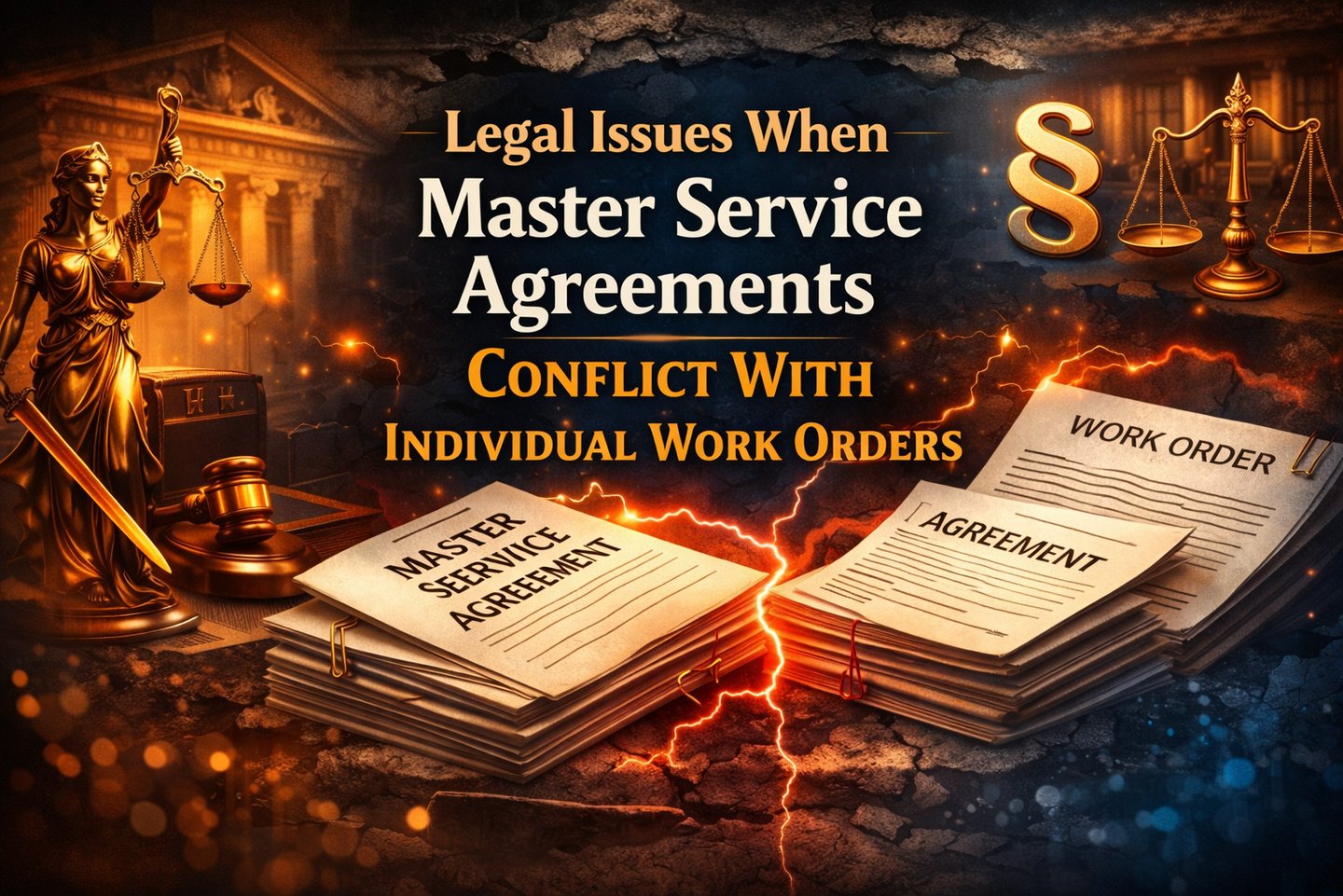
Legal Issues When Master Service Agreements Conflict With Individual Work Orders
There are major difficulties in interpretation and enforcement when master service agreements and single work orders are in conflict. The article looks at the entirety of the matter, consisting of a contractual hierarchy, court rules, and commercial risk distribution, which are the main factors determining such discrepancies.
CORPORATE LAWS
Sabhya Bhatia
3/5/20264 min read
INTRODUCTION
In using complex commercial agreements, the contractors would most likely apply a layered contractual structure consisting of a Master Service Agreement (MSA) along with separate Work Orders or Statements of Work (SOW). The MSA lays down the general contract that governs the parties, whereas work orders are used for particular transactions. Even though this structure is commercially efficient, it often leads to legal disputes when the terms of a work order are at odds with the MSA.
Such disputes raise the basic principles of contract law related to the intention of the parties, the clarity of the terms, and the sharing of risks. More and more often, the courts need to decide whether a work order merely carries out the MSA or is a modification of the contract. This paper discusses the main legal issues that arise from such conflicts and the different approaches the courts have taken to resolve them.
LEGAL NATURE OF MSAS AND WORK ORDERS
A Master Service Agreement (MSA) is usually regarded as a general contract that governs the various future transactions without the necessity of renegotiating the fundamental terms. It usually covers areas like limitation of liability, indemnities, intellectual property, dispute resolution, and termination. In contrast to a contract, a work order articulates the various terms of a transaction, which include the nature of the work, time frames, prices, and service level.
In the court's opinion, it is recognized that in most cases, work orders derive their enforceable nature from the MSA and do not stand as distinct agreements unless it is specifically stated so. The issue of law arises when both contracts contain binding provisions that are opposing one another.
HIERARCHY OF DOCUMENTS AND ORDER OF PRECEDENCE
The most conclusive factor in determining the inconsistencies is the existence of an express order of precedence clause. The courts always look upon such clauses as the parties’ intention with respect to the contract and enforce them accordingly. Should an MSA declare that its terms supersede those in conflicting work orders, the tribunals will be very hesitant to allow the exclusion via subordinate documents. [1]
Without a hierarchy clause, the courts analyze the context of the contractual relationship. Some might claim that the later date of a work order operates to change the MSA, but the judges’ thinking discloses that mere priority of time is not enough. There must be unequivocal proof of the intention to change the MSA. [2]
SPECIFIC VERSUS GENERAL CLAUSES
A common issue of interpretation occurs when certain provisions of a work order clash with the general terms of an MSA. The courts have applied the principle of “generalia specialibus non derogate," thus allowing the specific terms to prevail over the general ones. [3] This method is a reflection of the commercial reality since work orders are meant for individual and specific transactions only.
Nevertheless, the application of this principle is not automatic. In instances where the MSA clause that causes a conflict pertains to the fundamental aspect of risk allocation, especially in terms of the limitation of liability, then the courts will require that the work order contain clear and explicit language in order to become effective and to displace the MSA. [4] Absence of such clarity renders the MSA still in control.
LIMITATION OF LIABILITY AND INDEMNITY CONFLICTS
Disagreements surrounding the limitation of liability are classified among the most heated disputes arising from MSA–Work Order conflicts. The parties frequently try to reach a consensus to bolster liability limits or to have certain issues excluded from individual work orders. The courts have ruled that the company's liability regime under the MSA continues to apply if the work order does not expressly contradict it. [5]
This indicates that the parties consider the allocation of risk through the liability clauses as a deliberate commercial decision, rather than just a standard practice. In addition, the contradicting indemnity clauses are still being researched to find out if they were actively negotiated or just passively accepted. When courts determine enforceability issues, they evaluate the relative bargaining power of the parties. [6]
INCORPORATION BY REFERENCE AND AMENDMENT CLAUSES
MSAs are often referred to in the context of work orders, which leads to the question of the extent of such reference. [7] A clear reference and the terms that are being incorporated must be both identifiable and accessible for incorporation to be effective. Uncertainty may cause the application of different interpretations, and thus there will be a lack of certainty in the contract.
Additionally, formal amendment clauses are usually included in MSAs that necessitate written and authorized changes. Courts in most cases reject the application of inconsistent Work Orders that do not comply with such requirements and that are seen as an attempt to amend MSAs [8].
DISPUTE RESOLUTION AND GOVERNING LAW CONFLICTS
Discrepancies among the dispute resolution provisions create major procedural risks. If an MSA states arbitration and a work order says litigation, the courts usually support the MSA clause unless the work order evidently overrides it. [9] The courts’ hesitation to break up the dispute resolution mechanisms is a sign that they prefer efficiency and uniformity.
The allowance of parallel or conflicting forums could result in jurisdictional uncertainty, multiple proceedings, and different outcomes. Besides, courts look into whether the work order intentionally diverged from the MSA’s dispute resolution framework or simply indicates bad drafting. In international business, contradictory governing law clauses additionally increase the risk of non-enforcement, especially at the time of recognition and execution of awards or judgments.
CONCLUSION
Conflicts between MSAs and individual work orders reveal the tension between contractual flexibility and legal certainty. Judicial approaches consistently emphasize express drafting, clear hierarchy, and preservation of negotiated risk allocation. Work orders are not lightly construed as amending MSAs, particularly in relation to liability and dispute resolution. Careful drafting remains essential to mitigate disputes in layered contractual structures.
[1] Pagnan Spa v. Feed Products Ltd (1987) 2 Lloyd’s Rep 601 (CA)
[2] Globe Motors Inc v. TRW Lucas Varity Electric Steering Ltd (2016) EWCA Civ 396
[3] Radha Sundar Dutta v Mohd Jahadur Rahim AIR 1959 SC 24
[4] Watford Electronics Ltd v Sanderson CFL Ltd [2001] EWCA Civ 317
[5] BSNL v Reliance Communication Ltd (2011) 1 SCC 394
[6] Photo Production Ltd v Securicor Transport Ltd [1980] AC 827 (HL)
[7] Incorporated Council of Law Reporting v Attorney General [1972] Ch 73
[8] McEntire Joint Venture v Monrovia Unified School District 2002 WL 31992120 (Cal App)
[9] Enercon (India) Ltd v Enercon GmbH (2014) 5 SCC 1