
Legal Risks of Using Client-Provided Content Without Warranty Clauses
Utilizing content given by clients without warranty clauses puts businesses at high risk for copyright infringement, defamation, and breach of contract. This article delves into legal protections, shifts in liability, and key strategies for safeguarding service providers.
IPRCORPORATE LAWS
Raseena
2/28/20264 min read
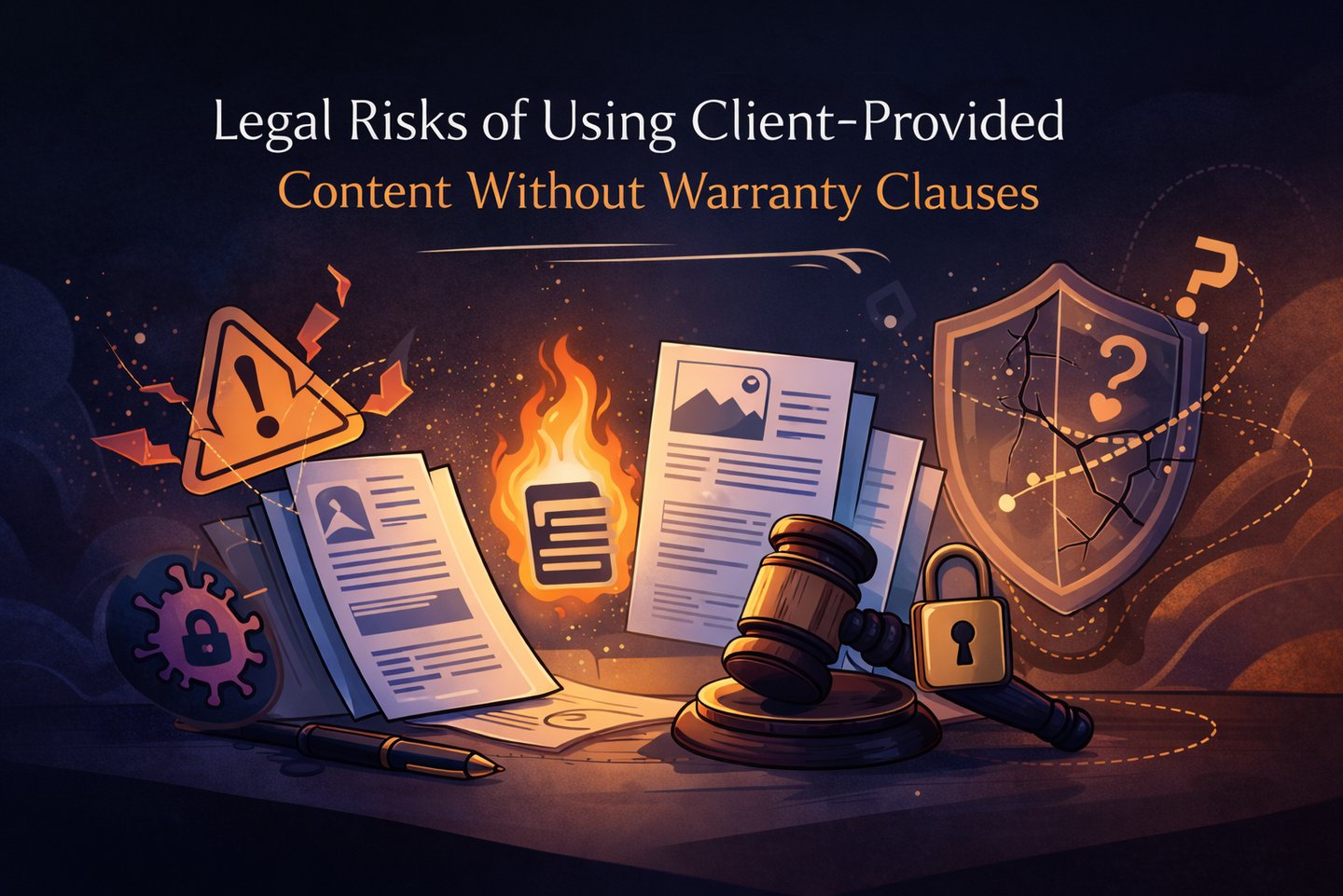
THE SILENT LIABILITY: NAVIGATING LEGAL RISKS OF CLIENT-PROVIDED CONTENT
In today's service economy, covering areas like digital marketing, web development, architectural design, and publishing, assets rarely flow in just one direction. Agencies and freelancers often depend on "client-provided content." This can consist of high-res images, proprietary data, pre-written text, or third-party software code. The common belief is that clients own what they share. But legally speaking, saying "I thought they had the rights" is hardly a solid defense in cases of intellectual property (IP) disputes. Without a strong warranty and indemnification clause, a service provider is basically piloting a plane without a parachute.
1. The Main Risk: Copyright Issues with Third Parties The biggest threat is the unauthorized use of copyrighted content. A client might hand over a "royalty-free" image they snagged from a Google search or a piece of background music for a video that was never properly licensed for commercial use. The Principle of Strict Liability Copyright law often operates on a strict liability basis. This means that the infringer's intent (the service provider) doesn't really matter when figuring out if an infringement took place. If you create a website for a client that has stolen images, the original creator can take legal action against both the client (who provided the images) and you (who put it online). Statutory Damages In places like the United States, statutory damages for "willful" infringement can go as high as $150,000 for each work. Even if the infringement is considered "innocent," the costs for legal defense and the minimum damages can be enough to put a small-to-medium enterprise (SME) out of business.
2. Defamation and Right of Publicity Beyond just intellectual property, any content provided by clients can lead to issues of defamation or infringing on someone else's right of publicity. If a client hands over text for a blog that makes false and harmful statements about a competitor, the agency that formats and shares that content could be seen as a "publisher" and might face legal consequences. Using someone's name, image, or voice without their permission, even if the client insists they "know the guy," can lead to costly lawsuits, especially in states with strong personality rights like California or New York.
3. Understanding Warranty and Representation Clauses To reduce these risks, it's essential for professional service agreements to have representations and warranties. Legally speaking, a "warranty" refers to a guarantee that a certain fact is accurate. When a client agrees to a contract that includes a warranty clause, they are officially declaring: They possess the content or have obtained all required licenses. The content does not violate any third-party rights (like IP, privacy, etc.). The content is neither defamatory nor unlawful. Without this clause, the burden of verification shifts toward the service provider. If a dispute arises, the provider has no contractual grounds to claim that the client misled them regarding the origin of the assets.
4. The Strength of Indemnification A warranty reveals the facts; indemnification offers the solution. An indemnification clause mandates that the client cover the service provider’s legal expenses, settlements, or judgments if a third party files a lawsuit regarding the content provided. If there’s no indemnity clause, even if you can show the client was to blame, you might still have to handle your own hefty legal defense costs. A properly written indemnity clause guarantees that the party accountable for the problematic content takes on the financial burden of the consequences.
5. Hidden Dangers: Regulatory and Data Compliance Issues In today's world of GDPR, CCPA, and HIPAA, content from clients goes beyond just images and text; it involves data. When a client hands over a mailing list for an email campaign or a database for a new app, the service provider takes on the role of a "data processor." If the client gathered that data unlawfully or without the right permissions, and the service provider utilizes it, both sides could face scrutiny from regulatory authorities. Warranty clauses need to clearly outline data privacy compliance, making sure the client guarantees that all data was obtained in line with relevant laws.
6. The "Work for Hire" Trap: A lot of service providers think that when they're brought on to create something, the client takes care of everything related to that project. But here's the catch: many "work for hire" contracts are one-sided. They hand over all ownership to the client, but the responsibility for the elements used to make that work stays with the provider. So, if your agreement says you're delivering a "finished, original product," but that product includes a "borrowed" asset from the client, you could be violating your own contract as soon as you send over the file.
STRATEGIC MITIGATION: BEST PRACTICES FOR SERVICE PROVIDERS
Relying just on a contract is a decent start, but having a multi-layered defense is even better.
· The Content Manifest Make it a requirement for clients to complete a "Content Manifest" or "Asset Log" for each project. This document should detail the source of every image, font, and text block they provide. It helps create a paper trail of the client’s claims of ownership.
· Due Diligence and "Red Flag" Awareness Even though you’re not a private investigator, overlooking clear signs of infringement can lead to legal trouble. If a client hands over a Disney character for their local plumbing logo, the service provider should raise a flag right away. Courts tend to be less forgiving towards "innocent" infringers who ignore obvious red flags.
· Insurance (Errors & Omissions) Having professional liability or E&O insurance is crucial. Make sure your policy includes coverage for "Third-Party Intellectual Property Infringement." However, keep in mind that many insurance companies require you to have standard warranty clauses in your client contracts to qualify for coverage. When you’re drafting or reviewing your next Master Service Agreement (MSA), it's best to consult with legal counsel for specific wording.
CONCLUSION
In creative and technical fields, the distinction between "doing a favor" and "taking liability" is incredibly slim. Getting a folder of images through Dropbox might look like a typical part of the onboarding process, but without the right legal setup, it’s a risky bet. A warranty clause doesn’t just safeguard your finances; it also outlines the professional limits of the relationship. It shifts the responsibility for the inputs onto the client, letting the service provider concentrate on delivering high-quality outputs. In a lawsuit-happy digital world, having clarity isn’t merely polite; it’s essential for survival.