
MEDIATION IN FAMILY DISPUTES: WHY LITIGATION IS THE LAST RESORT
Discover why mediation is the preferred first response to family disputes in India — faster, cheaper, confidential, and relationship-preserving. Complete legal guide with case law.
FAMILY LAWSERVICES
Laxita Chandolia
7/18/202619 min read
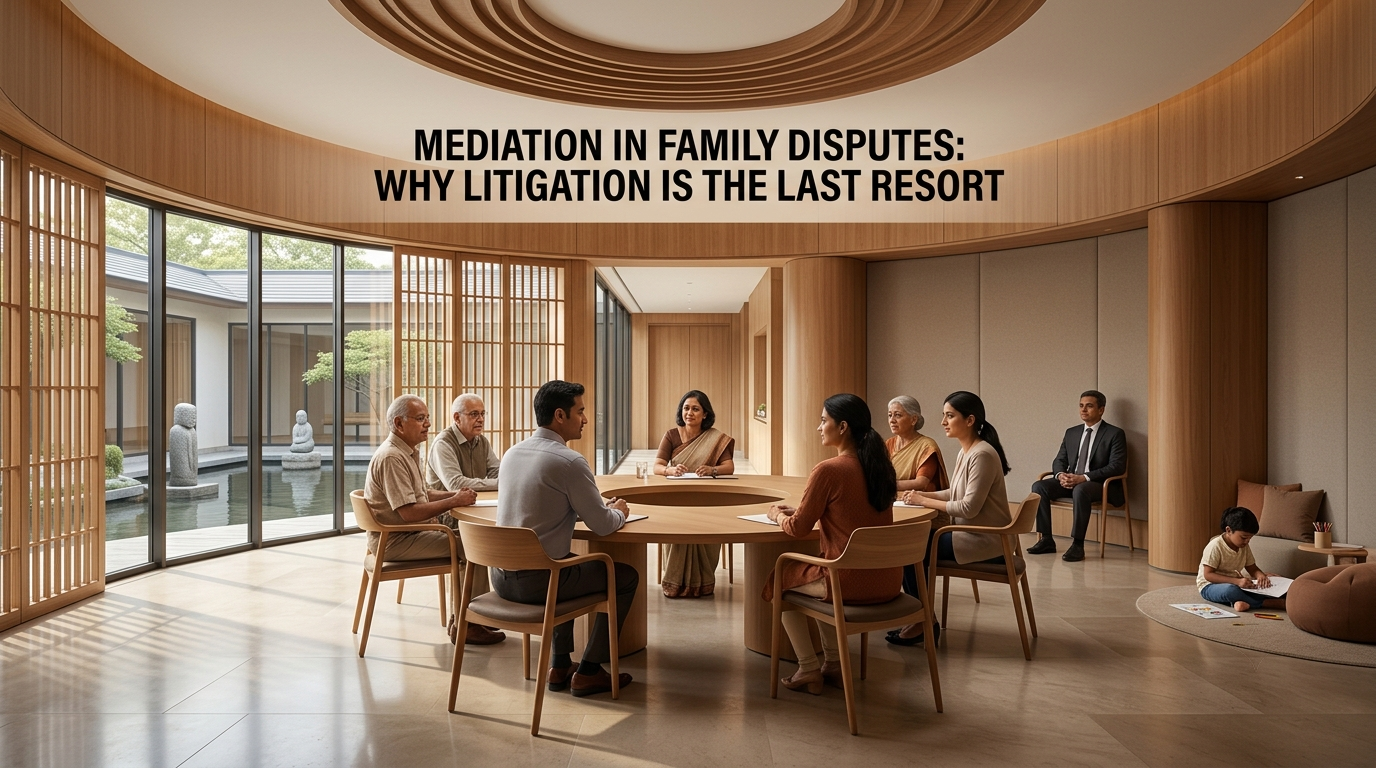
INTRODUCTION
Family disputes are unlike any other category of legal conflict. They are not simply disagreements about rights or money; they are deeply personal, emotionally charged, and often involve relationships that will continue long after the dispute is resolved. When parents disagree about child custody, when spouses negotiate property division, or when families navigate the aftermath of divorce, the legal process chosen to resolve those disputes can be just as consequential as the legal outcome itself.
Mediation has emerged as the most effective, humane, and practical first response to family disputes in India and across the world. Faster than litigation, significantly less expensive, entirely confidential, and far less damaging to the relationships that matter most, particularly where children are involved, mediation represents a fundamental shift in how family conflicts are understood and resolved.
This article examines what family mediation is, why it is increasingly preferred over litigation in family disputes, how the process works, its legal framework in India, its limitations, and when litigation remains the appropriate and necessary choice.
What Are Family Disputes?
The scope of family disputes in Indian law is vast. They encompass a wide range of deeply personal and legally significant matters, including:
Divorce and judicial separation — dissolution or suspension of the marital relationship
Annulment of marriage — declaration that a marriage is void or voidable
Restitution of conjugal rights — court orders requiring a spouse to return to the matrimonial home
Maintenance and alimony — financial support obligations between spouses and for children
Child custody and guardianship — determination of who has day-to-day care and legal responsibility for children
Visitation and access rights — arrangements for the non-custodial parent's contact with children
Legitimacy disputes — legal recognition of children's status
Marital property division — distribution of jointly held or matrimonial assets
Domestic injunctions — court orders protecting parties from harm or interference arising from the marital relationship
What distinguishes family disputes from commercial or civil disputes is their emotional dimension. Family conflicts are rarely single, isolated incidents. A financial dispute may be inseparable from years of emotional neglect. A custody disagreement may be driven by mutual distrust between former partners. A divorce may represent the culmination of decades of accumulated frustration and breakdown in communication.
This emotional complexity is precisely why the choice of dispute resolution process matters so profoundly in family law — and why mediation, which addresses the human dimension of conflict rather than simply its legal dimension, is increasingly recognised as the superior first response.
What Is Family Mediation?
Family mediation is a voluntary, confidential process in which a neutral third party, the mediator, facilitates structured communication between disputing family members, helping them to identify common ground and reach a mutually acceptable agreement.
The mediator does not impose a decision. Unlike a judge, the mediator has no authority to determine outcomes. Instead, the mediator creates a safe, structured environment in which the parties can communicate, often for the first time in a constructive way, and work toward a resolution that both find acceptable.
Definition: Family mediation is a voluntary and confidential process in which a trained, neutral mediator facilitates communication between disputing family members to help them reach an agreement that both parties find acceptable — without the need for court adjudication.
The significance of mediation in the family context is amplified by a simple practical reality: disputing family members may need to continue their relationship long after the dispute is resolved. Parents share responsibility for their children regardless of whether they are married. Families attend the same events, share the same communities, and interact across shared networks. An agreement reached through cooperation and mutual consent rather than imposed by a court is far more likely to be honoured, sustainable, and genuinely workable in practice.
Why Mediation Is Increasingly Preferred in Family Disputes
1. Speed and Efficiency
One of the most compelling practical advantages of mediation over litigation is time. Research consistently demonstrates that mediation resolves family disputes in a matter of weeks or months, while contested court proceedings in India can take several years to reach a final resolution.
For families dealing with urgent matters, child support, temporary custody arrangements, and access to the matrimonial home, this difference in speed is not merely a matter of convenience. It is a matter of genuine practical necessity. Children need stability. Financial arrangements need to be in place. Life cannot be indefinitely paused while court proceedings run their course.
2. Cost Effectiveness
Litigation is expensive. Court fees, lawyer fees across multiple hearings, costs of discovery and evidence, and the cumulative expense of years of proceedings can impose a devastating financial burden on families — often at the very moment when those families are least financially resilient.
Mediation is significantly less expensive. With fewer formal procedural stages, no adversarial evidence process, and a focus on reaching agreement rather than winning arguments, mediation reduces both direct legal costs and the indirect costs of prolonged dispute, including lost time, emotional fatigue, and the impact of ongoing conflict on professional and personal life.
3. Confidentiality and Privacy
Court proceedings in India are generally open to the public. Documents filed in court become part of the public record. In family disputes — which frequently involve intimate personal conduct, financial arrangements, children's welfare, and matters of deep personal sensitivity — this public exposure can cause significant additional harm.
Mediation is entirely confidential. Discussions in mediation are without prejudice — they cannot be used as evidence in subsequent legal proceedings. The agreement reached, if any, is a private document. This confidentiality is particularly important in disputes involving children, financial details, personal conduct, or any matter that the parties have a legitimate interest in keeping private.
4. Preservation of Relationships
Perhaps the most important advantage of mediation in the family context is its capacity to preserve or at least protect the relationships that the parties must maintain after the dispute is resolved.
Litigation is adversarial by design. It requires each party to take a position, marshal evidence to support that position, and seek to defeat the other party's case. This adversarial dynamic entrenches conflict, deepens mistrust, and frequently makes communication between the parties worse, not better, by the time the proceedings conclude.
Mediation operates on a fundamentally different philosophy. Even where parties are angry, hurt, or deeply distrustful of each other, the mediation process teaches them to focus on solving the problem rather than allocating blame. This shift — from looking for culprits to identifying workable solutions — is transformative in family disputes where cooperation will continue to be required.
5. Child-Centred Outcomes
In disputes involving children, the quality of the outcome matters enormously, not just its legal correctness but its practical workability. A custody arrangement that one party accepts under court order but resents profoundly is far less likely to serve the child's interests than an arrangement that both parents have genuinely agreed to and are committed to honouring.
Mediation allows parents to design parenting arrangements that reflect their children's actual needs, the family's specific circumstances, and both parents' practical realities rather than following a generic template imposed by a court. This flexibility, combined with both parents' ownership of the agreed outcome, produces arrangements that work better for children in practice.
The Mediation Process: How It Works
A family mediation process typically proceeds through four stages:
Stage 1: Introduction and Opening Statement
The mediator opens the session by explaining the process, establishing ground rules, confirming confidentiality, and creating a respectful, safe environment. This initial stage is particularly important in family mediation, where emotions are often high, where there may be significant mistrust between the parties, and where one or both parties may fear that the mediator will be biased toward the other side. A skilled mediator establishes their neutrality clearly and firmly at the outset.
Stage 2: Joint Session
Each party is given an uninterrupted opportunity to present their perspective on the dispute. The mediator listens carefully, identifies the key issues in dispute, notes areas of potential agreement, and begins to understand each party's underlying interests — which may be quite different from their stated positions. The joint session builds the mediator's understanding of the full picture while allowing each party to feel heard.
Stage 3: Caucus Sessions
The mediator holds individual, private meetings — called caucuses — with each party separately. These private sessions allow the mediator to explore each party's true priorities, concerns, and flexibility in greater depth than is possible in a joint session. In family disputes where there are strong emotions, a history of poor communication, or where one party feels unable to speak freely in the presence of the other, caucus sessions are particularly valuable. The mediator can reality-test positions, explore creative options for resolution, and build momentum toward agreement in a safe, private setting.
Stage 4: Closure and Agreement
Where the mediation produces a resolution, the parties' agreement is documented in a mediated settlement agreement — a written record of what has been agreed, signed by both parties. Depending on the nature of the agreement and the applicable legal framework, this agreement may be made a rule of court or filed as a consent decree, giving it the legal enforceability of a court order.
Legal Framework Supporting Mediation in India
India's legal framework has progressively expanded its recognition and support for mediation in family disputes across several significant legislative and judicial developments.
Code of Civil Procedure, 1908
Section 89 CPC empowers courts to refer cases to alternative dispute resolution mechanisms — including mediation — where the court considers that there exists an element of settlement that may be acceptable to the parties. This provision reflects Parliament's recognition that courts should actively facilitate out-of-court resolution wherever possible, particularly in disputes that are amenable to consensual settlement.
The Mediation Act, 2023
The Mediation Act, 2023, is a landmark development in India's ADR landscape. It provides a comprehensive statutory framework for mediation in India, covering:
Institutional mediation — conducted through accredited mediation institutions
Pre-litigation mediation — encouraging parties to attempt mediation before initiating court proceedings
Enforceability of mediated settlement agreements — addressing one of the historically most significant limitations of mediation in India by providing that mediated settlement agreements have the same legal effect as court decrees, making them directly enforceable.
The Mediation Act, 2023, represents a significant legislative commitment to mediation as a mainstream dispute resolution mechanism — not merely an optional alternative to be considered if litigation fails.
Hindu Marriage Act, 1955
Section 23(2) of the Hindu Marriage Act, 1955, makes it obligatory for courts to explore the possibility of reconciliation between the parties before awarding a decree of divorce. This statutory requirement reflects a foundational policy principle: that the breakdown of a marriage should not be treated mechanically, and that genuine efforts to restore or settle the relationship must be made before the court exercises its power to dissolve it.
This provision gives judicial expression to the same philosophy that underlies mediation — that consensual, relationship-preserving resolution should always be attempted before adversarial, court-imposed outcomes.
Judicial Support for Mediation in Family Disputes
Indian courts — including the Supreme Court — have consistently and emphatically supported mediation as the preferred first response to family disputes.
K. Srinivas Rao v. D.A. Deepa
The Supreme Court in this case highlighted the significant value of mediation in matrimonial disputes, emphasising that many family conflicts could be resolved far earlier if the parties had meaningful access to mediation. The Court's observation reflects judicial concern about the unnecessary escalation of family disputes into prolonged adversarial litigation — and its recognition that mediation is a more humane and effective response to the true nature of family conflict.
Salem Bar Association v. Union of India
The Supreme Court recognised Section 89 CPC as a major and progressive step toward alternative dispute resolution and faster justice in India. The Court's observations confirmed that ADR mechanisms — including mediation — are not peripheral or supplementary options but a central component of modern civil procedure. Family disputes, which are particularly suited to consensual solutions, are identified as among the most appropriate candidates for mediation referral.
Gaurav Nagpal v. Sumedha Nagpal
The Supreme Court reinforced the principle that divorce should be a last resort and that the law's first objective should be to preserve the marriage wherever possible. This judgment reflects the same philosophy as Section 23(2) of the Hindu Marriage Act — that family disputes require a response that recognises their human dimension, not merely their legal one.
B.S. Krishna Murthy v. B.S. Nagaraj
The Supreme Court encouraged lawyers to actively advise their clients toward mediation in family disputes, recognising that litigation in the family context can be exhausting, destructive, and counterproductive. The Court's comments reflect a growing judicial consensus that legal professionals have a professional and ethical responsibility to ensure their clients are aware of mediation as a viable and often superior alternative.
Collectively, these judicial authorities confirm that Indian courts increasingly regard mediation as the humane, sensible, and judicially preferred first step in family dispute resolution.
Mediation vs. Litigation in Family Disputes: A Comparison
Here is the comparison written in clean paragraph form, ready to paste directly into your article:
When a family dispute arises, one of the most important decisions you will make is not what outcome you want — it is how you choose to pursue it. Mediation and litigation are fundamentally different processes, and understanding the practical differences between them is essential for making an informed choice.
Speed is one of the most striking differences between the two approaches. Mediation typically resolves family disputes within a matter of weeks or months, depending on the complexity of the issues involved. Court litigation, by contrast, can take several years to reach a final resolution in India — a delay that imposes enormous personal, financial, and emotional costs on the families involved, particularly where children's arrangements or financial support are urgently needed.
Cost reflects this difference in timeline directly. Mediation is significantly less expensive than litigation. Without the procedural requirements of court hearings, multiple adjournments, extensive evidence filing, and the cumulative legal fees of years of contested proceedings, mediation reduces both the direct financial burden on families and the indirect costs of prolonged conflict — lost time, emotional exhaustion, and the disruption to professional and personal life that sustained litigation inevitably causes.
Confidentiality is another area where mediation holds a clear advantage in family matters. Court proceedings are generally open to the public, and documents filed in court become part of the public record. Mediation is entirely confidential — discussions are without prejudice and cannot be used as evidence in subsequent proceedings. For disputes involving children's welfare, financial arrangements, personal conduct, or any matter of deep personal sensitivity, this privacy is not merely convenient but genuinely important.
Control over the outcome differs fundamentally between the two processes. In mediation, the parties themselves design and agree upon the resolution — the mediator facilitates but does not impose a decision. In litigation, a judge who does not know the family, its dynamics, or its practical realities determines the outcome, applying the legal framework to the facts as presented. While a court judgment is authoritative and binding, it may produce an outcome that is legally correct but practically unworkable for the family concerned.
Flexibility follows directly from this difference in control. Mediation allows the parties to reach arrangements that are tailored specifically to their family's needs, circumstances, and plans. Litigation operates within a rigid legal framework that limits the range of outcomes available to those the law permits — regardless of whether those outcomes are the most practical or appropriate for the particular family.
Relationship impact may be the most important consideration of all in family disputes, particularly where children are involved. Litigation is adversarial by design — it requires each party to take a position and seek to defeat the other, a dynamic that entrenches conflict, deepens distrust, and frequently leaves the parties less able to communicate after the proceedings than they were before. Mediation operates on a fundamentally different philosophy, creating a structured environment in which even angry or deeply distrustful parties can focus on solving problems rather than assigning blame — preserving the capacity for cooperation that co-parenting and ongoing family relationships require.
Child-centred outcomes are significantly more achievable through mediation than through litigation. Mediation allows parents to design parenting arrangements that reflect their children's genuine needs, the family's specific circumstances, and both parents' practical realities. Court-ordered arrangements, by contrast, tend to follow more generic templates shaped by legal precedent rather than the individual family's situation. An arrangement that both parents have genuinely agreed to and feel ownership over is also far more likely to be honoured in practice — which ultimately serves children's interests far better than an arrangement that one parent accepts under compulsion.
Enforceability is one area where litigation has a traditional advantage, though this gap has narrowed significantly. A court decree is immediately and directly enforceable through the court's contempt and execution jurisdiction. A mediated settlement agreement, once formalised and filed as a consent decree — or made binding under the Mediation Act, 2023 — is also legally enforceable. Parties should ensure that any mediated agreement is properly documented and formalised to secure its enforceability.
Emotional impact is a dimension of family disputes that litigation consistently underestimates. Litigation tends to escalate conflict, increase hostility, and make communication between the parties progressively worse as proceedings continue. For families with children, this emotional escalation transfers directly onto the parenting relationship and can affect the sense of security and stability that children need. Mediation, by creating a respectful and solution-focused environment, minimises this emotional damage — even where the parties remain deeply in conflict, it teaches them to focus on resolution rather than recrimination.
Suitability ultimately determines which process is appropriate for any given dispute. Mediation is most effective in disputes involving child custody, maintenance, property division, visitation arrangements, and divorce by mutual consent — matters where the parties must continue to cooperate and where a consensual, flexible outcome serves everyone's interests. Litigation remains the necessary and appropriate response where there is domestic violence, coercive control, significant power imbalance, bad faith participation, or complex financial fraud — circumstances where the court's coercive powers and procedural protections are essential to produce a fair and safe outcome.
The choice between mediation and litigation is therefore not simply a tactical legal decision. It is a decision about what kind of resolution you want, what kind of relationship you need to maintain after the dispute is resolved, and what serves the genuine long-term interests of everyone involved — especially the children.
When Mediation Is Most Effective
Mediation is particularly well-suited to family disputes involving:
Child custody and visitation arrangements — where the parties must continue to cooperate as co-parents and where arrangements need to be flexible and genuinely workable
Maintenance and financial support — where the amounts and arrangements can be negotiated to reflect both parties' actual circumstances
Property division — where the parties can reach a mutually acceptable distribution without the expense of contested valuation proceedings
Divorce by mutual consent — where both parties agree on the breakdown of the marriage but need assistance in formalising the terms
Extended family disputes — where relationships within the wider family need to be preserved alongside the resolution of the immediate conflict
The Limits of Mediation: When It Is Not Appropriate
Mediation is not a universal solution. There are circumstances in which it is not appropriate and in which litigation remains the necessary and correct response.
Domestic Violence and Coercive Control
Where one party has been subject to domestic violence, abuse, or coercive control, voluntary mediation is fundamentally compromised. The power imbalance created by abuse means that the abused party cannot negotiate freely or safely — even in a mediation setting. In these circumstances, mediation should not be used, and the court's coercive powers of protection and enforcement are essential.
Significant Power Imbalance
Even without outright abuse, significant power imbalances between the parties — financial, educational, psychological, or social — can undermine the fairness of a mediated outcome. Where one party is significantly more sophisticated, resourceful, or assertive than the other, a mediated agreement may not truly reflect a voluntary and fair resolution.
Bad Faith Participation
Mediation depends on both parties' good faith engagement. Where one party uses mediation as a tactical device — to delay proceedings, gather information, or pressure the other party into concessions — the process is compromised. Experienced mediators and appropriate judicial oversight are essential safeguards against bad faith participation.
Complex Financial Disputes and Fraud
Where financial matters are highly complex, involve allegations of fraud or concealment of assets, or require forensic financial investigation, the structured procedural protections of litigation, including discovery, evidence rules, and judicial oversight, may be necessary to produce a fair and accurate outcome.
Enforceability Requirements
Where one party is unlikely to honour a voluntary agreement — and where the coercive enforcement power of a court order is necessary from the outset litigation provides protections that mediation alone cannot guarantee.
Why Litigation Still Has an Important Role
It is important to be clear: litigation is not obsolete in family law. There are circumstances in which it is not merely appropriate but essential.
Litigation provides:
Authoritative legal determination of rights — necessary where rights need to be declared definitively and enforceably
Procedural protections — including rules of evidence, judicial oversight, and the right of appeal — that protect vulnerable parties in ways that mediation cannot guarantee
Coercive enforcement powers — court orders are enforceable through the court's contempt jurisdiction in ways that mediated agreements, absent formalisation, may not be
Protection for vulnerable individuals — particularly victims of domestic violence, financial abuse, or coercive control who cannot negotiate safely in a mediation setting
The point is not that litigation should be abandoned — it is that litigation should be the last resort, deployed when mediation and other consensual processes have failed or are inappropriate, rather than the default first response to every family dispute.
Conclusion
Mediation has earned its place as the cornerstone of modern family dispute resolution — not as a fashionable trend but as a genuinely superior response to the true nature of family conflicts, which are emotional, continuous, and intensely personal.
Faster, less expensive, confidential, and relationship-preserving family mediation produces outcomes that are more likely to be honoured, more likely to serve the genuine interests of children, and more likely to allow families to move forward constructively compared to the adversarial, time-consuming, and emotionally exhausting process of litigation.
India's legislative framework — through Section 89 CPC, the Mediation Act, 2023, and Section 23(2) of the Hindu Marriage Act — and the consistent support of the Supreme Court confirm that mediation is not merely an option but an increasingly central feature of how India's legal system approaches family conflict.
Litigation retains an essential role for cases involving domestic violence, coercion, complex financial fraud, or where an authoritative court determination is genuinely necessary. But for the vast majority of family disputes — custody, maintenance, property division, and divorce by consent mediation should always be the first resort, not the last.
In family law, the process chosen to resolve a dispute shapes not only its legal outcome but also the lives, relationships, and emotional wellbeing of everyone involved — especially children. Choosing mediation first is not merely a legal strategy. It is a profoundly human one.
Need help with a family dispute?
[Internal Link: Contact Our Family Law Mediation Team]
[Internal Link: Family Law Legal Services — How We Can Help]
KEY TAKEAWAYS
Family mediation is a voluntary, confidential process in which a neutral mediator helps disputing family members reach a mutually acceptable agreement — without a judge imposing an outcome.
Mediation is faster (weeks to months vs. years), less expensive, fully confidential, and far less damaging to family relationships than contested court litigation.
Section 89 of the CPC empowers courts to refer family disputes to mediation, and the Mediation Act, 2023, provides a comprehensive statutory framework making mediated settlements directly enforceable.
Section 23(2) of the Hindu Marriage Act, 1955, requires courts to explore reconciliation before granting divorce, reflecting the same philosophy as mediation: that consensual resolution should always precede court-imposed outcomes.
The Supreme Court has consistently supported mediation in family matters in cases including K. Srinivas Rao v. D.A. Deepa, Salem Bar Association v. Union of India, and Gaurav Nagpal v. Sumedha Nagpal.
Mediation is particularly effective in disputes involving child custody, maintenance, property division, and visitation — matters where the parties must continue to cooperate after the dispute is resolved.
Mediation is not appropriate in cases involving domestic violence, coercive control, significant power imbalance, or bad-faith participation — in these circumstances, litigation provides essential protections.
Agreements reached through mediation that reflect both parties' genuine consent are more likely to be honoured and more likely to serve children's interests than court-imposed orders.
Litigation remains essential for declaring rights, protecting vulnerable individuals, and providing coercive enforcement — but should be the last resort, not the default first response.
The growing role of mediation in Indian family law reflects a fundamental shift in philosophy — from determining winners and losers to achieving outcomes that respect dignity, minimise harm, and encourage cooperation.
FREQUENTLY ASKED QUESTIONS
1. What is family mediation and how does it work?
Family mediation is a voluntary, confidential process in which a trained neutral mediator facilitates structured communication between disputing family members to help them reach a mutually acceptable agreement. The mediator does not impose a decision — the parties themselves control the outcome. The process typically involves joint sessions, private caucus meetings, and closure with a written settlement agreement if an agreement is reached.
2. Is mediation legally recognised in India for family disputes?
Yes. Mediation is legally recognised and actively encouraged under Section 89 of the Code of Civil Procedure, 1908, which empowers courts to refer family disputes to mediation. The Mediation Act, 2023 provides a comprehensive statutory framework for mediation in India, including provisions making mediated settlement agreements directly enforceable as court decrees.
3. What types of family disputes can be resolved through mediation?
Mediation is suitable for a wide range of family disputes, including divorce by mutual consent, child custody and visitation arrangements, maintenance and alimony negotiations, marital property division, and extended family property disputes. It is particularly effective where the parties must continue to cooperate after the dispute — especially in matters involving children.
4. Is a mediated settlement agreement legally binding in India?
Yes. Under the Mediation Act, 2023, a mediated settlement agreement signed by the parties and authenticated by the mediator is legally binding and directly enforceable. It can also be filed as a consent decree in court, giving it the full enforceability of a court order.
5. When is mediation not appropriate in a family dispute?
Mediation is not appropriate where there is domestic violence, abuse, or coercive control; where there is a significant power imbalance that prevents one party from negotiating freely; where one party is participating in bad faith; or where complex financial fraud or concealment requires the formal procedural protections of court proceedings. In these circumstances, litigation provides essential protections that mediation cannot guarantee.
6. How long does family mediation typically take in India?
The duration of family mediation varies depending on the complexity of the dispute and the number of issues to be resolved. Many family mediations are concluded within a few weeks to a few months — significantly faster than the years that contested court proceedings typically require.
7. Is family mediation confidential in India?
Yes. Mediation proceedings are confidential under the Mediation Act, 2023 and general mediation principles. Discussions in mediation are without prejudice — they cannot be used as evidence in subsequent court proceedings. This confidentiality is particularly valuable in family disputes involving children, financial matters, personal conduct, or other sensitive issues.
8. What is the role of the mediator in family mediation?
The mediator is a trained, neutral third party who facilitates communication between the disputing parties. The mediator does not take sides, does not impose a decision, and does not provide legal advice. The mediator's role is to create a structured, respectful environment in which the parties can communicate effectively and work toward a resolution they both find acceptable.
9. Can courts in India refer family disputes to mediation?
Yes. Under Section 89 of the Code of Civil Procedure, 1908, courts have the power to refer disputes — including family disputes — to mediation where the court considers that there is potential for settlement. Courts actively exercise this power in matrimonial and family matters, and the Supreme Court has repeatedly affirmed mediation as a central and preferred feature of modern family dispute resolution.
10. What did the Supreme Court say about mediation in K. Srinivas Rao v. D.A. Deepa?
In K. Srinivas Rao v. D.A. Deepa, the Supreme Court highlighted the significant value of mediation in matrimonial disputes, observing that many family conflicts could be resolved far earlier if the parties had meaningful access to mediation. The judgment reflects the Court's concern about unnecessary escalation of family disputes into prolonged adversarial litigation and its recognition of mediation as a more humane and effective alternative.
11. Does Section 23(2) of the Hindu Marriage Act require courts to attempt reconciliation?
Yes. Section 23(2) of the Hindu Marriage Act, 1955, makes it obligatory for courts to explore the possibility of reconciliation between the parties before granting a decree of divorce. This statutory requirement reflects the same philosophy as mediation — that consensual, relationship-preserving resolution should always be attempted before the court exercises its power to dissolve the marriage.
12. What is the difference between mediation and litigation in family disputes?
Mediation is voluntary, confidential, collaborative, and party-controlled — the parties reach their own agreement with the mediator's assistance. Litigation is adversarial, public, judge-controlled, and results in a binding court order. Mediation is faster, less expensive, and less damaging to family relationships. Litigation provides authoritative legal determinations, procedural protections, and coercive enforcement powers necessary in cases where mediation is not appropriate.
13. Can child custody disputes be resolved through mediation?
Yes. Child custody and visitation disputes are among the matters most commonly and most effectively resolved through mediation. Mediation allows parents to design parenting arrangements tailored to their children's actual needs and the family's specific circumstances rather than following a generic court-imposed template. Agreements reached by consent are also more likely to be honoured by both parents in practice.
14. What is the Mediation Act, 2023, and what does it provide for family mediation?
The Mediation Act, 2023, is India's comprehensive statutory framework for mediation. It encourages institutional mediation, provides for pre-litigation mediation before initiating court proceedings, and — most significantly — provides that mediated settlement agreements are legally binding and directly enforceable, addressing a historically significant limitation of mediation in India.
15. Is it advisable to have a lawyer during family mediation?
Having a lawyer advise you during the mediation process is generally recommended, particularly in complex family disputes involving significant financial assets, child custody arrangements, or where the legal implications of proposed agreements are unclear. A lawyer can review the mediated settlement agreement before you sign it to ensure it accurately reflects what has been agreed and protects your legal interests — while the mediation itself remains focused on communication and consensual resolution.