
MUTUAL CONSENT DIVORCE IN INDIA 2026: DIGITAL HEARINGS & FASTER PROCESS
Learn how mutual consent divorce works in India in 2026 — digital hearings, online mediation, cooling-off period waiver, and step-by-step process under Section 13B HMA.
FAMILY LAWSERVICES
Ishika
7/18/202614 min read

INTRODUCTION
Divorce in India is no longer what it once was. For decades, couples seeking to dissolve their marriage — even by mutual agreement — faced a process defined by repeated court appearances, procedural delays, and a system that felt designed for conflict rather than cooperation. In 2026, that experience has changed fundamentally.
Mutual consent divorce – always the most humane and legally efficient pathway for couples who agree that their marriage has irretrievably broken down – has been transformed by the adoption of digital hearings, electronic filing systems, online mediation, and technology-driven judicial reforms. For couples who have made a considered, joint decision to separate, the legal system now offers a process that is faster, more accessible, less expensive, and far less disruptive to their lives than the traditional courtroom-centric model.
This guide explains everything you need to know about mutual consent divorce in India in 2026: what it is, the legal framework governing it, the essential conditions that must be met, how digital hearings and online mediation have transformed the process, and what couples can expect at every stage.
What Is a Mutual Consent Divorce?
Mutual consent divorce is a legal process through which a married couple jointly decides to dissolve their marriage after concluding that they can no longer live together as husband and wife. Unlike a contested divorce in which one spouse initiates proceedings against the other on specific legal grounds, a mutual consent divorce is a collaborative process in which both spouses agree on the dissolution of the marriage and on the terms of their separation. The mutual consent divorce framework exists across India's principal personal law statutes, reflecting its recognition as the most appropriate and least harmful mechanism for ending a marriage where both parties are in agreement.
Definition: Mutual consent divorce is a legal proceeding in which both spouses jointly petition the competent court for dissolution of their marriage, affirming that they have lived separately for the required period, cannot live together, and mutually agree that the marriage should be dissolved along with agreed terms for settlement, maintenance, child custody, and property division.
Legal Framework Governing Mutual Consent Divorce in India
Mutual consent divorce is governed by different personal law statutes applicable to different communities and religious groups in India:
Section 13B — Hindu Marriage Act, 1955
Section 13B of the Hindu Marriage Act, 1955, is the primary provision governing mutual consent divorce for Hindu couples. It permits a husband and wife to jointly petition the District Court or Family Court for dissolution of their marriage by mutual consent, subject to the fulfilment of prescribed conditions.
Section 28 — Special Marriage Act, 1954
Section 28 of the Special Marriage Act, 1954 provides the equivalent framework for couples married under the SMA — irrespective of their religion. Both spouses must jointly petition the District Court, affirming that they have lived apart for at least one year, cannot live together, and have mutually agreed to dissolve their marriage.
Essential Conditions for Mutual Consent Divorce
For a mutual consent divorce to be granted under Section 13B of the Hindu Marriage Act, 1955 (and the equivalent provisions under other personal laws), several essential conditions must be satisfied.
1. Mandatory Separation Period
The spouses must have been living separately for a minimum period of one year immediately before the presentation of the joint petition. This is a mandatory threshold condition — it cannot be waived by either the parties or the court.
It is important to note that "living separately" does not necessarily require the spouses to be residing in different houses. Courts have recognised that spouses may be living separately even under the same roof if they are no longer cohabiting as husband and wife — meaning they are not sharing a bedroom, not engaging in marital relations, and not functioning as a married couple in the conventional sense.
2. Joint Petition and Agreement
Both the husband and the wife must jointly file the petition for a mutual-consent divorce. This is a fundamental requirement — a unilateral application by one spouse, however well-intentioned, does not constitute a mutual consent divorce petition. The joint petition must include:
A statement confirming the period of separation
Confirmation that both parties cannot live together
Confirmation of mutual agreement to dissolve the marriage
Agreed terms of settlement — including maintenance and alimony arrangements, child custody and visitation arrangements, and property division
3. Mutual and Free Consent
The cornerstone of mutual consent divorce is the free, voluntary, and continuing consent of both spouses. The decision to dissolve the marriage must arise from the independent and genuine choice of each party — it must not be the product of fraud, coercion, undue influence, intimidation, or misrepresentation.
Critically, consent must not only exist at the time of filing the joint petition; it must ordinarily continue until the decree of divorce is granted. Either party retains the right to withdraw their consent at any point before the final decree is passed. If the court finds that consent has been obtained improperly or that either spouse has been compelled to agree, it may refuse to grant the decree.
This is a safeguard of fundamental importance, particularly in the context of digital proceedings — courts must satisfy themselves that consent expressed through video conferencing or online platforms is as genuine and voluntary as consent expressed in person.
4. First Motion
The first motion is the initial filing of the joint petition before the Family Court or District Court. At the first motion hearing, both parties appear before the court (physically or, where permitted, virtually), confirm their identities, affirm their consent, and confirm the terms of the settlement. The court records the statements of both parties, and the first motion is formally admitted.
5. Cooling-Off Period
Following the first motion, the law provides for a cooling-off period during which the parties are given time to reconsider their decision before the divorce is finalised.
Under Section 13B(2) of the Hindu Marriage Act, 1955, the parties were traditionally required to observe a six-month cooling-off period between the first motion and the filing of the second motion for the final decree. The purpose of this period is to provide spouses with a genuine opportunity to reconsider their decision and, where possible, preserve the institution of marriage.
In the landmark judgement of Amardeep Singh v. Harveen Kaur (2017), the Supreme Court held that the six-month cooling-off period under Section 13B(2) is directory rather than mandatory — meaning courts have the discretion to waive it in appropriate cases where the following are true:
The statutory minimum separation period of one year has already been completed.
All efforts at mediation and reconciliation have been made and have failed.
There is no possibility of the parties resuming cohabitation.
Waiting a further six months would serve no practical purpose and would cause unnecessary hardship.
This ruling has significantly reduced the minimum timeline for completing mutual consent divorce proceedings in cases where the court exercises its discretion to waive the cooling-off period.
6. Second Motion and Final Decree
The second motion is filed after the expiry of the cooling-off period (or upon waiver of the same by the court). At the second motion hearing, both parties again confirm their consent to the dissolution of the marriage. If the court is satisfied that all conditions are met and that consent is genuine and continuing, it pronounces the decree of divorce by mutual consent — formally dissolving the marriage.
How Digital Hearings Have Transformed Mutual Consent Divorce in 2026
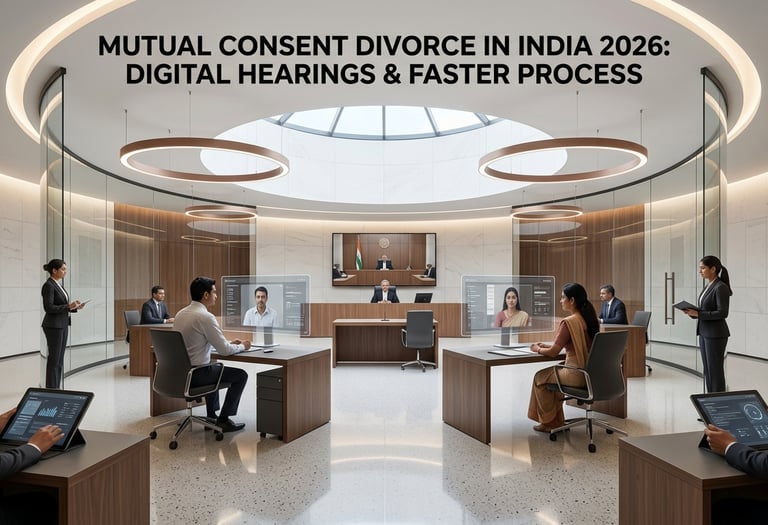
The adoption of digital hearings and virtual court infrastructure represents one of the most significant developments in India's family law system in recent years. In 2026, technology has fundamentally changed the experience of mutual-consent divorce proceedings — making them faster, more accessible, and far less burdensome for couples navigating an already difficult life transition.
Virtual and Hybrid Court Proceedings
Family courts across India have increasingly adopted secure video conferencing platforms for conducting mutual consent divorce hearings. In 2026, hybrid court systems combining in-person attendance for certain critical stages with virtual participation for others will become a standard feature of the family court landscape.
This development is particularly significant for:
Couples residing in different cities or states — who previously faced the logistical challenge of both appearing physically in the same court on multiple dates
Non-Resident Indians (NRIs) — who can now participate in proceedings without travelling to India for each hearing
Individuals with health concerns or disabilities — for whom repeated court visits imposed a disproportionate burden.
Senior citizens — for whom the physical demands of courthouse attendance may be significant
Working professionals — whose work commitments make frequent daytime court appearances difficult
E-Filing and Electronic Document Management
The e-filing of court documents has streamlined the administrative process of mutual consent divorce significantly. Couples can now prepare and submit petitions, affidavits, settlement agreements, identity documents, and supporting records electronically through designated court portals — without the need to physically attend the court registry.
This electronic document management system has reduced:
The time spent on procedural administrative steps
The cost and inconvenience of producing multiple physical copies of documents
The risk of documents being misplaced or delayed in the physical court filing process
The need for repeated visits to court offices for procedural matters that can be handled digitally
Online Mediation
Online mediation has emerged as a powerful complement to digital court proceedings in mutual consent divorce cases. Couples who require assistance in reaching agreement on contested aspects of their settlement — maintenance amounts, child custody arrangements, property division, or other ancillary matters — can now access mediation services remotely through secure online platforms.
Online mediation provides:
Flexibility — sessions can be scheduled at times that suit both parties, reducing conflict over scheduling.
Accessibility — parties in different locations can participate without travel
Confidentiality — the same without-prejudice protections apply to online mediation as to in-person mediation
Efficiency — many online mediation processes resolve outstanding issues more quickly than traditional in-person mediation, as the absence of physical courtroom formality can reduce tension.
Several countries — including Singapore, the Netherlands, and various EU member states — have led the development of digital divorce and online mediation frameworks. India's judiciary has drawn on these international models in developing its own digital infrastructure for family proceedings.
Digital Consent Verification
One of the most legally significant challenges introduced by digital proceedings is the need to ensure that consent expressed virtually is as genuine and voluntary as consent expressed in person. Courts have developed protocols for verifying identity, confirming the voluntariness of consent, and satisfying themselves that neither party is under duress even where appearances are conducted remotely.
Courts retain the discretion to require physical attendance where the circumstances of a case demand closer judicial scrutiny — for example, where there are concerns about the genuineness of consent, where one party appears distressed, or where the terms of the settlement require detailed judicial examination. The digital framework supplements but does not replace judicial oversight.
The Mutual Consent Divorce Process in 2026: Step by Step
Step 1: Consultation and Agreement
Both spouses consult with their respective lawyers and reach an agreement on all key terms of the separation, including maintenance and alimony, child custody and visitation arrangements, and property division. A comprehensive settlement agreement is drafted and reviewed by both parties' legal advisors.
Step 2: Filing the Joint Petition (First Motion)
The joint petition — including the settlement agreement and all required supporting documents — is filed electronically through the court's e-filing portal, where available, or physically at the Family Court registry.
Step 3: First Motion Hearing
Both parties appear before the Family Court — in person or virtually, where the court permits — to confirm their identities and affirm their consent to the dissolution of the marriage on the agreed terms. The court records their statements and formally admits the petition.
Step 4: Cooling-Off Period or Waiver Application
The six-month cooling-off period begins. Where both parties wish to proceed more quickly and meet the criteria established in Amardeep Singh v. Harveen Kaur (2017), an application may be filed seeking waiver of the cooling-off period.
Step 5: Mediation (Where Required)
Where any outstanding issues remain unresolved, the court may refer the parties to mediation — conducted in person or online to resolve those issues before the second motion.
Step 6: Second Motion Hearing
After the cooling-off period expires (or is waived), both parties again appear before the court to confirm their continuing consent. The court satisfies itself that all conditions are met.
Step 7: Decree of Divorce
The Family Court pronounces the decree of mutual consent divorce, formally and legally dissolving the marriage. The decree is issued, and both parties receive certified copies.
Safeguards and Judicial Oversight in Digital Proceedings
The expansion of digital hearings in mutual consent divorce proceedings has been accompanied by important judicial safeguards designed to ensure that the technology enhances rather than undermines the fairness and integrity of the process.
Before granting a decree of mutual consent divorce, the family court must satisfy itself that:
Both spouses have voluntarily and genuinely consented to the dissolution of their marriage.
The settlement agreement is genuine, lawful, and fair.
There has been no coercion, fraud, or undue influence on either party.
All essential conditions — including the separation period and the cooling-off period (unless waived) — have been duly satisfied.
Courts retain full discretion to require physical attendance at any stage of proceedings where the circumstances demand it — ensuring that digital convenience never compromises judicial accountability.
Benefits of the Modern Mutual Consent Divorce Framework
The combination of mutual consent divorce provisions, digital hearings, e-filing, and online mediation has produced a framework that offers significant practical benefits for couples navigating separation in 2026:
Reduced time — the overall timeline from first motion to final decree has been shortened considerably, particularly where the cooling-off period is waived
Lower costs — reduced travel, fewer physical court appearances, and electronic document management all reduce the direct and indirect costs of proceedings.
Greater accessibility — couples separated by geography, health constraints, or work commitments can participate fully in proceedings without the disproportionate burden of repeated physical court attendance.
Less emotional disruption — a more streamlined, less adversarial process reduces the emotional toll on both parties and on any children involved
Maintained judicial oversight — digital proceedings have not reduced judicial scrutiny of consent and settlement terms; courts continue to apply the same standards of fairness and voluntariness.
Conclusion
Mutual consent divorce in India in 2026 reflects a legal system that has responded thoughtfully and effectively to both the changing needs of families and the opportunities offered by technology. The combination of a well-established legal framework anchored in Section 13B of the Hindu Marriage Act, 1955, and equivalent provisions across personal laws with digital hearings, e-filing systems, and online mediation has produced a process that is more accessible, more efficient, and more humane than at any previous point in India's legal history.
The Supreme Court's recognition in Amardeep Singh v. Harveen Kaur (2017) that the cooling-off period is directory rather than mandatory has further reduced unnecessary delay for couples who have genuinely and carefully made their decision.
For couples who have reached a mutual, considered, and informed decision that their marriage has irretrievably broken down, the law now provides a pathway to legal dissolution that respects their dignity, protects their rights, and minimises unnecessary hardship — while maintaining the judicial oversight that ensures fairness and voluntariness at every stage.
Divorce remains a deeply personal and significant decision. But in 2026, the legal process of mutual consent divorce no longer needs to make a difficult decision harder than it already is.
KEY TAKEAWAYS
Mutual consent divorce allows both spouses to jointly dissolve their marriage by agreement — without the need for contested court proceedings establishing fault or specific grounds.
It is governed by Section 13B of the Hindu Marriage Act, 1955, Section 28 of the Special Marriage Act, 1954, Section 10A of the Divorce Act, 1869, and the Parsi Marriage and Divorce Act, 1936.
Essential conditions include: one year of separation, a joint petition, free and voluntary consent of both parties, a first motion hearing, a cooling-off period, and a second motion hearing before the final decree.
The Supreme Court in Amardeep Singh v. Harveen Kaur (2017) held that the six-month cooling-off period is directory rather than mandatory; courts may waive it in appropriate cases.
Digital hearings in 2026 allow couples to participate in proceedings via secure video conferencing, significantly reducing the burden of repeated physical court appearances.
E-filing systems enable electronic submission of petitions, affidavits, settlement agreements, and supporting documents through designated court portals.
Online mediation helps couples resolve outstanding issues — maintenance, custody, and property division — remotely and efficiently before the second motion hearing.
Courts retain full discretion to require physical attendance where circumstances demand closer judicial scrutiny of consent or settlement terms.
Digital proceedings are particularly beneficial for NRIs, couples in different cities, individuals with health concerns, and professionals with demanding work schedules.
Despite technological advancement, judicial oversight of consent and settlement fairness remains unchanged — courts must be fully satisfied that consent is genuine, voluntary, and free from coercion before granting any decree.
FREQUENTLY ASKED QUESTIONS
1. What is a mutual consent divorce in India?
Mutual consent divorce is a legal process under which both spouses jointly petition the competent court to dissolve their marriage, confirming that they have lived separately for at least one year, cannot live together, and mutually agree to end the marriage. It is governed by Section 13B of the Hindu Marriage Act, 1955 and equivalent provisions in other personal law statutes.
2. What are the essential conditions for a mutual consent divorce under the Hindu Marriage Act?
The essential conditions are: both spouses must have lived separately for at least one year; both must mutually and freely agree to dissolve the marriage; a joint petition must be filed; a first motion hearing must be conducted; a six-month cooling-off period must be observed (unless waived by the court); and a second motion must be filed confirming continuing consent before the final decree is granted.
3. Can the six-month cooling-off period be waived in a mutual consent divorce?
Yes. The Supreme Court in Amardeep Singh v. Harveen Kaur (2017) held that the six-month cooling-off period under Section 13B(2) of the Hindu Marriage Act is directory rather than mandatory. Courts have discretion to waive it where the parties have already completed the one-year separation period, all reconciliation efforts have been exhausted, and waiting further would serve no purpose and cause unnecessary hardship.
4. Can mutual consent divorce proceedings be conducted online in India in 2026?
Yes. Family Courts across India have increasingly adopted digital hearing platforms, allowing parties, their lawyers, and mediators to participate in proceedings via secure video conferencing. E-filing systems also allow electronic submission of all required documents. However, courts retain discretion to require physical attendance where the circumstances of the case demand it.
5. What documents are required for a mutual consent divorce petition?
Typically required documents include: the joint petition signed by both parties; identity proof of both spouses; proof of marriage (marriage certificate); proof of separation; the settlement agreement covering maintenance, child custody, and property division; address proof; and passport-sized photographs. Requirements may vary by court — a lawyer can confirm the specific requirements applicable to your case.
6. What is the first motion in a mutual consent divorce?
The first motion is the initial hearing at which both spouses appear before the Family Court, confirm their identities and consent, and have their statements recorded by the court. The joint petition is formally admitted at this stage, and the six-month cooling-off period begins.
7. What is the second motion in a mutual consent divorce?
The second motion is the final hearing at which both spouses again appear before the court — after the cooling-off period has expired or been waived — to confirm their continuing consent to the dissolution. If the court is satisfied that all conditions are met, it pronounces the decree of divorce by mutual consent.
8. Can either party withdraw consent before the divorce is finalised?
Yes. Either party retains the right to withdraw their consent to the mutual consent divorce at any point before the final decree is passed. If consent is withdrawn, the joint petition cannot proceed, and the court will not grant a mutual consent divorce on that petition.
9. What is the minimum time for completing a mutual consent divorce in India?
The minimum statutory period is one year of separation before filing, plus six months between the first and second motions — making the theoretical minimum approximately 18 months from the date of separation. Where the court waives the six-month cooling-off period under the Amardeep Singh judgment, the minimum period from filing to decree can be significantly shorter.
10. How has online mediation helped couples in mutual consent divorce proceedings?
Online mediation allows couples to resolve outstanding issues — such as maintenance amounts, child custody arrangements, and property division — remotely and efficiently through secure online platforms. It reduces the need for multiple in-person meetings, makes the process accessible to couples in different locations, and often produces faster resolutions than traditional in-person mediation.
11. Does digital mutual consent divorce apply to NRIs?
Yes. The adoption of digital hearings and e-filing has been particularly beneficial for Non-Resident Indians who wish to file for mutual consent divorce in India without making multiple trips to India for each hearing. Courts may permit NRI parties to appear via video conferencing for some or all stages of the proceedings, subject to applicable court rules and judicial discretion.
12. What is the difference between a mutual consent divorce and a contested divorce?
In a mutual consent divorce, both spouses agree to dissolve the marriage and file a joint petition — there is no fault allegation and no adversarial proceeding. In a contested divorce, one spouse files a petition against the other on specific legal grounds (such as cruelty, adultery, or desertion), and the other spouse may contest the petition. Mutual consent divorce is significantly faster, less expensive, and less emotionally damaging than contested divorce.
13. Can child custody be settled as part of a mutual consent divorce?
Yes. The settlement agreement filed as part of a mutual consent divorce petition should include agreed arrangements for child custody, visitation rights, and child maintenance. The court will review these arrangements to ensure they are in the best interests of the child before granting the decree.
14. Is a mutual consent divorce decree valid throughout India?
Yes. A decree of mutual consent divorce granted by a competent Family Court or District Court in India is valid throughout the country and is recognised as a legal dissolution of the marriage for all purposes under Indian law.
15. What happens if one spouse is not available for the court hearing due to illness or work commitments?
In 2026, digital hearing infrastructure will allow parties to appear before the court via secure video conferencing where the court permits. This significantly reduces the impact of geographical distance, health constraints, or work commitments on the ability to participate in proceedings. In cases of genuine hardship, courts may also grant adjournments — though digital hearings have substantially reduced the frequency with which adjournments are required for logistical reasons.