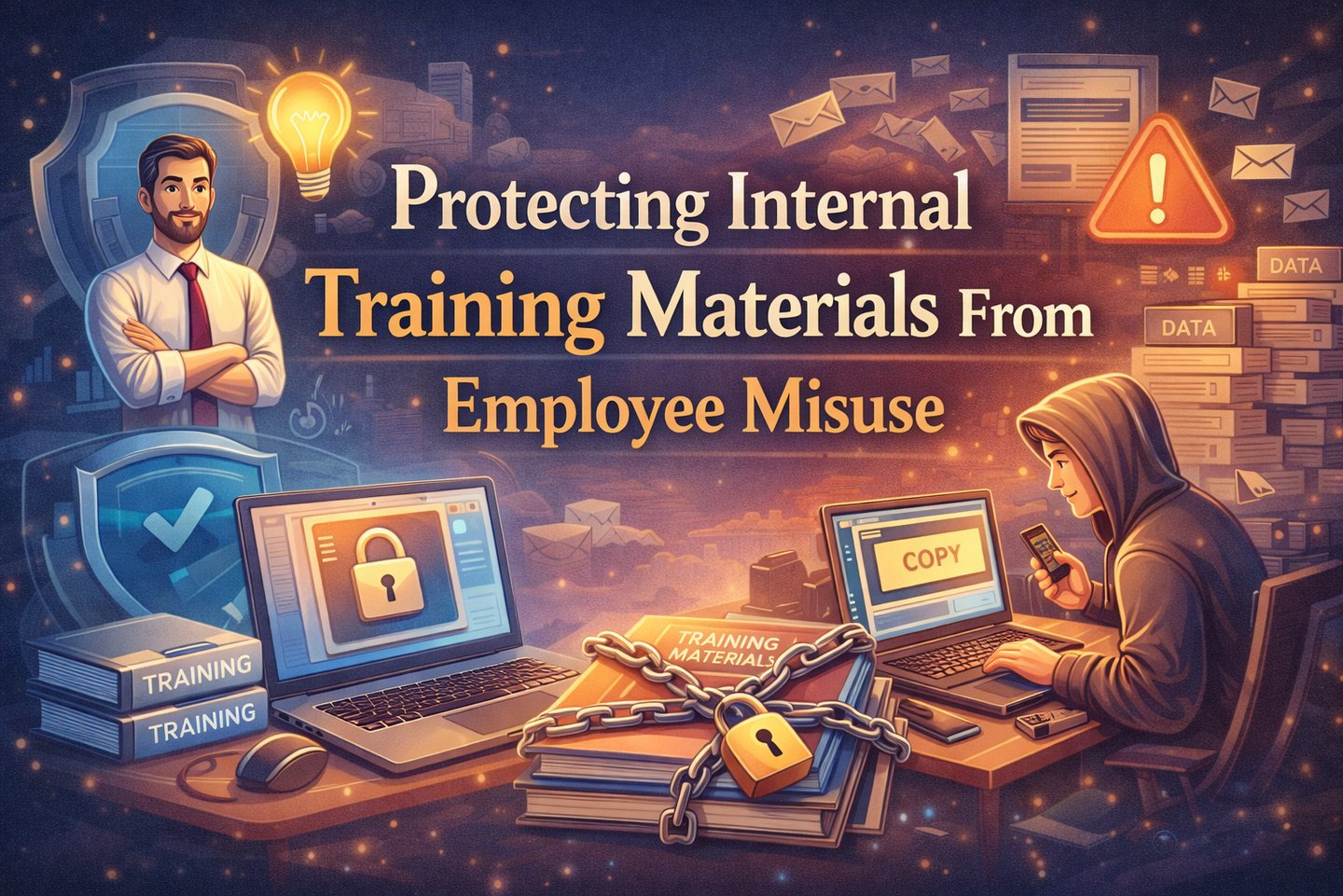
Protecting Internal Training Materials From Employee Misuse
Organizations must secure internal training content against unauthorized sharing, modification, and commercial exploitation by employees through governance, technology controls, awareness programs, and enforceable policies.
IPRCORPORATE LAWS
Nirmit
2/27/20263 min read
Introduction
In modern organizations, internal training materials are far more than educational tools. They contain proprietary knowledge, operational processes, compliance frameworks, and strategic insights that form valuable intellectual assets. Delivered through learning management systems, manuals, webinars, and digital knowledge bases, these resources play a critical role in organizational growth. Yet many companies underestimate a growing risk: misuse of training content by employees.
Such misuse is often unintentional. Employees may share slides with former colleagues, upload recorded sessions for portfolio purposes, or reuse internal diagrams in external projects. With remote work, cloud storage, and AI-enabled extraction tools, copying and distributing content has become effortless. What once required physical duplication now takes only seconds.
The consequences can be serious. Training materials may reveal workflows, pricing logic, vendor details, or regulatory procedures. Unauthorized disclosure can erode competitive advantage, create compliance risks, and weaken intellectual property claims. Despite this, training content is frequently treated less rigorously than source code or product designs, leaving ownership boundaries unclear. Digital learning platforms further increase exposure by enabling downloads, screen recordings, and multi-device access. Without clear governance, contractual protection, technical safeguards, and employee awareness, organizations remain vulnerable. Protecting training materials therefore requires a balanced approach—combining policy clarity, cultural reinforcement, role-based access controls, and proportionate monitoring—to ensure knowledge remains accessible internally while protected externally.
Governance and Classification Policies
Organizations must begin protection efforts by formally classifying training materials as corporate intellectual property. Each document, video, slide deck, or recorded workshop should carry a visible confidentiality label such as "Internal," "Restricted," or "Highly Confidential." This classification helps employees immediately understand sensitivity and expected handling behavior. Clear policies should define who may download, print, or share materials and under what circumstances. Policies must also specify that training remains company property even after employment ends. Periodic policy acknowledgment during annual compliance training reinforces accountability and reduces ambiguity.
Access Control and Digital Rights Management
Technical safeguards prevent unintentional and deliberate misuse. Role‑based access ensures employees only view courses relevant to their job responsibilities. Sensitive leadership or strategic training should require multi‑factor authentication and restricted viewing sessions. Digital rights management (DRM) tools can disable screen recording, limit downloads, and embed invisible watermarks identifying the viewer. Expiring access tokens prevent permanent offline copies. When employees resign or change roles, access should automatically terminate through HR system integration. These controls protect content while still allowing convenient learning.
Employee Awareness and Ethical Culture
Protection is most effective when employees willingly cooperate. Organizations should educate staff on why training materials matter: they represent research investment, operational methods, and competitive advantage. Awareness campaigns can include onboarding briefings, short reminder banners within learning platforms, and real‑world examples of corporate data misuse consequences. Managers should model correct behavior by avoiding casual sharing of internal decks externally. When employees see leadership respect knowledge ownership, cultural norms develop that discourage misuse even without enforcement.
Monitoring and Incident Detection
Proactive monitoring identifies risks before damage occurs. Learning platforms can track unusual activity patterns such as bulk downloads, repeated access outside working hours, or access to unrelated departments’ courses. Automated alerts allow security teams to intervene early and clarify intent. Monitoring should remain transparent; employees should be informed that activity is logged for security purposes. Transparency maintains trust while still deterring misuse. Regular audits of archived materials also ensure outdated sensitive content is removed from circulation.
Legal and HR Enforcement Procedures
Even with preventive measures, violations may occur. Organizations must define a fair response framework. Minor unintentional violations may require counseling and retraining, while deliberate exfiltration may justify disciplinary action or legal proceedings. Employment contracts, confidentiality agreements, and exit interviews should explicitly mention training materials. Exit processes should include reminder notices and confirmation that no company learning content remains in personal storage. Documented enforcement demonstrates seriousness and strengthens legal protection if disputes arise.
Supporting Technology Infrastructure
Modern protection relies on integrated systems rather than isolated tools. Learning management systems should connect with identity management platforms to enable automatic permission updates. Secure cloud storage, watermarking software, behavior analytics, and endpoint protection collectively create layered defense. Backup copies should remain encrypted, and external sharing links must be disabled by default. The objective is not heavy surveillance but risk reduction through controlled architecture.
Best Practices Checklist
· Classify all training content as intellectual property
· Limit downloads and enforce view‑only access where possible
· Use watermarking and activity logging
· Provide regular employee awareness sessions
· Automatically revoke access during role change or exit
· Audit and retire outdated materials periodically
· Document disciplinary procedures clearly
Conclusion
Protecting internal training materials requires balance. Organizations must safeguard knowledge without discouraging learning participation. By combining governance, technical controls, cultural awareness, and fair enforcement, companies can maintain open knowledge sharing internally while preventing external leakage. Effective protection ultimately supports innovation, preserves competitive advantage, and strengthens trust between employees and the organization.