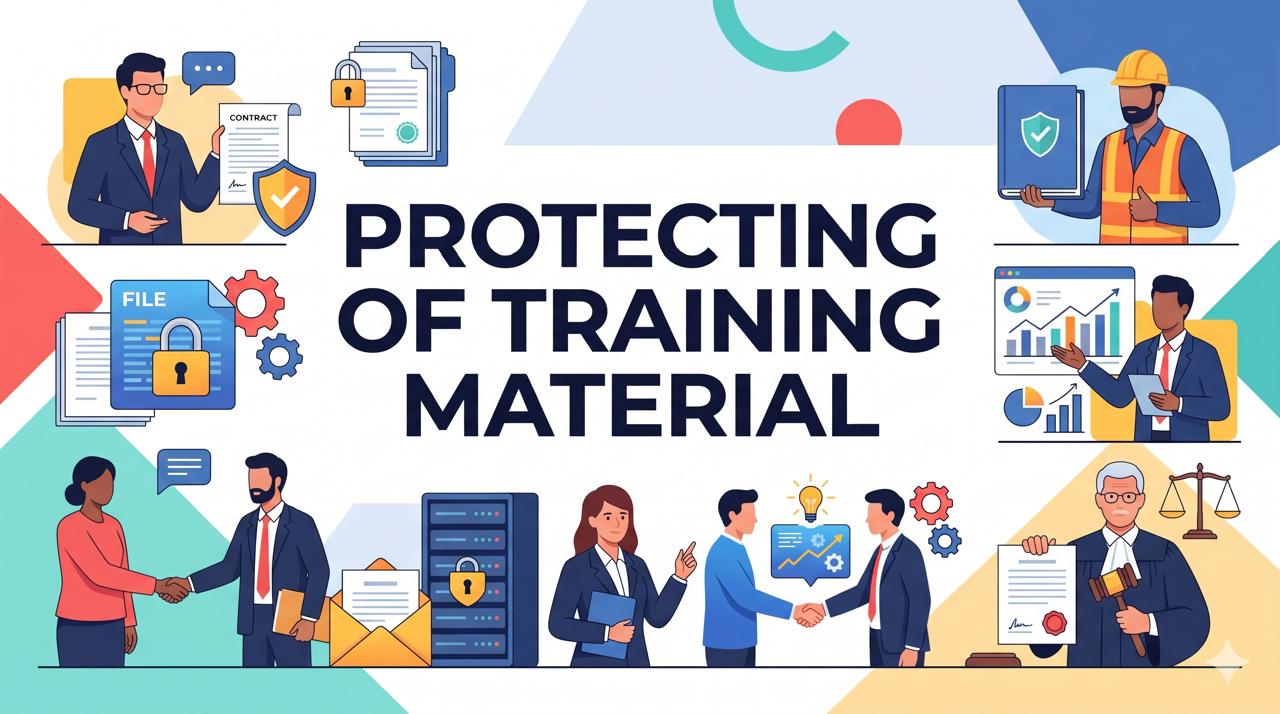
Protection Of Training Material
This Article looks at the question of whether or not companies can safeguard product manuals and training materials through the copyright law in terms of originality, ownership, and limitations, with reference to the statutory provisions and judicial precedents.
IPR
Harshi
4/23/20265 min read
I. Introduction
In the contemporary corporate environment, intellectual assets have also gone beyond inventions and branding to encompass organised knowledge sources such as product manuals and training resources. These documents play an important role both in standardising operations, providing clarity to the user and developing employees. Given how much capital one must invest in the development of such materials, the question of their legal protection becomes a matter of great importance. Copyright law, being a part of intellectual property, exists for the protection of original expressions of ideas. However, the extension of copyright protection to corporate instructional materials is not clear-cut since often such works combine functional information with expressive elements. This article attempts to analyse whether product manuals and training materials fall under the ambit of the Copyright Act, 1957 and the limitations and practical issues involved.
II. Recognition of Product Manuals as “Literary Works” under the Copyright Act, 1957
Section 13 of the Copyright Act, 1957, is the basis of protection of copyright in India, and the copyright lasts in original literary, dramatic, musical, and artistic works. The product manuals and training materials are typically considered to be included in the category of literary works under Section 2(o) of the Act that extends not only to traditional written texts but also to compilations, tables, and instructional material.
The statute does not bar technical and commercial writings. As such, even documents with functional/instructional purposes can be considered literary works, as long as they meet the requirement of novelty. Also, Section 14 provides the copyright owner with exclusive rights such as reproduction, distribution and communication to the public, thus allowing the companies to regulate the usage of such materials.
III. Originality as the Threshold for Protection
Originality is the main protection that needs to be given in copyright. The traditional doctrine of the sweat of the brow has developed into a more sophisticated form of Indian jurisprudence, necessitating a certain level of creativity. The Supreme Court in Eastern Book Company v. D.B. Modak[1] decided that to be subject to protection, a work should entail the exercise of skill and judgment, and should contain at least a modicum of creativity.
This threshold may not be satisfied by simple reproduction of technical specifications or standard procedures in the context of product manuals. But where the material is evidence of systematic arrangement, of a commentary of explanation, of illustrations, or of a peculiar mode of presentation, it will probably be regarded as original. Curated content, instructional design, and pedagogical structuring are often used as training material, which in itself is an expression of creative input and therefore meets the need for originality.
IV. The Idea-Expression Dichotomy in Instructional Materials
One of the key principles of the copyright law is the idea-expression dichotomy, under which the law only protects the expression of ideas and not ideas. This rule is especially applicable in the case of product manuals and training materials since they often express the functional or technical information.
R.G. Anand v. Deluxe Films[2]The Courts of law reiterated the fact that copyright does not apply to ideas, themes, and methods and that copyright protection is restricted to the specific piece of work. Therefore, although a firm cannot register exclusive rights over a process, a system, or a method as outlined in a manual, it has the right to safeguard the actual language, format, schemes, and explanatory patterns applied in the presentation of such information.
This exception is necessary so that copyright law does not negatively affect innovation or the availability of useful knowledge, but at the same time protects the intellectual work of expression of the same knowledge.
V. Ownership of Copyright in Corporate Settings
Section 17 of the Copyright Act, 1957, provides the ownership of the copyright in product manuals and training material. Under this, where a work is made in the course of employment under a contract of services, the employer is treated as the initial owner of the copyright, except in the case where there exists an agreement to the contrary.
This is one of the key provisions that matter to the companies that use employees, consultants, or external trainers to create instructional materials. When it comes to independent contractors, the copyright may not necessarily become vested in the company, and it is therefore imperative to have explicit contractual provisions that designate copyright.
This type of contractual transparency is essential not only to prove ownership but also as a measure of ensuring corporate rights against such conduct as unauthorised reproduction or transmission of corporate content.
VI. Training Materials as Composite and Creative Works
Some of the training materials include various aspects, such as written materials, presentations, diagrams, audio-visual and interactive resources. This composite quality increases their right to be covered by copyright laws because various sections of the composite work can be classified in various categories of works to be granted copyright protection.
The interpretation of the law by courts has always been in favour of the safeguarding of material used in education and teaching. It was determined in University of London Press Ltd v. University Tutorial Press Ltd (1916) that although originality is not necessarily novelty, it must comprise an intellectual exertion of its own. The principle supports the protection of presentation of training contents, even where they are founded on existing knowledge, as long as they are presented in a novel way.
VII. Infringement and Protection in the Digital Era
As more corporate resources are becoming digitised, product manuals and training resources are often delivered via online platforms, internal portals and cloud-based systems. Although this increases accessibility, it also subjects such materials to the dangers of unauthorised duplication, distribution, and abuse.
According to Section 51 of the Copyright Act, infringement is a violation of copyright whereby a copy, distribution, or communication of a copyrighted work is done without permission. Additionally, Section 65A offers security against technological protection measures circumventions and enhances enforcement of the digital environment.Irrespective of the existence of these statutory safeguards, the practical enforcement is difficult, especially where the digital dissemination is widespread or cross-border infringement occurs.
VIII. Limitations and Exceptions under the Law
Though copyright can provide enormous security, it has some restrictions. Functional works, or works that are not creatively expressed, might not be considered as being under protection. The merger doctrine may also be used in the situation where an idea can only be described in a number of ways, hence limiting the number of possible copyrights.
Further, fair dealing limitations in the Copyright Act constitute exceptions to copyrighted material, which means a limited exception to use the same on the grounds of private study, research, criticism, or review. These exceptions to prevent abuse of copyright legislation provide that protection will not jeopardise access to knowledge or research, and that protection will not restrict imperialism in educational exploitation.
IX. Conclusion
Product manuals and training material are precious corporate property that can be safeguarded by copyright as long as they represent originality of expression. Nonetheless, this protection will not be extensive, and as a result, companies will need to implement efficient protection measures in the digital arena.