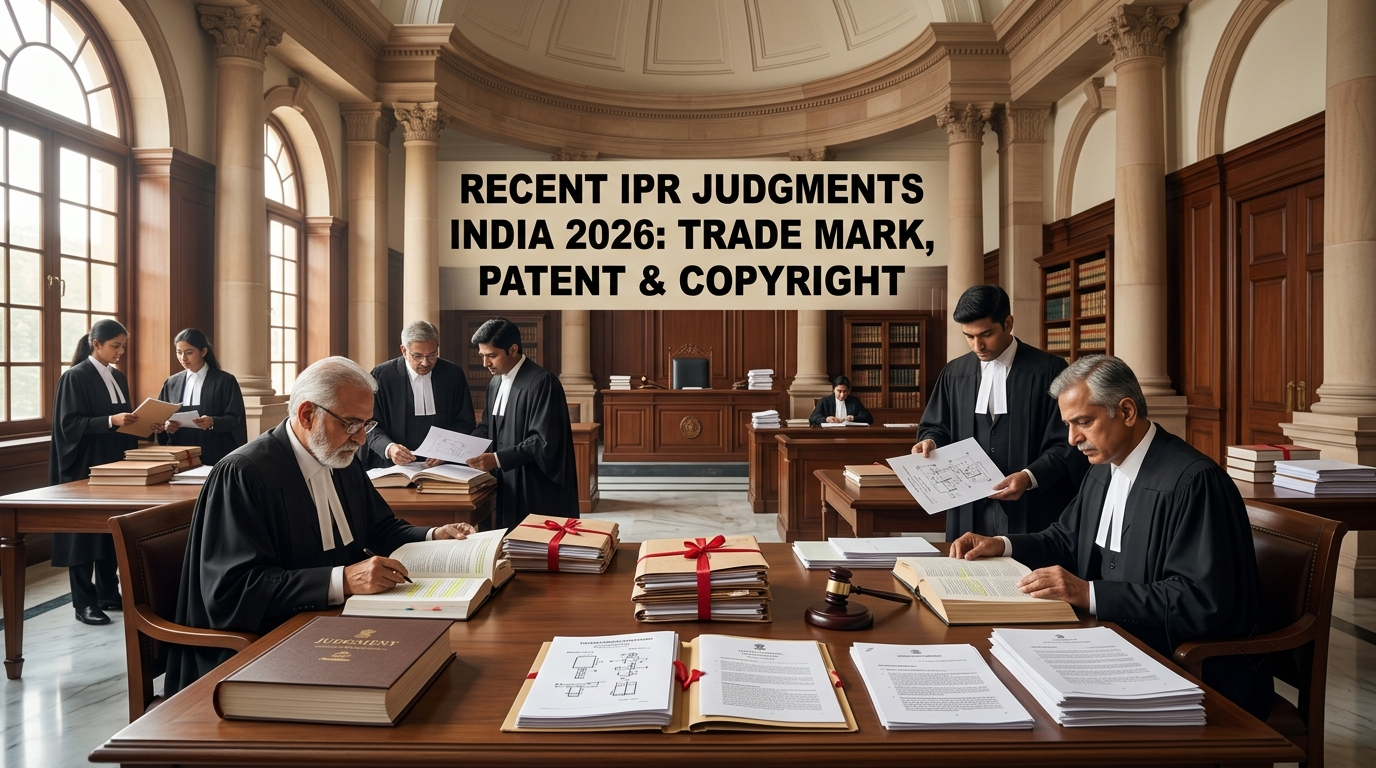
RECENT IPR JUDGMENTS INDIA 2026: TRADE MARK, PATENT & COPYRIGHT
Analysis of landmark Indian IPR judgments 2026 Bombay & Madras High Courts on pharmaceutical trade marks, Bolar exception under Section 107A, patent estoppel and copyright infringement.
IPRSERVICES
Sandeep Choudhary
7/22/202630 min read
INTRODUCTION
India's intellectual property landscape is evolving rapidly. The first half of 2026 has produced a series of landmark High Court judgments that are already reshaping how trade mark infringement, pharmaceutical patent rights, copyright protection, and the critical Bolar exception under the Patents Act are understood and applied by Indian courts. This article provides a comprehensive analysis of four significant recent IPR judgments decided by the High Court of Bombay and the High Court of Madras — decisions that every IP practitioner, pharmaceutical company, brand owner, and legal professional needs to understand.
Overview: Why These 2026 IPR Judgments Matter
The four judgments analysed in this article address questions at the cutting edge of Indian IP law:
When are two pharmaceutical trade marks phonetically similar enough to constitute infringement and passing off?
What standard of proof applies to deceptive similarity in the pharmaceutical sector?
What constitutes trade mark infringement combined with copyright infringement in packaging?
What is the scope of the Bolar exception under Section 107A of the Patents Act, 1970?
Does a consent decree in earlier patent proceedings operate as issue estoppel in subsequent infringement suits?
What evidence must a defendant adduce to successfully rely on the research and development exception to patent infringement?
Each of these questions carries profound practical implications — for pharmaceutical companies preparing to launch products, for brand owners protecting decades of goodwill, for innovator drug companies defending their patents, and for generic manufacturers seeking to rely on statutory defences.
Case 1: Alkem Laboratories Ltd. v. Numen Pharma Private Limited 2026 SCC OnLine Bom 4400 | High Court of Bombay | Decided: June 8, 2026
Background and Facts
Alkem Laboratories Ltd. is one of India's leading pharmaceutical companies and the registered proprietor of the trade mark "ALCIPRO", a mark adopted in 1990 and registered in Class 5 under the erstwhile Trade and Merchandise Act, 1958. The mark has been in continuous commercial use since 1991 and covers a Ciprofloxacin-based antibiotic prescribed for bacterial infections, urinary tract infections, nose and throat infections, and lung infections. A variant mark, "ALCIPRO-TN", was subsequently registered in 1998.
Numen Pharma Private Limited, a company incorporated only in 2023, applied for registration of the trade mark "ACIPROX" on 16 January 2023 on a proposed-to-be-used basis. The defendant's product bearing the ACIPROX mark contains ACECELOFENAC as its active ingredient and is prescribed for short-term relief of pain, inflammation, and swelling in musculoskeletal conditions.
Alkem filed a notice of opposition to the defendant's trade mark application and subsequently initiated Commercial IP Suit No. 679 of 2025 before the High Court of Bombay for trade mark infringement and passing off. Ad-interim reliefs were granted against the defendant on 8 October 2025.
The Defendant's Defence
Numen Pharma raised several defences that are commonly encountered in pharmaceutical trade mark disputes:
First, it argued that the word "CIPRO" is descriptive of the molecule Ciprofloxacin and therefore no party can claim a monopoly over it, and that the word "CIPRO" has at least 314 registered trade marks on the Trade Mark Registry.
Second, the defendant contended that ACIPROX is not phonetically similar to ALCIPRO. The defendant submitted that ACIPROX is pronounced "A-SI-PROX" while ALCIPRO is pronounced "AL-SI-PRO" — and that these are phonetically different.
Third, the defendant argued that ACIPROX was derived from the combination of its active ingredients — "ACECLOFENAC" and "PYREXIA" — and had therefore been adopted bona fide.
Fourth, the defendant contended that since both products are Schedule 'H' drugs sold only on prescription by qualified doctors, there could be no confusion among consumers.
Fifth, the defendant pointed to the differences in packaging, colour scheme, and the prominence of its company logo "N MEN" as additional distinguishing features.
The Court's Analysis and Decision
Justice Sharmila U. Deshmukh, sitting in the Commercial Division of the High Court of Bombay, conducted a rigorous analysis of the competing submissions and the applicable legal principles.
On Phonetic Similarity — The Anti-Dissection Rule
The Court firmly rejected the defendant's attempt to compare the rival marks syllable by syllable. Relying on the Division Bench decision in Sun Pharmaceutical Industries Ltd. v. Meghmani Lifesciences Ltd., the Court held that this syllable-by-syllable comparison is impermissible — the marks must be compared as a whole.
When compared as a whole, the Court found that ACIPROX and ALCIPRO are phonetically similar. The defendant had merely deleted the letter 'L' from ALCIPRO and added the letter 'X' to create ACIPROX. The Court observed that in hurried or casual utterance, the words are similar sounding, and the possibility of the terminal 'X' being slurred over meant that the defendant's mark could easily be mistaken for the plaintiff's.
The Court made a critically important observation about the special standard of care required for pharmaceutical trademarks:
It is the bare possibility test that applies to medicinal preparations — not the probability test applicable to ordinary consumer goods. Even the bare possibility of confusion is sufficient to restrain the use of a deceptively similar pharmaceutical trade mark. This is because the consequences of one drug being handed over for another — when both products contain different active ingredients treating different conditions — can be medically disastrous.
On the Schedule 'H' Defence
The Court decisively rejected the argument that the Schedule 'H' nature of the drugs eliminated the possibility of confusion. Relying on the Supreme Court's landmark pronouncement in Cadila Health Care Ltd. v. Cadila Pharmaceuticals Ltd. (2001), the Court noted that:
Prescriptions are frequently telephoned to pharmacists or written in handwriting that may not be legible.
Neither doctors nor pharmacists are immune from confusion or mistake.
The varying literacy infrastructure across India's urban, semi-urban, and rural populations requires strict measures to prevent confusion arising from similar pharmaceutical trade marks.
The fact that drugs are prescription-only does not alone prevent confusion, given the practical realities of how medicines are dispensed across the country.
On the "Common to Trade" Defence
The court held that merely showing the existence of 314 registered trademarks containing the word "CIPRO" is insufficient to establish that ALCIPRO is common to the trade. What the defendant needed to demonstrate and failed to demonstrate was that those marks are in extensive use. Registration alone, without evidence of open, continuous, and extensive use since the relevant period, cannot make a mark common to the trade.
On Distinctiveness of ALCIPRO
The Court found that the plaintiff's mark is not a mere clipping of the INN "Ciprofloxacin" — it is an invented mark combining a portion of the molecule name with the distinctive prefix "AL". The fact that ALCIPRO was registered under the erstwhile Trade and Merchandise Act, 1958 itself demonstrates that the mark was considered distinctive and registrable at the time. The plaintiff's claim to exclusivity lies not in the molecule Ciprofloxacin but in its unique invented mark.
On the Explanation for Adoption of ACIPROX
The Court was entirely unconvinced by the defendant's explanation that ACIPROX was derived from a combination of "ACECLOFENAC" and "PYREXIA". The Court observed that no combination of the letters of those two words yields "ACIPROX"; the explanation was therefore a post-hoc rationalisation rather than a genuine account of the mark's origin.
On Passing Off
Applying the classical trinity of goodwill, misrepresentation, and damage, the Court found all three elements established:
Goodwill: The plaintiff, with a sales turnover of Rs. 13,97,00,000 in 2023 alone (the year the defendant was incorporated), has clearly established goodwill and reputation associated with the ALCIPRO mark.
Misrepresentation: The defendant's adoption of a phonetically similar mark when any trade mark registry search would have discovered the plaintiff's registered mark constitutes misrepresentation.
Damage: The risk of the defendant's ACIPROX product being dispensed when a patient requests ALCIPRO (or vice versa) constitutes a real and substantial risk of damage to the plaintiff's reputation and goodwill
Order
The Court made the Interim Application absolute and granted an interim injunction restraining Numen Pharma, its directors, employees, distributors, retailers, and agents from manufacturing, selling, offering for sale, advertising, or otherwise using the trade mark ACIPROX or any other mark deceptively similar to the plaintiff's registered trade marks ALCIPRO and ALCIPRO-TN in relation to pharmaceutical and medicinal preparations.
Key Legal Principles Established
1. The Anti-Dissection Rule is Mandatory
Trade marks must be compared as a whole. Syllable-by-syllable dissection to demonstrate dissimilarity is impermissible and has been consistently disapproved by the Bombay High Court's Division Bench.
2. The Bare Possibility Test Applies to Pharmaceuticals
In pharmaceutical trade mark disputes, courts apply the bare possibility of confusion — not the probability of confusion. Even a remote possibility that one drug could be dispensed for another is sufficient to grant relief.
3. Schedule 'H' Status Does Not Eliminate Confusion Risk
The fact that drugs are sold only on prescription does not eliminate the risk of confusion, given the practical realities of verbal prescriptions, illegible handwriting, and variable literacy levels across India.
4. Registration Alone Does Not Prove "Common to Trade"
To establish that a mark is common to the trade, a defendant must demonstrate not merely that similar marks are registered but that they are in extensive, open, and continuous use in the market.
5. A Phonetically Similar Mark Adopted by a Late Entrant Is Suspect
Where the plaintiff is a prior user and registered proprietor of a well-known mark, and the defendant is a late entrant who would have discovered the plaintiff's mark through any registry search, the adoption of a phonetically similar mark raises a strong inference of misrepresentation.
Case 2: Blue Cross Laboratories Private Limited v. Alto Healthcare Private Limited & Anr. 2026:BHC-OS:13429 | High Court of Bombay | Decided: June 17, 2026
Background and Facts
Blue Cross Laboratories Private Limited is the registered proprietor of the trade marks "MEFTAL" and "MEFTAL-SPAS" (registration numbers 384238 and 538416 respectively, both in Class 05). The trade mark MEFTAL is a coined and invented word, first adopted in 1981, with the MEFTAL-SPAS variant introduced in 1982 for analgesic and antispasmodic preparations.
Blue Cross Laboratories is also the registered proprietor of the copyright in the original artistic work of the MEFTAL-SPAS strip and carton design, registered under the Copyright Act, 1957 vide registration No.
A-80641/2007 dated 18 September 2007.
The defendants Alto Healthcare Private Limited (the marketer) and a second defendant (the manufacturer) were found to be using the mark "MEFIAL-SPAS" on their analgesic and antispasmodic preparation. The defendants had essentially copied the entire MEFTAL-SPAS trade mark, replacing only the fourth letter 'T' with the letter 'I'. Beyond the mark itself, the defendants had also copied the plaintiff's entire artwork, packaging design, blue and red colour scheme, and the geometric design bordering the mark.
Despite being duly served with the writ of summons, the defendants never appeared in the proceedings. Defendant No. 1 had filed a written statement on 31 March 2017 but thereafter ceased to participate. The suit accordingly proceeded ex parte against both defendants.
The Court's Analysis and Decision
Justice Arif S. Doctor delivered a comprehensive judgment on 17 June 2026, addressing trade mark infringement, copyright infringement, and passing off.
On Trade Mark Infringement
The comparison of the rival marks was straightforward: MEFTAL-SPAS versus MEFIAL-SPAS. The defendants had taken the entire mark and changed only a single letter. The Court found unmistakable visual similarity between the marks, and additionally found clear phonetic similarity — MEFTAL-SPAS and MEFIAL-SPAS sound virtually identical when spoken, particularly in hurried or casual utterance.
The Court applied the well-established principles from K.R. Chinna Krishna Chettiar v. Shri Ambal & Co. (1969) — that deceptive similarity must be assessed by comparing marks as a whole, focusing on their distinctive and essential features, and considering both visual and phonetic resemblance. The Court also relied on Hiralal Prabhudas v. Ganesh Trading Co. and Parle Products (P) Ltd. v. J.P. and Co., Mysore for the settled propositions that:
Marks are remembered by overall impressions rather than precise details.
The test is that of an average purchaser with imperfect recollection.
Microscopic side-by-side comparison is impermissible.
Overall and broad salient similarity determines deceptive similarity
On these principles, the Court found that MEFIAL-SPAS is deceptively similar to MEFTAL-SPAS — there can be no doubt about this given that only one letter distinguishes the two marks. The Court found that the defendants had blatantly imitated the plaintiff's products.
On Copyright Infringement
The Court found that the defendants had copied not merely the trade mark but the entire artistic work appearing on the MEFTAL-SPAS carton and strip — including the registered copyright work (registration No. A-80641/2007). The defendants had copied:
The complete layout and design of the packaging
The blue and red colour scheme
The geometric design bordering the trade mark
The general trade dress of the plaintiff's product
The Court held that this wholesale copying of the plaintiff's registered copyright work constituted clear copyright infringement under the Copyright Act, 1957.
On Passing Off
The Court applied the classical trinity: goodwill and reputation, misrepresentation, and damage. Given that MEFTAL-SPAS has been in continuous use since 1982, over 40 years and has been extensively sold domestically and internationally, the plaintiff's goodwill was clearly established. The defendants' use of a virtually identical mark and packaging constituted self-evident misrepresentation. The risk of consumers purchasing the defendants' product believing it to be the plaintiff's was clear.
On Costs
The Court made an important observation on costs in commercial IP suits. Section 35 of the CPC, as amended by the Commercial Courts Act, 2015, requires courts to award realistic costs to successful parties and to have regard to the conduct of the parties. In this case:
The defendants had adopted a deceptively similar mark.
They had pirated the plaintiff's registered copyright work.
Despite being duly served, they had chosen not to appear or contest the claim.
Their adoption of the mark was clearly dishonest and in bad faith.
The products involved pharmaceutical preparations, where public health and safety considerations amplify the seriousness of the conduct.
Taking all these factors into account, the Court ordered each defendant to pay Rs. 5,00,000 (Rupees Five Lakhs) as costs to the plaintiff within 8 weeks, with interest at 8% per annum if not paid within that period.
Order
The suit was decreed in full in terms of prayer clauses (a) to (e). Permanent injunctions were granted restraining the defendants from infringing the plaintiff's trademarks and copyright and from passing off their products as those of the plaintiff.
Key Legal Principles Established
1. Copying a Single-Letter Variant of a Registered Mark Is Clear Infringement
Where a defendant has taken a plaintiff's entire trade mark and changed only a single letter, the deceptive similarity is self-evident, and the inference of deliberate copying is irresistible.
2. Trade Mark Infringement and Copyright Infringement in Packaging Are Cumulative
A defendant who copies both the trademark and the entire packaging artwork commits both trademark infringement and copyright infringement — distinct causes of action that each independently support relief.
3. Commercial Courts Must Award Realistic Costs in Pharmaceutical IP Cases
Where defendants have adopted dishonest and bad-faith marks in the pharmaceutical sector — and then compounded their conduct by failing to appear — courts should award realistic and compensatory costs under the amended Section 35 CPC framework, not nominal costs.
4. Non-Appearance Does Not Diminish the Seriousness of Infringement
The defendants' failure to contest the proceedings does not reduce the severity of their conduct — in fact, it lends further credence to the plaintiff's case that the adoption was entirely dishonest and actuated by bad faith.
Case 3: Communication Components Antenna Inc. v. Rosenberger Hochfrequenztechnik GmbH & Co. KG Delhi High Court | Judgment: 30 March 2026 | Justice Prathiba M. Singh
Background
Communication Components Antenna Inc. (CCAI), a Canadian telecommunications company, owned Indian Patent No. IN240893, titled "Asymmetrical Beams for Spectrum Efficiency". The patent relates to antenna technology used in cellular base stations to improve network capacity by using asymmetrical beam patterns, which reduce interference while increasing subscriber capacity.
CCAI alleged that Rosenberger and its affiliated Indian and Chinese companies were manufacturing and selling multi-beam antennas that infringed this patent.
Issues Before the Court
The Delhi High Court considered four principal questions:
Whether Patent IN240893 was valid or liable to be revoked.
Whether Rosenberger's antenna products infringed the patent.
Whether CCAI was entitled to a permanent injunction.
Whether damages and other relief should be granted.
Defendant's Arguments
Rosenberger challenged the patent's validity on several statutory grounds under the Patents Act, 1970, including:
Lack of novelty.
Lack of inventive step (obviousness).
Insufficient disclosure.
Claims not clearly defining the invention.
False representation.
Non-patentability.
Court's Findings
The court rejected the validity challenges and held that:
The invention represented a genuine technical advancement over prior art.
The patent sufficiently disclosed the invention.
The claims were adequately defined.
The defendants' antennas embodied the patented technology and therefore infringed the patent.
Decision
The Delhi High Court:
Granted a permanent injunction restraining Rosenberger from manufacturing, importing, selling, or offering for sale infringing antenna products in India until the patent's expiry.
Dismissed the counterclaim seeking revocation of the patent.
Awarded damages of USD 2,604,525 (or the rupee equivalent), together with 5% annual interest from the date of judgment until realisation, plus litigation costs.
Significance
This judgment is one of the most significant Indian patent decisions of 2026 because it:
Reaffirmed strong judicial protection for telecommunications patents.
Demonstrated the Delhi High Court's detailed technical analysis in patent litigation.
Clarified the standards for novelty, inventive step, and patent infringement under the Patents Act, 1970.
Reinforced that successful patentees may receive both injunctive relief and substantial monetary damages where infringement is established.
Case 4: Novartis AG v. Venkata Narayana Active Ingredients Pvt. Ltd. 2026 SCC OnLine Mad 4681 | High Court of Madras | Decided: June 3, 2026
Background and Facts
This is one of the most significant patent judgements of 2026, a comprehensive ruling by Justice Senthilkumar Ramamoorthy of the High Court of Madras that addresses the scope of the Bolar exception under Section 107A of the Patents Act, 1970, the operation of consent decrees as issue estoppel in patent proceedings, and the burden of proof on a defendant claiming the research and development exception to patent infringement.
Novartis AG is the proprietor of Indian Patent No. 212815 (IN 212815), granted for a new chemical entity with the international non-proprietary name "VILDAGLIPTIN" prescribed for the treatment of Type 2 Diabetes Mellitus. The patent was granted with effect from 9 December 1999 under the Patent Cooperation Treaty (PCT) framework.
Venkata Narayana Active Ingredients Pvt. Ltd — the defendant is an active pharmaceutical ingredient (API) manufacturer. It came to light that the defendant had exported large quantities of VILDAGLIPTIN API from India to importers in Egypt, specifically to Inspire Pharmaceutical Company, Mash Premiere, and Eva Pharma during the years 2016 to 2018, while the suit patent was in full force.
Prior Proceedings — C.S. No. 329 of 2015
The complexity of this case arises from a prior proceeding between the same parties. In 2015, Novartis filed a quia timet (preventive) suit (C.S. No. 329 of 2015) when the defendant offered VILDAGLIPTIN for sale on its website. That suit was decreed on 31 July 2015 based on undertakings given by the defendant on 28 July 2015, in which the defendant unconditionally acknowledged and accepted that Novartis is the registered patentee of IN 212815, accepted the validity of the patent, and undertook not to manufacture, sell, supply, export, import, or otherwise deal in VILDAGLIPTIN in any form.
Despite those solemn undertakings given to the High Court, the defendant proceeded to manufacture and export thousands of kilograms of VILDAGLIPTIN API to Egypt during 2016 to 2018. This brought about the current suit.
Issues Framed by the Court
The Court recast the issues in the case in February 2025 to address thirteen specific questions, including:
Whether the suit patent expired on 9-12-2018 (as contended by the defendant) or on 9-12-2019 (as contended by the plaintiffs)
Whether the supply of VILDAGLIPTIN to Egyptian importers was for scientific research and development purposes within Section 107A, or for commercial purposes
Whether the defendant violated its undertaking given in the earlier proceedings
Whether the defendant is estopped from challenging the validity of the suit patent given the consent decree
Whether VILDAGLIPTIN is a metabolite and therefore not patentable under Section 3(d) of the Patents Act
Whether the patent grant was vitiated by non-disclosure under Section 8 of the Patents Act
The Court's Analysis and Decisions on Each Issue
Issue: Term of the Patent — When Did IN 212815 Expire?
The defendant contended that the patent expired on 9 December 2018, calculated from the priority date. The plaintiffs contended that the patent expired on 9 December 2019, calculated from the PCT international filing date of 9 December 1999.
The Court applied Section 53 of the Patents Act, which provides that the term of a patent in the case of international applications filed under the Patent Cooperation Treaty designating India shall be twenty years from the international filing date accorded under the Patent Cooperation Treaty. Section 7(1B) confirms that the filing date in such cases is the international filing date.
The PCT filing date was 9 December 1999, as reflected in the Form-3 accompanying the patent application. The Court therefore concluded that the suit patent expired on 9 December 2019 — as contended by the plaintiffs. The defendant had proceeded on the misconception that the term should be calculated from the priority date.
Critical consequence: The exports of VILDAGLIPTIN API made by the defendant during 2016 to 2017 were made while the suit patent was in force. The claim for relief, including damages, accordingly survived the patent's expiry.
Issue: Estoppel — Can the Defendant Challenge Patent Validity?
The defendant sought to challenge the validity of IN 212815 in the current proceedings, arguing that the patent should not have been granted for the API, that there was misrepresentation before the patent office, that disclosures under Section 8 were not made, and that VILDAGLIPTIN is a metabolite excluded under Section 3(d).
The Court held that the defendant is estopped from raising any challenge to the validity of the suit patent. The earlier consent decree based on undertakings in which the defendant unconditionally acknowledged Novartis's rights and the patent's validity operates at minimum as an issue estoppel against the defendant.
Relying on the Supreme Court's judgment in Raja Sri Sailendra Narayan Bhanja Deo v. State of Orissa (1956) and the principle that a consent decree is intended to put a stop to litigation between the parties as effectively as a contested judgment, the Court held that allowing the defendant to relitigate the validity of the patent which it had expressly conceded in the earlier proceedings — would be manifestly unjust.
Even if the consent decree does not operate as strict res judicata under Section 11 CPC in respect of all questions, the court held that issue estoppel clearly operates to prevent the defendant from challenging patent validity.
Issue: Is VILDAGLIPTIN a Metabolite Under Section 3(d)?
The defendant raised the argument that VILDAGLIPTIN is a metabolite and therefore falls within the exclusion in Section 3(d) of the Patents Act, which excludes from patentability the mere discovery of a new form of a known substance unless it results in enhanced efficacy.
The Court disposed of this issue decisively. The defendant's own expert witness (DW 2) had conceded in cross-examination that Vildagliptin is a new chemical entity and that the name Vildagliptin is "an international non-proprietary name (INN) awarded by WHO to the said compound". The defendant adduced no evidence whatsoever to establish that VILDAGLIPTIN is a metabolite. The issue was accordingly decided against the defendant.
Issue: Non-Disclosure Under Section 8 of the Patents Act
The defendant argued that the plaintiff failed to make required disclosures under Section 8 of the Patents Act, which requires a patent applicant to disclose corresponding foreign applications for the same or substantially the same invention.
The Court conducted a detailed analysis of Section 8, Rule 12 of the Patent Rules, and Form 3. It concluded that:
Section 8 imposes an obligation to disclose corresponding foreign applications — not to disclose prior art.
The defendant's contention that Exhibits D-13 and D-14 (prior art documents) were corresponding applications requiring disclosure was not established.
The defendant failed to demonstrate that D-13 and D-14 were applications for the same or substantially the same invention as IN 212815
Even proceeding on the assumption that these documents might be material under Section 8, without comparing the complete specifications, no rational conclusion can be drawn from the defendant's assertion.
The issue was decided against the defendant.
Issue: The Bolar Exception — Scope and Application of Section 107A
This is the most significant and far-reaching portion of the judgment. The central question is whether the defendant's export of thousands of kilograms of VILDAGLIPTIN API to Egyptian importers fell within the Bolar exception under Section 107A(a) of the Patents Act, 1970.
Section 107A(a) provides that any act of making, constructing, using, selling, or importing a patented invention solely for uses reasonably relating to the development and submission of information required under any law for the time being in force, in India, or in a country other than India, that regulates the manufacture, construction, use, or sale of any product shall not be considered an infringement of patent rights.
The Legislative History of Section 107A
The Court traced the genesis and legislative history of Section 107A with meticulous care. The Bolar exception originated in the United States following the Federal Circuit's decision in Roche Products, Inc. v. Bolar Pharmaceutical Co., which prompted the US Congress to enact 35 U.S.C. Section 271(e)(i). The TRIPS Agreement's Article 30 then enabled member countries to enact limited exceptions to patent rights.
India's Section 107A was enacted through the Patents (Amendment) Act, 2005. The legislative history — including the Joint Parliamentary Committee Report, the Notes on Clauses, and the Statement of Objects and Reasons makes the object of the provision clear: to enable persons other than the patent holder to take necessary steps to obtain regulatory approval to be in a position to bring a generic product to market immediately or soon after the patent expires. It is a regulatory approval provision — not a provision permitting use of a patented product for academic research, general experimentation, or teaching.
The Burden of Proof
The Court addressed a fundamental question on which the Delhi High Court's decision in Bayer Corporation v. Union of India (2019) had taken the view that Section 107A is an independent provision and not an exception, and that therefore the onus does not lie on the defendant.
Justice Ramamoorthy respectfully disagreed with the Delhi High Court's characterisation. The Court held that because Section 107A incorporates a Bolar provision that, if not satisfied, would constitute infringing use, the provision should be construed as an exception — and the onus lies on the defendant to plead and establish that its use falls within the exception.
What Evidence Is Required to Establish Section 107A?
The Court laid down a detailed framework of the minimum documentary evidence that a person relying on Section 107A must produce:
Evidence that regulatory approval was sought in India or outside India in relation to the patented product
Evidence that the regulator requested product-related data — such as pre-clinical or clinical trial data relating to the patented product in response to a request for approval
Where the person seeking regulatory approval is not the API manufacturer, evidence of a request for supply from the person seeking regulatory approval to the manufacturer or seller.
Evidence that the impugned use of the patented product is reasonably related to the request for regulatory approval
The Court also endorsed the non-exhaustive factors identified by the Delhi High Court in Bayer as relevant to determining whether a matter falls within Section 107A, including the nature of the product, the identity of the importing party, the quantity exported, the end-use purpose, and the relevant regulations in the destination country.
The court also drew on the Italian Court of Cassation's judgement in Sicor S.R.L. & Teva Pharmaceutical Industries Limited v. Boehringer Ingelheim Pharma GmbH & Co. KG (2024), which held that the Bolar purpose must be clear from the outset and that where the API manufacturer is not the party seeking regulatory approval, a "commissioning" relationship must be established the manufacturer must act only by reason of a request supported by a declared purpose capable of exculpating its conduct.
Application to the Facts
Applying this framework, the Court found that the defendant comprehensively failed to discharge the burden of establishing the Section 107A exception:
The purchase orders from Egyptian importers (Inspire Pharma, Mash Premiere, Eva Pharma) did not state that the VILDAGLIPTIN was required for research and development or regulatory purposes — the purchase orders simply ordered the API without specifying any research or regulatory purpose.
The defendant adduced no evidence that the Egyptian regulatory authorities had requested VILDAGLIPTIN for preclinical or clinical trial purposes.
The Egyptian importers (Inspire Pharma and Eva Pharma) were already commercially selling VILDAGLIPTIN formulations — if they were already in commercial sale, they would not require regulatory approval from scratch.
The defendant's own manager of quality assurance admitted in the commissioner's report that "some customers inform that they want Vildagliptin for trial purpose. But we do not make any due diligence as such" — a damning admission that the defendant conducted no due diligence on the declared purpose of the API
Documents showed that the defendant had been exporting VILDAGLIPTIN to Egypt even before the giving of its undertakings to the High Court in 2015 — while concealing this from the Court.
The quantities exported (200 kgmes, 800 kgmes) were excessive by any reasonable assessment of what would be needed for genuine clinical trials.
The Court concluded that it was unable to find that the defendant's manufacture and export of VILDAGLIPTIN was solely for research and development purposes or that the use was reasonably related to regulatory requirements. The defendant's exports constituted infringement of the suit patent IN 212815.
On Damages vs. Rendition of Accounts
The plaintiffs claimed damages of Rs. 34.95 crores based on the supply value of the exported VILDAGLIPTIN. However, the Court found that this figure was stated in the written arguments but not supported by evidence in the proof affidavit. On this basis, the Court held that while an accurate quantum of damages could not be determined from the materials on record, the plaintiffs are entitled to a rendition of accounts by the defendant and a decree of profits to be calculated on that basis.
Order
The suit was decreed in terms of reliefs in clauses (a), (c), and (d) of the plaint — permanent injunction, delivery up of infringing stock, and rendition of accounts followed by a decree of profits. The defendant was also directed to pay costs, to be determined by the Taxing Officer in accordance with Section 35 CPC.
Key Legal Principles Established
1. Patent Term for PCT Applications Runs from the International Filing Date
The term of a patent granted on a PCT application designating India is twenty years from the international filing date — not from the priority date. Section 53 read with Section 7(1B) and the PCT Explanation make this clear.
2. Consent Decrees Create Issue Estoppel in Patent Proceedings
Where a party has given solemn undertakings to the court unconditionally acknowledging a patent's validity, and the court has passed a consent decree on that basis, that party is estopped from challenging the patent's validity in subsequent infringement proceedings arising from the same patent.
3. Section 107A Is an Exception — the Onus Lies on the Defendant
The Bolar exception in Section 107A is not a mere statutory right but an exception to the patent holder's rights under Section 48. The burden of pleading and establishing that the use falls within Section 107A lies on the defendant asserting the exception.
4. Section 107A Is a Regulatory Approval Provision — Not a General Research Exception
The object and purpose of Section 107A is to enable persons to obtain regulatory marketing approval for generic products so they can enter the market immediately upon patent expiry — it is not a provision permitting the use of patented products for academic experiments, general research, or teaching, which are addressed separately under Section 47(3).
5. Detailed Evidentiary Framework for Section 107A
A defendant relying on Section 107A must produce a minimum of four categories of documentary evidence: evidence of regulatory approval being sought; evidence of the regulator's request for product-related data; evidence of a commissioning request from the person seeking regulatory approval; and evidence that the use is reasonably related to the regulatory approval process.
6. Where API Importers Are Already in Commercial Sale, the Section 107A Defence Cannot Succeed
Where the foreign importers of a patented API are already commercially selling formulations containing that API, they cannot simultaneously claim that the imported API is required for regulatory approval purposes — they would not need further regulatory approval if they are already selling commercially.
7. Breach of Court Undertakings in Patent Proceedings Is Treated with Utmost Seriousness
The Court's detailed examination of the defendant's breach of its 2015 undertakings — including the finding that the defendant had been exporting VILDAGLIPTIN even before giving those undertakings — reflects the courts' firm stance against parties who give solemn undertakings to the court and then breach them.
Cross-Cutting Themes: What These 2026 Judgments Tell Us About Indian IP Law
Reading these four decisions together, several important themes emerge that shape the current state of Indian intellectual property law.
The Pharmaceutical Sector Receives Heightened Judicial Scrutiny
Across all four cases, Indian courts have demonstrated a consistent willingness to apply higher standards of protection to IP rights in the pharmaceutical sector. The rationale is not merely commercial — it is public health. The risk that a patient may receive the wrong medication due to trade mark confusion, or that a generic drug manufacturer may exploit a patented API without genuine regulatory purpose, carries consequences that go far beyond commercial harm. Courts have reflected this in their approach to the bare possibility test, the Schedule 'H' defence, and the burden of proof for Section 107A.
The Bolar Exception Has Well-Defined Boundaries
The Madras High Court's detailed analysis of Section 107A provides the most comprehensive judicial treatment of the Bolar exception in Indian law to date. The Court's clarification that Section 107A is a regulatory approval provision — not a general research exception — and that the burden of proof lies on the defendant to establish its applicability with detailed documentary evidence, will significantly affect how pharmaceutical companies structure their pre-patent-expiry manufacturing and export activities.
The practical implications are significant: Indian API manufacturers who wish to rely on Section 107A to export patented compounds to overseas markets must ensure they have in place, before commencing supply:
Clear documentation from the overseas importer of the regulatory purpose of the supply
Correspondence from the relevant overseas regulatory authority confirming that data relating to the patented compound has been or is being requested
Internal compliance systems to verify the purpose of every export of a patented API
Due diligence records demonstrating that the declared purpose has been verified
Consent Decrees Are Powerful and Binding in IP Litigation
The Novartis judgment sends a clear message to litigants who give undertakings or consent to decrees in patent proceedings: those commitments are binding and will be enforced rigorously. A party cannot give solemn undertakings to a court acknowledging a patent's validity and then, in subsequent proceedings, attempt to challenge that same patent. Issue estoppel — if not strict res judicata — will operate to foreclose such challenges.
The Anti-Dissection Rule Remains Inviolable in Trade Mark Law
The Alkem and Blue Cross judgments reinforce the anti-dissection rule as the cornerstone of trade mark comparison methodology in Indian courts. Whether the court is comparing ALCIPRO with ACIPROX or MEFTAL-SPAS with MEFIAL-SPAS, the comparison must be of the marks as a whole — their overall impression, phonetic similarity, and the likelihood of confusion in the mind of an average consumer with imperfect recollection.
Costs in Commercial IP Suits Should Be Realistic and Compensatory
The Blue Cross judgment's award of Rs. 5 lakhs as costs to the plaintiff against each defendant, in a case characterised by blatant copying of both trade mark and copyright work, reflects the Commercial Courts Act's framework requiring realistic and compensatory costs. Courts are increasingly moving away from nominal costs awards in IP cases — particularly where the defendant's conduct has been dishonest, the defendant has failed to appear, and the products involved raise public health concerns.
Public Health Considerations Permeate Pharmaceutical IP Disputes
A consistent thread running through all the pharmaceutical IP cases in this analysis is the courts' explicit recognition of the public health dimension of pharmaceutical IP disputes. The risk of confusion between pharmaceutical products — whether from similar trade marks or from the exploitation of patented medicines without genuine regulatory purpose — is not merely a commercial risk. It is a public health risk. This recognition has shaped the standards applied across trade mark, copyright, and patent disputes.
Practical Implications for Businesses and IP Practitioners
For Pharmaceutical Companies and Brand Owners
These judgments provide clear guidance on protecting pharmaceutical trade marks in India:
Register your pharmaceutical trade marks as early as possible — prior registration creates a presumption of validity and distinctiveness that late entrants cannot easily overcome
Document your sales turnover, promotional activities, and market presence — evidence of goodwill is essential for both infringement and passing off claims.
Monitor the Trade Mark Registry for applications deceptively similar to your marks and file oppositions promptly.
Do not be deterred by arguments that your mark is derived from a generic chemical name — invented marks combining a prefix or suffix with a portion of a molecule name can be distinctive and protectable.
In trade mark opposition proceedings, ensure you adduce evidence of open, continuous, and extensive use — not merely registration.n
For Generic Drug Manufacturers and API Exporters
The Novartis judgment has important compliance implications for generic pharmaceutical companies:
Before exporting any patented API, obtain and retain documentation of the specific regulatory purpose for which the API is being supplied.
Ensure that purchase orders from overseas buyers specifically state the regulatory purpose of the API
Verify that the overseas importer is not already in commercial sale of the patented compound — if they are, a Section 107A defence will be extremely difficult to establish
Implement internal compliance protocols for patented API exports, including due diligence verification of declared purposes.
Never give undertakings to a court regarding patent rights unless you are prepared to comply with them fully and in good faith.
For IP Litigants Generally
Consent decrees and court undertakings in IP proceedings carry powerful estoppel consequences — approach them with full awareness of their long-term implications.
Courts will award realistic and compensatory costs in commercial IP cases, particularly where the defendant's conduct has been dishonest or in bad faith — do not treat costs as a minor consideration in IP litigation strategy.
In pharmaceutical trade mark disputes, the bare possibility of confusion — not the probability — is the applicable standard, making it significantly easier for registered mark holders to obtain injunctive relief.
Conclusion
The IPR judgements of the first half of 2026 demonstrate Indian courts' sophisticated and principled approach to intellectual property rights in the pharmaceutical sector and beyond. From the Bombay High Court's rigorous application of phonetic similarity principles in pharmaceutical trade mark disputes, to the Madras High Court's landmark analysis of the Bolar exception and the burden of proof under Section 107A, these decisions collectively advance the development of Indian IP law in ways that will shape practice and strategy for years to come.
The key messages from these judgements are clear: trade mark protection for invented pharmaceutical marks is robust; the Bolar exception has defined and enforceable boundaries; court undertakings in patent proceedings create issue estoppel; and courts will award realistic costs where IP rights have been violated through dishonest or bad-faith conduct.
For businesses operating in India's pharmaceutical, healthcare, and technology sectors, understanding and applying the principles from these judgements is not optional — it is an essential component of sound IP strategy and legal compliance.
KEY TAKEAWAYS
Alkem v. Numen Pharma (2026): ALCIPRO and ACIPROX are phonetically similar when compared as a whole — the anti-dissection rule is mandatory; the bare possibility test applies to pharmaceutical marks; the Schedule 'H' defence does not eliminate confusion risk.
Blue Cross v. Alto Healthcare (2026): Copying a registered trade mark with a single-letter change, combined with copying the entire registered copyright artwork, constitutes clear infringement; courts must award realistic costs in dishonest pharmaceutical IP cases.
Novartis v. Venkata Narayana (2026): The term of a PCT patent runs from the international filing date, not the priority date; consent decrees create issue estoppel preventing patent validity challenges; Section 107A is a regulatory approval exception on which the defendant bears the burden of proof.
The Bolar exception (Section 107A) requires detailed documentary evidence: regulatory approval must have been specifically sought; the regulator must have requested product-related data; a commissioning relationship must be established where the defendant is not the regulatory approval applicant.
Where overseas importers of a patented API are already in commercial sale of the patented compound, the Section 107A defence cannot succeed.
Indian courts consistently apply a higher standard of protection to pharmaceutical trade marks than to ordinary consumer goods, reflecting the life-threatening consequences of pharmaceutical product confusion.
Realistic and compensatory costs are increasingly awarded in commercial IP suits where defendants have acted dishonestly, failed to appear, or breached court undertakings.
Brand owners should monitor the Trade Mark Registry and file oppositions promptly — a late entrant who would have found the plaintiff's registered mark through any registry search faces a strong inference of misrepresentation.
Generic pharmaceutical companies must implement robust Section 107A compliance protocols before exporting patented APIs, including documented regulatory purpose verification from overseas buyers.
These 2026 judgments collectively confirm that Indian IP courts are sophisticated, principled, and willing to enforce IP rights vigorously, particularly where public health considerations are engaged.
FREQUENTLY ASKED QUESTIONS
1. What is the bare possibility test in pharmaceutical trade mark cases?
The bare possibility test is the standard applied by Indian courts in pharmaceutical trade mark infringement cases. Unlike ordinary consumer goods cases, where the test is whether confusion is probable — in pharmaceutical cases, even a bare or remote possibility of confusion is sufficient to grant injunctive relief. This higher standard applies because the consequences of one drug being dispensed for another can be medically dangerous or fatal.
2. Why does the Schedule 'H' defence fail in pharmaceutical trade mark cases?
The Schedule 'H' defence that drugs sold only on prescription cannot be confused has been repeatedly rejected by Indian courts. This is because prescriptions are frequently telephoned to pharmacists (creating phonetic confusion risks), handwritten prescriptions may be illegible, pharmacists and doctors are not immune from confusion or mistake, and India's diverse linguistic and literacy landscape creates additional risks of confusion in the dispensing of medicines.
3. What is the anti-dissection rule in trade mark law?
The anti-dissection rule is the principle that trade marks must be compared as a whole — in their entirety, and by the overall impression they create — rather than being broken down and compared syllable by syllable or part by part. The rule prevents defendants from artificially constructing dissimilarities by isolating individual components of competing marks.
4. What is the Bolar exception under Indian patent law?
The Bolar exception is the provision in Section 107A(a) of the Patents Act, 1970 that exempts from patent infringement any act of making, constructing, using, selling, or importing a patented invention solely for uses reasonably related to the development and submission of information required under any law regulating the manufacture, construction, use, or sale of any product. Its purpose is to allow generic manufacturers to seek regulatory approval for their products so they can enter the market immediately upon patent expiry.
5. Who bears the burden of proof for the Section 107A Bolar exception?
According to the Madras High Court's 2026 judgment in Novartis v. Venkata Narayana, the burden of proving that use falls within Section 107A lies on the defendant asserting the exception. The Court characterised Section 107A as an exception to the patent holder's rights under Section 48 — and exceptions must be established by those who seek to rely on them.
6. What evidence is required to successfully rely on the Section 107A exception?
At a minimum, the defendant must produce: (a) evidence that regulatory approval was specifically sought for the patented product in India or abroad; (b) evidence that the regulatory authority requested product-related data (such as clinical or pre-clinical trial data) relating to the patented product; (c) where the defendant is not the party seeking regulatory approval, evidence of a commissioning request from the person seeking approval; and (d) evidence that the use is reasonably related to the regulatory approval request.
7. Does a consent decree in earlier patent proceedings prevent validity challenges in later infringement suits?
Yes, according to the Madras High Court's 2026 Novartis judgment. Where a party has unconditionally acknowledged a patent's validity in undertakings to the court, and a consent decree has been passed on that basis, that party is estopped (by issue estoppel, if not strict res judicata) from challenging the patent's validity in subsequent proceedings involving the same patent.
8. How is the term of an Indian patent calculated for PCT applications?
For patents granted on applications filed through the Patent Cooperation Treaty (PCT) designating India, the term of the patent is twenty years from the international filing date accorded under the PCT — not from the priority date. This is established by Section 53 read with the Explanation thereto and Section 7(1B) of the Patents Act, 1970.
9. Can copying a single letter of a registered trade mark constitute infringement?
Yes. As the Blue Cross v. Alto Healthcare judgment illustrates, changing a single letter of a well-known registered trade mark (MEFTAL-SPAS to MEFIAL-SPAS) while copying the entire packaging design, colour scheme, and copyright artwork constitutes clear trade mark infringement, copyright infringement, and passing off. The deceptive similarity in such cases is self-evident.
10. What costs can a successful plaintiff expect in a commercial IP suit in India?
Under the Commercial Courts Act, 2015, Section 35 CPC as amended requires courts to award realistic and compensatory costs — not nominal costs — to successful parties in commercial suits. Courts are required to have regard to the conduct of the parties. In pharmaceutical IP cases where defendants have adopted dishonest marks, copied registered copyright works, and failed to appear, courts have awarded substantial costs to reflect the seriousness of the conduct.
11. What is the significance of the Cadila Health Care judgement for pharmaceutical trade mark cases?
Cadila Health Care Ltd. v. Cadila Pharmaceuticals Ltd. (2001) is the Supreme Court's authoritative pronouncement on the standard of care required in pharmaceutical trade mark cases. The Court held that the bare possibility of confusion is sufficient in pharmaceutical trade mark cases, that Schedule 'H' drugs are not immune from confusion-based claims, that the linguistic and literacy diversity of India requires strict measures to prevent pharmaceutical trade mark confusion, and that confusion and mistake can arise even for prescription drugs where similar goods are marketed under look-alike and sound-alike marks.
12. Can a common-to-trade defence succeed based on registered marks alone?
No. Indian courts have consistently held that mere existence of similar marks on the Trade Mark Register is insufficient to establish that a mark is common to the trade. What must be demonstrated is that those similar marks are in extensive, open, and continuous commercial use. Registration without evidence of use in the market does not diminish the plaintiff's claim to protection.
13. What is the difference between Section 107A and Section 47(3) of the Patents Act?
Section 47(3) provides that any person may use a patented product or process for experiment or research, including the imparting of instructions to pupils. This is a general research and teaching exception. Section 107A(a) is specifically a regulatory approval provision — it permits manufacture, sale, and export of a patented product solely for the purpose of developing and submitting information to regulatory authorities for marketing approval. The two provisions serve different purposes and have different scopes.
14. What practical steps should Indian API manufacturers take before exporting patented compounds?
Before exporting any patented API, manufacturers should: identify whether the API is covered by a valid Indian patent; determine whether the export falls within Section 107A by verifying the regulatory purpose with documented evidence; obtain purchase orders that specifically state the regulatory purpose; verify that the buyer is not already in commercial sale of the compound; implement internal compliance protocols for patented API exports; and obtain independent legal advice on the applicable patent position.
15. How do these 2026 IPR judgments affect pharmaceutical companies preparing to launch generic products?
These judgments collectively reinforce that Indian courts will scrutinise both the regulatory purpose of pre-launch API activities and the trade marks chosen for new generic products with close attention. Generic companies must ensure that their Section 107A activities are properly documented and genuinely limited to regulatory purposes, and that their product trade marks are clearly distinguishable — both visually and phonetically — from established innovator brands.