SaaS Contracts Transfer Data Control Without Businesses Realising It
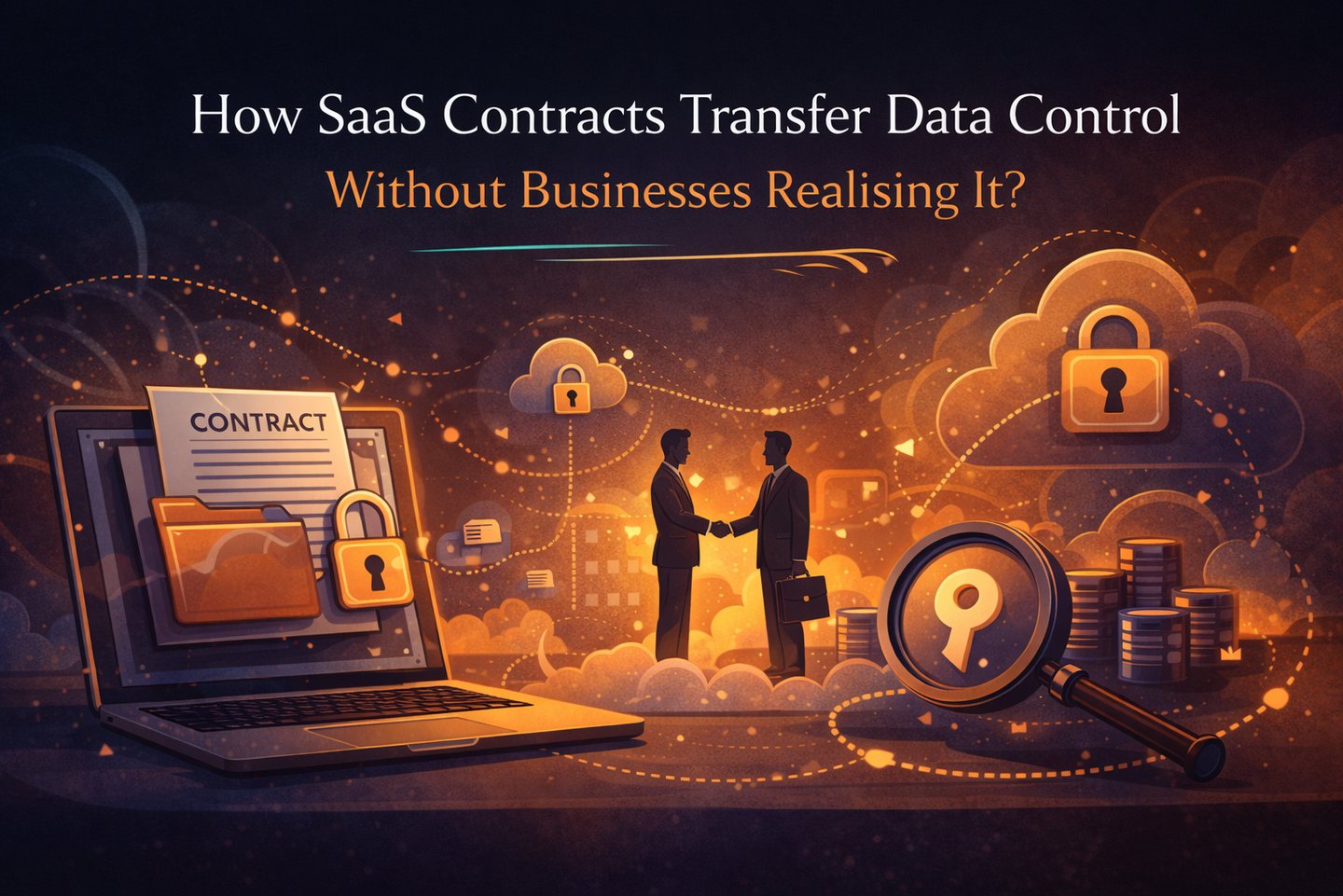
SaaS contracts often look simple but contain hidden clauses in themselves, which shifts the control of data from businesses to service providers. This article analyzes how service providers control data in a subtle way through contractual agreements and what steps a business can take to prevent this.
CORPORATE LAWS
Suhani
2/28/20264 min read
Introduction
Firstly, we shall try to understand what an SaaS contract is. A SaaS (Service as a Software) Agreement is a legally binding agreement between a service provider and a consumer (generally companies) that lays down terms for accessing software over the internet, like Zoom, Microsoft 365, Google Workspace, Cloud, etc. The company need not buy the software but pays the subscription amount to access it online. It becomes easy for the consumer to store and handle data. But this convenience has a hidden cost. The cost of data security and privacy. As soon as the customer uploads data on the software, the control slips to the hand of the service provider.
How SaaS Contracts Transfer Control
Most of the time during subscription agreements, consumers click on ‘I Agree’ without giving it a second thought, without even thoroughly reviewing them. However, this can lead to irreversible danger to data security. These agreements generally favor the service provider in terms of access to data and place the burden of data security on the subscriber. The agreements often use clauses like "right to copy or modify for service improvement," which grants them wide rights over consumers' data. Many vague clauses also provide your data to AI in the name of training AI models and analyzing data. There are various hidden clauses that the businesses miss, which include providing access to data for various purposes.
Data Ownership vs. Data Rights
Most SaaS contracts contain clauses stating that the ownership of data rests with the customer. However, later they add terms of agreement stating the service provider can use and analyze the data to improve their services for research and development. These rights are often depicted to be critical for product development, but they give control of the data to the service providers. The business doesn't notice it because of lengthy terms and signs it instantly. Moreover, companies with huge popularity like Microsoft and Google are considered safe, with everyone thinking they are using them. So, risks are ignored and the data is left unprotected. Generally, non-experts find it difficult to understand technical jargon, and service providers leverage this opportunity.
Data Location and Subprocessors
SaaS businesses usually do not store data in one location. They rely on cloud service providers and subcontractors, sometimes in different countries. Usually, there is a clause in the contract that allows cloud service providers to use “subprocessors” without requiring prior consent each time. Although this is common practice, it could lower your understanding and control over where your data is stored, who is processing it, and which privacy laws apply to it. A business may believe that their data is subject to local laws, only to discover later that it is processed in a different country.
Termination and Data Retrieval Limits
Many firms consider contracts at the start of a relationship and not at the end. When a SaaS contract expires, you usually have a short time, sometimes 30 or 60 days, to download your data. After that, the vendor can delete it permanently. Some contracts also incur costs for data export, offer data in fixed formats, omit some metadata from export. This can lead to vendor lock-in. Vendor lock-in occurs when a customer becomes dependent on a single vendor for products or services. If it is difficult or costly to switch to a new vendor, then control remains with the original vendor.
Automatic Renewal Provisions
Automatic Renewal Provision means that the service agreement is renewed automatically unless a proper notice is given. If pricing changes or data terms evolve, businesses may find themselves bound by updated terms simply because they failed to meet a cancellation deadline. Control over data is more than just ownership; it is also about flexibility. Long-term renewals decrease flexibility. Therefore, if there is a provision for automatic renewal, it can lead to data control in the hands of service providers for a long period of time unless explicitly cancelled.
Limited Liability for Data Loss
One of the most overlooked parts of any SaaS contract is the limitation of liability clause. These types of clauses tend to set a cap on the financial liability of the provider based on the amount paid in the previous 12 months. For example, if a company paid a Rs. 200,000 subscription in the previous year, then the maximum liability that can be imposed is this amount only. Hence, in simple terms, the provider controls the system and has limited liability, whereas the consumer holds most of the risk.
How Can Businesses Protect Themselves?
Businesses cannot avoid SaaS, as it holds an important part of their work. But it can take as few steps to lower the risk as reviewing and understanding the agreements thoroughly and negotiating data rights wherever possible. They should clarify the procedures and ensure transparency. They must examine the liability caps and monitor all updates, ensuring accountability. One of the most important steps is consulting for legal expertise at the right time and making use of it whenever a situation arises.
Conclusion
The truth is, SaaS contracts do not “steal” data directly. They do it gradually through licensing rights, liability caps, renewal provisions, and data usage terms. On paper, ownership does not always mean control. Before signing, slowing down and examining critical contract terms can help businesses retain actual control over their most precious resource: their data. In the modern digital economy, data is power. But it is not only a matter of who owns it. It is also a matter of who actually controls it.