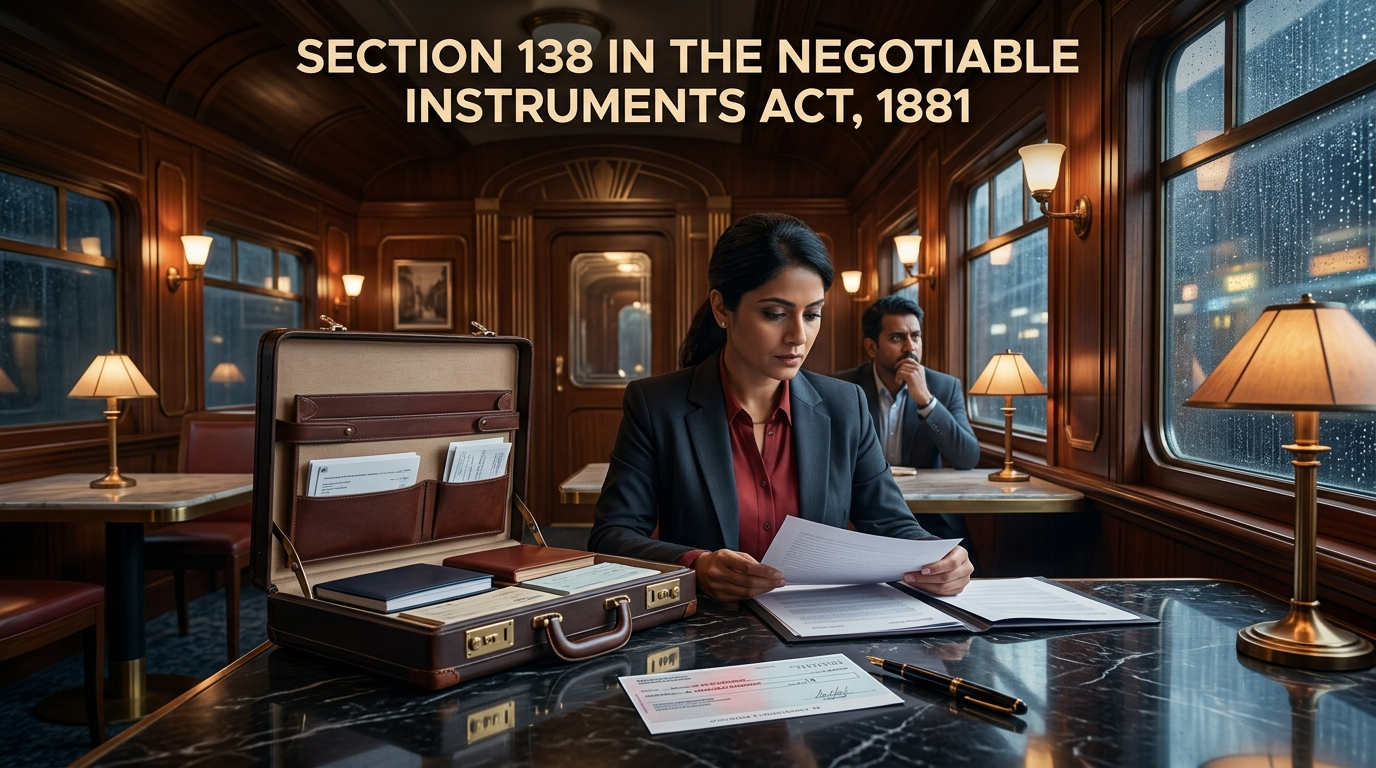
Section 138 in The Negotiable Instruments Act, 1881
This article examines cheque dishonour under Section 138 of the Negotiable Instruments Act, 1881, its meaning, legal requirements, procedural framework, penalties, and remedies available to ensure accountability and confidence in financial transactions.
CORPORATE LAWSSERVICES
DIVYA GOYAL
6/19/20265 min read
Introduction
Cheques have been an important instrument of payment in financial and commercial transactions, as they create a supporting document and evidence of a promise to pay. However, legal consequences arise from the issuance of a cheque that is returned to him unpaid by a bank. This situation has been referred to as cheque dishonour or cheque bounce. In India, cheque dishonour due to lack of sufficient funds is dealt with under Section 138 of the Negotiable Instruments Act, 1881. This provision was introduced to strengthen confidence in the transactions of banking and commercial business.
Meaning of Cheque Dishonour
A dishonoured cheque is returned by a bank and has been refused payment. The bank returns an unpaid cheque along with a memo stating the reason. Section 138 applies to a case of cheque dishonour where:
· The funds in the account are insufficient; or
· The payment exceeds the arrangement agreed to be made between the account holder and the bank.
The aim of Section 138 is to ensure that sufficient funds are maintained by a person who issues a cheque and that there is confidence in the commercial practice.
Essential Requirements for Section 138
For an offence under Section 138, the following conditions are to be satisfied:
· Cheque issued in relation to a binding debt or liability: The cheque must have been issued to settle a recoverable debt or liability. Section 138 is not applicable to a cheque issued as a gift or issued without consideration.
· Validity of period: A cheque must be presented to a bank within three months from the date mentioned on the cheque.
· Dishonour of cheque: A cheque shall be considered dishonoured if it is returned for exceeding the arrangements made with the bank.
· Issuance of legal notice: A payee or holder of a cheque is legally bound to issue a written demand notice within thirty days of learning of the dishonour of the cheque.
· Failure to make payment: The drawer is required to make the payment within fifteen days from the date of the receipt of the notice, failing which the payee or holder of the cheque is legally permitted to institute legal proceedings against the drawer.
Procedure Following Dishonour of a Cheque
The legal process prescribed under Section 138 of the Negotiable Instruments Act, 1881, is as follows:
· Step 1: A cheque is presented for encashment at the bank.
· Step 2: A cheque is returned unpaid to the payee with a cheque return memo.
· Step 3: A legal notice is sent to the drawer by the payee demanding the payment.
· Step 4: The drawer is given a period of fifteen days to make the payment.
· Step 5: If the payment is still not made, the payee has the right to file a complaint before the concerned Magistrate.
The procedures under Section 138 of the Negotiable Instruments Act, 1881, are important as they may affect the maintainability of the complaint.
Punishment under Section 138 of the Negotiable Instruments Act, 1881
The punishment for a person guilty under Section 138 of the Negotiable Instruments Act, 1881 is:
· A term of imprisonment which may extend up to two years.
· Fine, which may extend up to two times the amount of the cheque; or
· Both a term of imprisonment and a fine.
Legal Options Available After Cheque Dishonour
Several legal options are available depending upon the circumstances of the case, which a dishonoured check holder can pursue:
· Legal Notice: Sending a legal notice is the first step following a check's dishonour. The check drawer can respond by fixing the mistake and avoiding further legal action.
· Filing a complaint under Section 138: If the payment is not made after the legal notice is issued, the complainant can file a case before the magistrate for the offence under Section 138.
· Recovery Mechanism: The complainant can also initiate a civil action for the recovery of the dishonoured check amount. where the focus is to punish the check drawer.
· Mediation: To avoid the hassle and lengthy procedures of the judiciary, the Courts prefer to implement mediation or a settlement. In the case of Meters and Instruments Pvt. Ltd. v. Kanchan Mehta, the Supreme Court observed that cheque dishonour cases should be solved practically, therefore promoting efficient disposal of disputes.
· Jurisdiction: Another significant legal issue has been to determine the proper court to file a complaint. Delivering an opinion in favour of the complainant in the case of Dashrath Rupsingh Rathod v. State of Maharashtra also significantly influenced an understanding of the rules of jurisdiction and the recent amendments to the law to provide clarity and avoid procedural difficulties.
Conclusion
Section 138 of the Negotiable Instruments Act, dealing with cheque dishonour, is an important instrument in the legal system that ensures the reliability of financial transactions. This provision aims to achieve a proper balance between the interest of the payee and the right of the drawer to make payment before the institution of a criminal proceeding against him/her. It is necessary to be aware of the timelines involved in such a process due to the fact that any small procedural error may impact the decision of the court.
Frequently Asked Questions (FAQs)
1. What is cheque dishonour under Section 138 of the Negotiable Instruments Act, 1881?
Cheque dishonour, commonly known as cheque bounce, occurs when a bank refuses to honour a cheque due to insufficient funds or because the amount exceeds the arrangement made with the bank. Section 138 of the Negotiable Instruments Act, 1881, makes such dishonour a criminal offence, subject to certain conditions.
2. What are the essential conditions for initiating proceedings under Section 138?
To invoke Section 138, the cheque must have been issued towards a legally enforceable debt or liability, presented within its validity period, returned unpaid by the bank, followed by a legal notice within thirty days, and the drawer must fail to make payment within fifteen days of receiving the notice.
3. Is a cheque issued as a gift covered under Section 138 of the Negotiable Instruments Act?
No. Section 138 applies only when the cheque is issued in discharge of a legally enforceable debt or liability. A cheque issued as a gift or without consideration does not attract criminal liability under this provision.
4. What is the time limit for sending a legal notice after a cheque bounces?
The payee or holder in due course must issue a written demand notice to the drawer within thirty days from the date of receiving information from the bank regarding the dishonour of the cheque.
5. What happens if the drawer fails to pay after receiving the legal notice?
If the drawer does not make payment within fifteen days from the date of receipt of the notice, the payee may file a complaint before the competent Magistrate for the offence under Section 138 of the Negotiable Instruments Act, 1881.
6. What is the punishment for cheque dishonour under Section 138?
A person convicted under Section 138 may be punished with imprisonment for a term extending up to two years, a fine which may extend to twice the amount of the cheque, or both imprisonment and fine.
7. Can a cheque dishonour dispute be settled through mediation?
Yes. Courts encourage amicable settlement and mediation in cheque dishonour cases. In Meters and Instruments Pvt. Ltd. v. Kanchan Mehta, the Supreme Court emphasized the need for pragmatic solutions and speedy disposal of such disputes.
8. Can the holder of a dishonoured cheque file a civil suit in addition to criminal proceedings?
Yes. Apart from initiating criminal proceedings under Section 138 of the Negotiable Instruments Act, the holder may also institute a civil suit for recovery of the cheque amount and any other damages arising from the default.