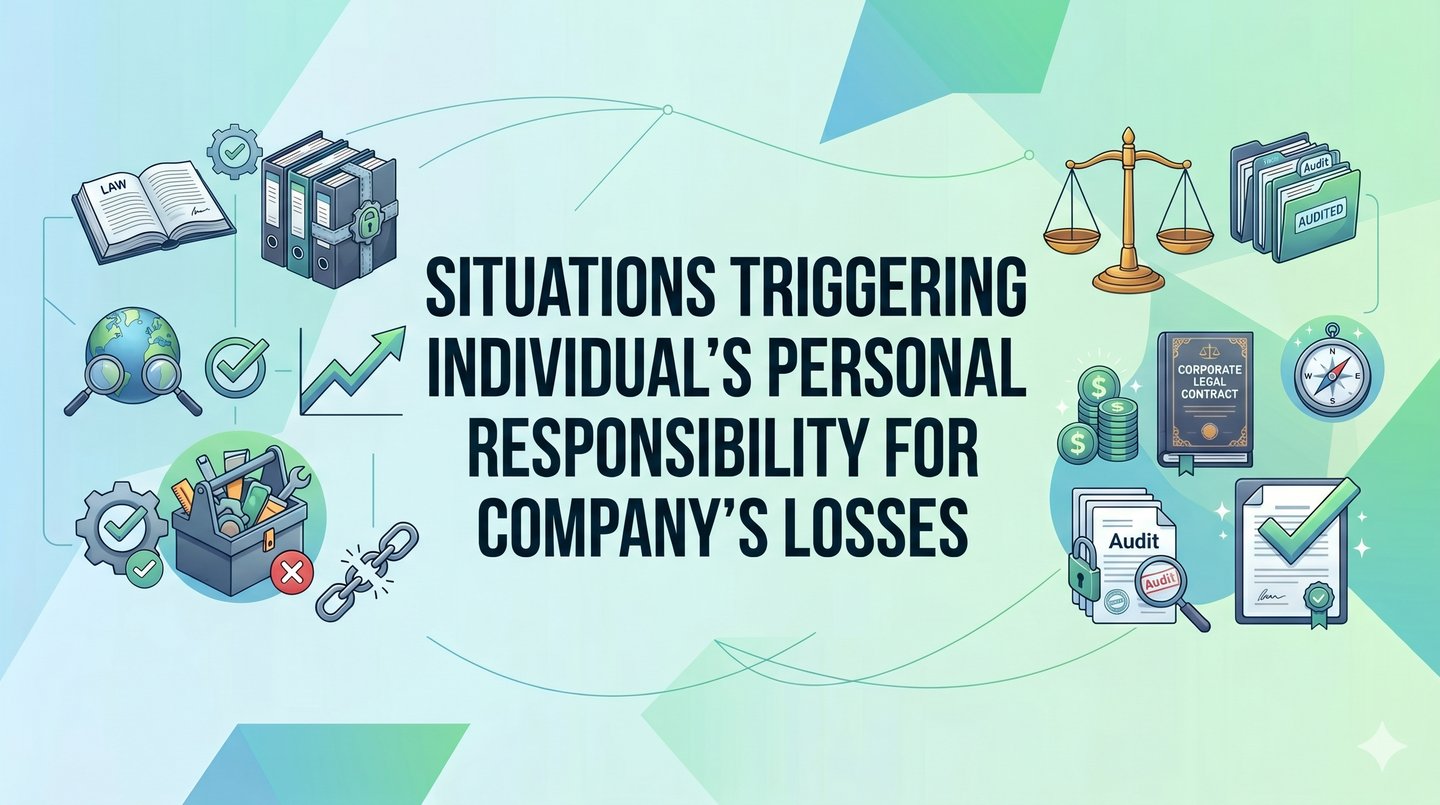
Situations Triggering Individual’s Personal Responsibility For Company’s Losses
This article examines the legal circumstances under which directors lose their limited liability protection, exploring fiduciary duties, statutory obligations, and the judicial doctrine of piercing the corporate veil.
CORPORATE LAWS
Aryan Mundra
5/6/20263 min read
Introduction
A company is a separate legal entity, which means its debts and losses are ordinarily its own and not those of its directors. This principle is one of the foundations of modern company law because it encourages entrepreneurship and investment without exposing individuals to unlimited personal risk. The corporate veil protects the shareholders and officers of the company, but when the concept of a separate entity is misused and any fraudulent or illegal activity takes place, the veil is lifted to punish the actual offender. In the case of Salomon vs. A. Salomon Co. Ltd. (1897), the concept of a separate legal entity of the company was deduced, and it was held that the company is independent from its members and shareholders and has an identity of its own. Once a company is incorporated, it becomes an ‘artificial person’, and the veil is used to protect the interests of the owner (including directors) and members of the company.
But this protection is not an absolute right. Today, the shield is increasingly porous. When a director’s conduct crosses the line into negligence, statutory default, or outright fraud, the law doesn't hesitate to "pierce" that veil. Once that happens, personal assets are no longer off-limits to corporate creditors.
The Fiduciary Breach: A Failure of Trust
Directors are fiduciaries, which means they have a legal duty to act in the best interests of the company and not themselves. When they fail this fundamental test, liability follows.
The Duty of Care, Skill, and Diligence
The law doesn’t demand perfection. However, it does demand diligence. If a director ignores blatant financial red flags or fails to oversee management, they can be sued for the resulting losses.
Duty to Avoid Conflicts of Interest
Loyalty is absolute. Exploiting corporate secrets or business opportunities for personal gain is a clear breach of trust. In these cases, courts often order the director to “account for profits,” meaning the ill-gotten gains must be returned to the company treasury.
Statutory Liability and Insolvency
Beyond general duties, specific laws create strict liability for directors. This is especially true when a company enters the twilight zone of near-insolvency.
Wrongful Trading
If you keep trading while knowing or even just being in a position where you should have known that the company has no hope of avoiding liquidation, you are in trouble. Courts can order such directors to contribute personally to the company’s assets.
Fraudulent Trading
This is more serious. It requires proving an actual intent to defraud creditors. If proven, the director’s liability for the company's debts becomes unlimited.
Environmental and Tax Liabilities
Modern legislation has extended personal liability to certain areas of regulation. For example, in many jurisdictions, directors can be held personally liable for a company not paying employee withholding taxes (PAYE/GST) or for environmental damage caused by the company's operations. These provisions are designed to ensure that directors do not see compliance with regulations as a secondary consideration to making profits.
❖ Pay As You Earn (PAYE) is a system where employers deduct income tax and social insurance contributions directly from employees' wages or pensions before they receive their pay.
Judicial Intervention: Piercing the Veil
Courts generally don’t like to ignore a company’s separate legal status. But they will do it if the corporate structure is being used as a "sham" or a "facade" to hide wrongdoing. Under the "Evasion Principle", a director cannot hide behind a shell company to escape an existing legal obligation like a court order. If they try, the judiciary will lift the veil and hold them directly responsible. The goal here is simple i.e. to ensure the corporate form isn't used as a cloak for deception.
Mitigating the Risks and Defensive Governance
The risk is real, but it is manageable. Smart directors protect themselves through a three-pronged strategy:
D&O Insurance: This provides a financial cushion for legal defence and settlements.
Indemnification Clauses: It means contractual promises where the company covers legal costs for actions taken in good faith.
Active Oversight: Documenting everything. Comprehensive board minutes and independent legal advice are your best defences.
Conclusion
Limited liability is a privilege, not a permanent immunity. The shift from protected director to personally liable individual is almost always a result of the director’s own choices. Whether it’s statutory mandates during a crisis or a court-ordered piercing of the veil, the message is clear: if you fail the office, the losses will follow you home. For anyone in the boardroom today, understanding these boundaries is a prerequisite for leadership.