
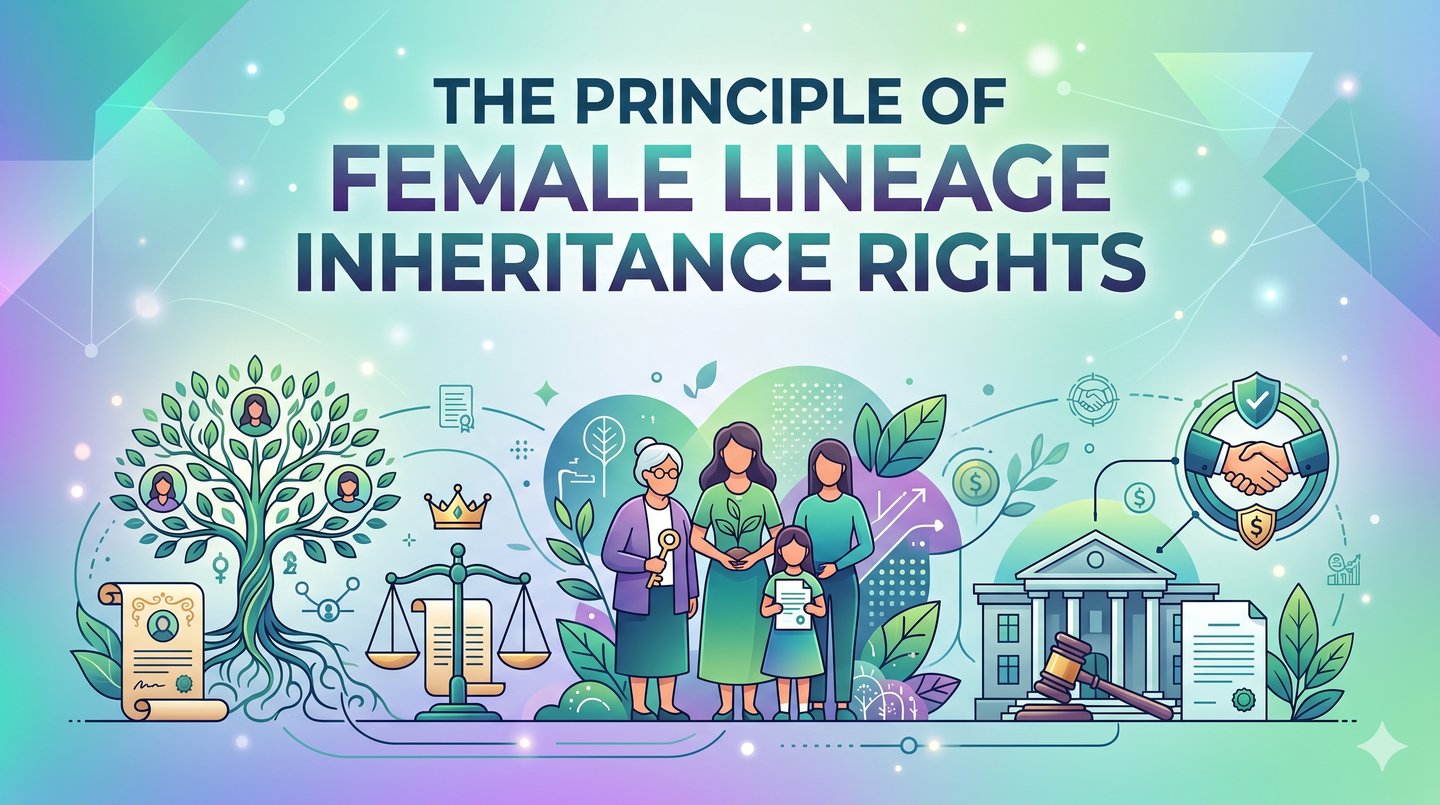
The Principle Of Female Lineage Inheritance Rights
This piece explores whether daughters hold an equal birthright in Hindu ancestral property, tracing the legislative shift of 2005 and pivotal Supreme Court rulings that redefined inheritance law in India.
FAMILY LAW
Sairamdommetti
5/7/20265 min read
Introduction-
Indian society has long drawn a line between a son and a daughter when it comes to who truly ‘belongs’ to the family home. Historically, a daughter was expected to leave her natal household upon marriage, and with that departure went any informal claim she might have had to the family estate. The law reflected this expectation — the Hindu Succession Act of 1956 acknowledged daughters as heirs, but stopped well short of granting them a stake in ancestral property from birth. Sons stepped into that role automatically, acquiring what lawyers call coparcenary rights the moment they entered the world. It took nearly five decades before Parliament corrected this imbalance. The Hindu Succession (Amendment) Act of 2005 tore down this wall, and the Supreme Court later reinforced the demolition so thoroughly that no ambiguity could survive. What follows is an attempt to unpack what the law now actually says, why it matters, and where real-world barriers still linger.
Understanding Ancestral Property Under Hindu Law-
Not every piece of property owned by a father qualifies as ‘ancestral.’ Hindu personal law draws a firm distinction between two categories. The first is self-acquired property — assets the individual earned, purchased, or received as a personal gift. The owner enjoys near-absolute freedom over this; he may give it away, mortgage it, or leave it to whomever he pleases through a will. The second category is ancestral property, which refers to assets that have descended through an unbroken male line for up to four generations without ever being formally divided. The defining feature of ancestral property is that a share in it attaches to a person at birth, not at death. This makes it categorically different from ordinary inheritance, where rights typically crystallise only after a person passes away.
The Legal Framework: From 1956 to Today-
Several legislative provisions together shape what a daughter can claim :
Hindu Succession Act, 1956: Daughters were placed in Class I of the heir hierarchy, entitling them to a share when a male Hindu died intestate. Yet this did not translate into any entitlement during the father’s lifetime, nor did it make them coparceners.
Section 6, Hindu Succession (Amendment) Act, 2005: This provision re-drew the coparcenary map. A daughter, it declared, would henceforth be a coparcener by birth — holding the same rights and shouldering the same obligations as her brother. Crucially, marriage would not strip her of this standing.
Vineeta Sharma v. Rakesh Sharma, 2020: The Supreme Court put to rest a long-running dispute about whether the 2005 amendment was forward-looking or could also reach back in time. The bench held that because coparcenary rights spring from birth, not from the amendment date, a daughter’s entitlement survives even where the father had already passed away before 2005.
The Vineeta Sharma Ruling: Why It Changed Everything-
Before 2020, India’s courts were speaking in contradictory voices. The Allahabad and Madras High Courts read the 2005 amendment as retrospective. Others, including an earlier Supreme Court bench in Prakash v. Phulwati (2015), insisted a daughter could only claim rights if her father was alive on September 9, 2005. A different bench in Danamma v. Amar (2018) took a more liberal view, muddying the waters further.
The three-judge bench in Vineeta Sharma swept all of this aside. Its reasoning was elegantly simple: since the coparcenary right springs from birth and exists independently of any amendment, the question of whether the father was alive at a particular date is legally irrelevant. The right pre-dates the statute; the statute merely confirmed it. This effectively wiped out the preconditions that earlier judgments had imposed and ensured that no daughter would lose her birthright on a technicality of timing.
Sujata Sharma v. Manu Gupta, 2015: The Delhi High Court went a step further and confirmed that the eldest female coparcener is entitled to manage the Hindu Undivided Family as its Karta — a managerial role once treated as the exclusive domain of men.
What Exactly Does a Daughter’s Coparcenary Status Mean?
Being a coparcener is not merely a symbolic title. It carries tangible legal weight :
A stake from the moment of birth: The share does not materialise upon a family member’s death or at any specific age — it exists from day one.
Power to seek partition: A daughter may approach a civil court and formally demand that the ancestral property be divided, receiving her identified share.
Eligibility to manage family property: As a coparcener, she can step into the role of Karta and administer the Hindu Undivided Family’s affairs, which includes signing documents and making financial decisions on behalf of the family.
Shared responsibility for debts: Rights are paired with obligations. A daughter coparcener is equally answerable for pre-existing family debts attached to the ancestral estate
One Critical Boundary: Self-Acquired Property Remains the Father’s to Decide-
The law does not strip fathers of all autonomy. Where property is genuinely self-acquired — built from personal savings, individual enterprise, or received as a gift unconnected to the joint family — a father retains the freedom to direct it wherever he chooses through a registered will. A daughter has no overriding claim on such property. The equal entitlement discussed throughout this article is specific to ancestral property, where no single individual can claim ownership of more than their own undivided share. Attempting to bequeath an entire piece of ancestral land through a will is legally defective to the extent it encroaches on a coparcener’s pre-existing share.
Common Questions on Daughters’ Rights in Ancestral Property-
Q1. Does marriage take away a daughter’s right to ancestral property?
Not at all. The 2005 amendment specifically closes this door. A daughter’s coparcenary status is unaffected by her matrimonial journey — she holds the same position whether she is unmarried, married, separated, or widowed.
Q2. Can a father write a will to prevent his daughter from getting ancestral property?
Only partially. A father may will away his own defined share in the coparcenary. He cannot, however, will away shares that belong to other coparceners — including his daughter. Any portion of a will that purports to transfer what is not solely the testator’s to give is open to legal challenge.
Q3. What happens if the family had already divided the property before 2005?
Where a partition was formalised through a registered deed or a court decree before December 20, 2004, the amendment does not unravel it. The law treats such partitions as settled. Unregistered or oral divisions, however, carry no such protection and may be contested by daughters asserting their statutory rights.
Challenges That Still Persist-
Gap between awareness and action: A significant number of women in rural and semi-urban India remain unaware that the law even changed. Without that foundational knowledge, no claim is ever filed.
Informal family pressure: Daughters who do know their rights often choose not to assert them under pressure to preserve family harmony. Relinquishment deeds are sometimes signed without the signatory fully grasping what she is surrendering.
Deliberate pre-emptive partitions: Some families registered formal partitions in the months leading up to December 20, 2004, specifically to lock daughters out before the amendment could take effect.
Documentation gaps: Proving that property is genuinely ancestral in character requires tracing ownership through multiple generations. Revenue records are frequently incomplete, disputed, or unavailable.
Slow-moving courts: Partition suits can drag on for many years. For a daughter living apart from the family and pursuing a claim largely on her own, the cost — financial and emotional — of sustained litigation is not always manageable.
Conclusion
The transformation in how Indian law treats daughters in matters of ancestral property is one of the more quietly consequential shifts in the country’s post-independence legal history. What began as a limited right to inherit from a deceased father has grown into a full coparcenary standing — a birthright that attaches before any death occurs and survives marriage, time, and even the absence of the father at the moment the law changed. The Supreme Court’s ruling in Vineeta Sharma removed the last credible procedural hurdle. Yet the gap between what the statute promises and what daughters actually receive on the ground remains wide. Awareness, affordable legal aid, and a willingness within families to honour the law rather than circumvent it are the true levers of change. Property equality and gender equality are not separate conversations — they are the same one.