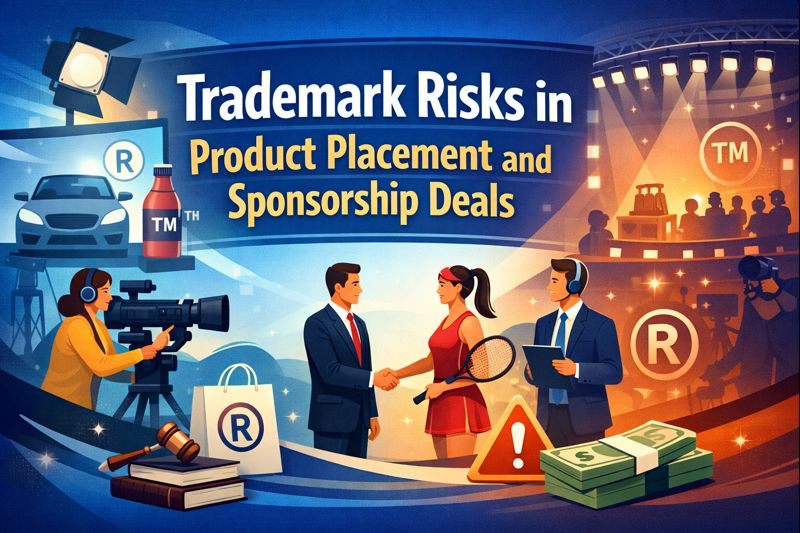
Trademark Risks in Product Placement and Sponsorship Deals
This article is solely about how trademark law is solving these issues, with specific attention to influencer marketing and instances of negative product placement. Further, it focuses on the Indian legal framework that addresses the same issue, and informed by comparative international practices, the main aim of this discussion is to identify existing regulatory gaps, enforcement challenges, and the increasing need for legal reform to protect brand goodwill while preserving creative freedom.
IPR
Shreshta Sahu
1/13/20264 min read
Introduction
Today, the face of advertisement is changing; it no longer looks like it did in the 1900s, when advertisements meant ads only. Brands quietly show up in movies, videos, sports matches, and on social media. You must have seen famous people like actors and actresses using it, with no actual announcement that it’s an advertisement. This way of advertisement is called product placement or sponsorship, and it works by becoming one in instead of being obvious.
But this can give rise to serious concern about trademark laws. Trademark laws were made to prevent people from getting confused and to protect the reputation and name of the brand. When brands present themselves in the posts and videos without permission and without telling people that it’s an ad, the rules don’t always work properly. Online creators and influencers use brands all the time, often without any prescribed rule. This is the main reason why the law struggles to keep up with how advertising works today.
Trademark Infringement and False Association
Many times people utilize brand names and logos without availing themselves of the actual permission. This imposes a great threat to trademark law. In India, trademark law states that if someone utilizes someone else's brand or a brand that belongs to another in a way that causes confusion, it is trademark infringement. In India, if a movie or video shows a brand logo without permission—especially if money, gifts, or free products are involved—it may break the rules.
This actually happened a lot with influencers. Influencers often show or talk about products casually, without saying if it’s an advertisement or if the brand allowed it. This often led to a misconception that an influencer is being paid by the brand even when they aren’t. The Indian laws also give protection to those brand names that are not yet registered. The Supreme Court has pronounced in their judgment that what matters is whether people are misled, not whether the person meant to cheat. So if the influencer pretends to make it look like they are associated with the brand even when they are not, it can certainly get them in trouble even if they didn’t mean to do anything wrong.
Negative Product Placement and Brand Damage
A brand can also attract injuries even when its concerned customers are not confused. This happens often when a brand is portrayed in an ill way in the movies and on platforms like OTT, and this concept of false or ill portrayal is known as negative product placement. Even when people know that the portrayal is fake, it can lead to real effects in the long run.
Indian trademark law has rules and regulations to protect a brand from that kind of damage. According to the trademark law in India, a brand should not be present as an ill brand, even in the movies, or if it is presented in a wrong way, prior permission should be taken. But courts are careful because movies and shows are also a way to tell stories and share ideas. In Caterpillar Inc. v. Walt Disney Co., a brand was shown badly in a movie, but the court said there was not enough proof that people were actually harmed.
In another situation, in a TV show, a fitness brand was represented in a very ill manner that upset the viewer. Even though it was just part of the story, people reacted strongly, and the brand quickly lost money and reputation. These examples show a problem. Today, brand damage can happen very fast online and be clearly seen, but the law often asks for proof that takes a long time to collect. By then, the damage is already done.
Influencers, Endorsements, and Consumer Protection
The Indian law clarifies that when an influencer talks about and shows a product, they induce people to utilize it in their daily life, known as endorsement. The rule is meant to protect people from being tricked by fake ads. But even though this rule exists, it is not always followed or enforced properly.
There are also advertising guidelines that tell influencers to clearly say when a post is paid or sponsored. These rules are made by an organization that gives advice, not punishment. Because they cannot legally force anyone to follow the rules, many influencers ignore them.
This leaves a gap in the system. When rules are weak or not enforced, people can misuse brand names and logos without facing serious consequences, and consumers may not realize they are being influenced by hidden advertisements.
Platform Responsibility and Law Gaps
Big apps and websites like social media platforms also make things confusing. The law says these platforms are not responsible for wrong content unless they are told to remove it and refuse to do so. But in real life, it takes a long time to remove posts that misuse brand names or logos. By the time action is taken, the video or post may already be seen by millions of people. This makes it harder for brands to protect themselves and puts all the work on them.
What Other Countries Do
In some other countries, the rules are much more clear and easy to enforce. In the United States, influences are bound to clearly when they are paid and when they are not; if they don't, they attract liability. In the United Kingdom, the same rules are being taught to the influencer. Compared to this, India relied on many separate laws and on friendly guidelines that are not yet strong enough for today's fast pace.
Conclusion
Product placement and sponsorship are the top ways or roots for bards to advertise, but such roots can give rise to concerning issues, mainly and often utilizing brand names without their prior consent and making a picture before people that is not true. Indian laws are not yet capable enough to counter these concerning issues. Brands often can be seen knowing court dues after the damages have been done. Brands often have to go to court after the damage is already done, and we can see that many ads are clearly marked as ads in India.
To deal with this issue and concern, India needs even more clear and strong laws. Influencers need to be bound to disclose when they are paid for advertisement and when not. Brands and influencers are hereby required to execute a permission agreement, harmful content should be removed quickly, and creators should be taught about trademark rules. If these changes are not made, brands may lose trust, and people may stop believing what they see online.