
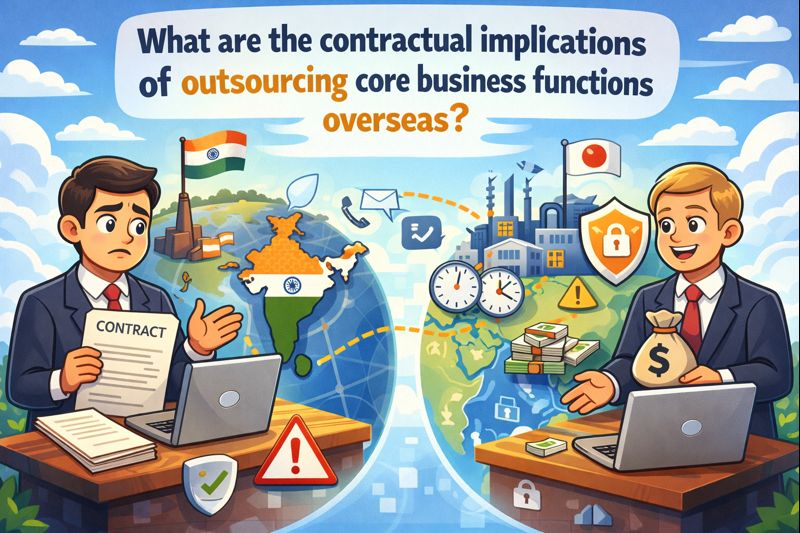
What are the contractual implications of outsourcing core business functions overseas?
In response to competitive forces and beneficial economic impacts, outsourcing the main business transfers the operational performance without legal responsibility. The non-delegable duties of Indian contract, corporate, regulatory, labor, and dispute-resolution regimes notwithstanding, the judiciary protects structured outsourcing and only interferes with sham or evasive ones.
CORPORATE LAWS
Ansh Yashaswi
1/2/20265 min read

I. Introduction
Outsourcing is no longer a marginal cost-reduction activity but rather a source of enterprise structure in the 21st century. Organizations are more often offshoring the core business functions such as technology infrastructure, compliance operations, customer interfaces, and research activities. This change increases exposure to law. Indian law does not in any way forbid outsourcing of the core functions, but it has never granted outsourcing permission to turn into a tool of law avoidance. The main legal issue is, however, not whether outsourcing is acceptable, but the extent to which the liability remains upon delegation, notwithstanding the delegation. This paper discusses that boundary in contract law, corporate governance, sectoral regulations, labor jurisprudence, dispute resolution, and taxation.
II. Contract Law: Delegation Without Discharge
According to the Indian Contract Act of 1872, unless the contract or the nature of the obligation permits delegation, contractual promises must typically be fulfilled by the promisor. Acceptance of performance from a third party does not discharge the original promisor from liability. Therefore, it operates as a mode of performance, not a novation.
When essential business operations are outsourced, this distinction becomes crucial. It is not possible to treat functions that are essential to customer interaction, revenue generation, or compliance as fungible. Even in cases where execution takes place offshore, the principal entity is still responsible for the breach. Contractual arrangements that use outsourcing to transfer liability are both commercially risky and doctrinally flawed.
III. Enforceability and Limits of Substituted Performance
Outsourcing-based defenses are limited by the Specific Relief Act of 1963. Contracts involving ongoing supervision, specialized skills, or continuous duties are not expressly enforceable against third parties. Courts may allow substituted performance, but the principal contracting party is still the target of remedies.
Vendor failure offshore almost never triggers frustration unless the disruption is truly catastrophic and legally unavoidable. Rarely do generic delegation or force majeure clauses satisfy this requirement. Instead of providing protection, drafting that presumes otherwise encourages enforcement failure.
IV. Corporate Governance, RBI Regulation, and Contractual Risk Architecture
Fiduciary responsibility in the Companies Act, 2013, is firmly established on the board level. Directors have a responsibility of care, diligence, and supervision of the running of the business, even the external outsourced activities. This outsourcing of core functions, which is not under governance control, can hence translate to a fiduciary-duty violation rather than a breach of business judgment.
This stance is acute in the case of regulated parties. Outsourcing of information technology services to external parties by the Reserve Bank of India Board of Directors, 2023, contains finer details such as the policies of outsourcing approved by the board, materiality, and ongoing monitoring. The outsourcing arrangements should not handicap the entity from servicing the regulatory or customer demands.
Conformity can not be abstract. Mitigation of the risks should be contractual. Outsourcing core IT or compliance functions that are required to be in compliance with RBI, the following is required:
Step-in rights that allow the regulated body or its nominee to take up operations under either regulatory instruction or on the distress of the vendors.
Shadow-vendor or dual-vendor contingencies of important services.
Free of charge audit and inspection of subcontractors and cloud providers.
Agreed upon exit and transition support plans in order to guarantee continuity.
In the RBI Guidance Note on Operational Risk Management and Operational Resilience (2024), the element of third-party dependence is regarded as a systemic weakness. During disruption, it is the role of boards to provide continuity in important operations. The outsourcing of functional areas thus becomes a subject of much criticism rather than leniency in a contract.
V. Data Protection, Cybersecurity, and Cross-Border Processing
The Digital Personal Data Protection Act, 2023, provides an accountability means in which control, not the geography, is followed. Data fiduciaries will have an obligation to deal with lawful processing and protection, breach remedies, and grievance redress regardless of the processing outside India. Outsourcing essential digital processes to foreign countries thus increases the exposure to compliance.
Parallel liability is created by the Information Technology Act, 2000, which involves wrongful loss that occurs when there is failure to exercise reasonable security practices. The mitigation has to go beyond indemnities and encompass:
Elaborated data processing contracts assigning processor responsibilities.
Simulations and testing of audit and compliance verification rights.
Strict timelines of breach notification in line with statutory obligations.
Regulatory exposure cannot be neutralized using commercial risk allocation in those situations where fiduciary duties are non-transferable.
VI. Intellectual Property Creation and Ownership Risks
Outsourcing core functions frequently involves the creation of proprietary outputs. Connected to the Copyright Act, 1957, and the Patents Act, 1970, there is no statutory transfer of ownership to the commissioning enterprise in the absence of an effective written assignment.
Mitigation would involve the mandatory assignment of the present-tense IP covering the whole of the foreground intellectual property, which is enforceable by moral rights waiver where possible. In offshore development of software, algorithms, or technical processes, the escrow of source code or documentation is necessary. In the absence of escrow and step-in access, even though IP ownership can still legally hold during an insolvency or dispute involving a vendor, in practice, it cannot be commercially used.
VII. Labour Law, Sham Outsourcing, and Judicial Calibration
Indian labour law does not invalidate outsourcing as a business model. It intervenes only where outsourcing disguises statutory evasion.
The Supreme Court supported outsourcing in Raj Kumar Mishra v. CBSE (2025) when there was a legitimate contractual middleman and engagement was governed by a documentary framework. Evidence and structure were given precedence by the Court over vague claims of control. On the other hand, rather than criticizing outsourcing in general, the Court in Dharam Singh v. State of Uttar Pradesh (2025) upheld constitutional limitations by denouncing ongoing ad hoc engagement in public employment.
Courts uphold structured outsourcing and only penalize evasive or exploitative arrangements, according to the calibrated position. Clear intermediary structures, a lack of supervisory control, and a formal division between the principal and the workforce are the key components of mitigation.
VIII. Dispute Resolution, Arbitration, and Enforcement Strategy
Cross-border dispute Outsourcing controversies often result in cross-border enforcement disputes. The Arbitration and Conciliation Act of 1996 regulates interim relief, tribunal jurisdiction, and award enforcement. In case of offshore vendor bankruptcy, principals have to be prepared by using powerful arbitration provisions in order to enjoy interim protection, retention of assets, and continuum protection.
The Draft Arbitration and Conciliation (Amendment) Bill, 2024, heralds a change in the direction of institutional arbitration, emergency arbitrators, and an intervention by the judiciary. The course of action makes early planning based on seat selection, institutional rules, and arbitrator profiles a procedural choice and a strategic contracting decision. Contracts that do not go in this direction are at risk of creating friction in enforcement.
IX. Taxation and Permanent Establishment Exposure
Outsourcing core overseas operations also triggers tax risk. The permanent establishment exposure under the Income Tax Act, 1961, is that offshore teams are used to regularly negotiate commercial terms, enter into contracts, result, or perform as dependent agents.
Escalation of risk occurs when the offshore staff have authority to manipulate pricing, customer acquisition, or suppliers despite contracts that may have been officially signed in India. Mitigation necessitates functionality demarcation, outright disallowing offshore contract-concluding authority, and contemporaneous documentation of transfer-pricing accords of economic substance that coheres with the contractual arrangement. Statutory attribution cannot be defeated by the mere disclaimers.
Conclusion
Indian law does not prohibit outsourcing of core business functions. It prohibits outsourcing of responsibility. Collectively, contract law, corporate governance norms, sectoral regulation, labour jurisprudence, arbitration frameworks, and tax statutes hold the principal enterprise accountable. Outsourcing is only legal when it is set up with rules, regulatory alignment, and careful drafting that takes litigation into account.