
What are the contractual Risks in Software White-Label Rebranding Arrangements?
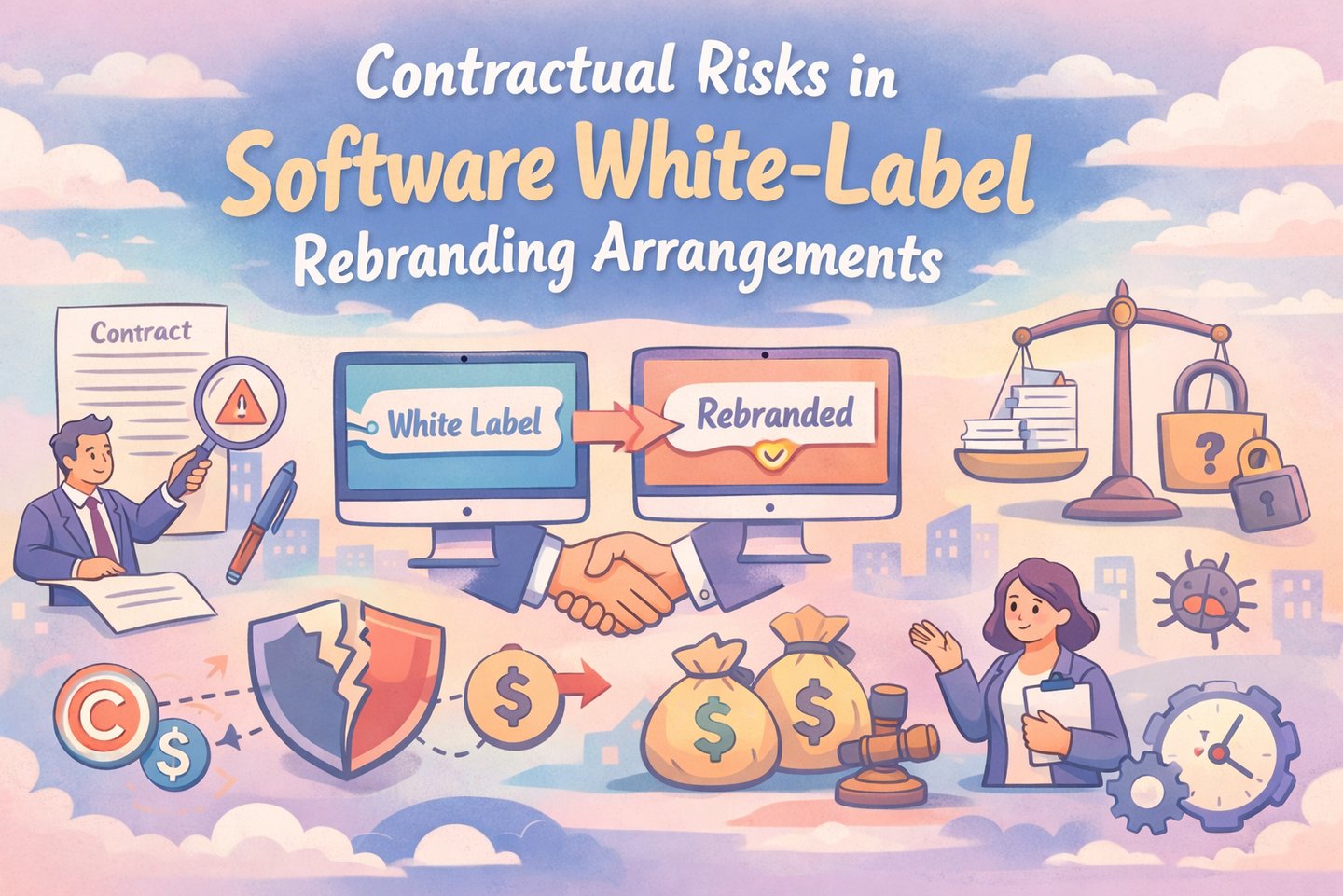
White-label software rebranding offers commercial efficiency but carries significant contractual risks involving intellectual property, liability, data protection, service levels, financial exposure, and termination dependency.
CORPORATE LAWS
Tanmay
2/24/20264 min read
Introduction
White-label software arrangements have become increasingly common in today’s digital economy. Start-ups and established businesses alike often prefer to license an existing software product and rebrand it as their own rather than build technology from scratch. It saves time, reduces development costs, and accelerates market entry. On the surface, it appears to be a practical and efficient business model.
However, behind the convenience lies a complex web of contractual risks. These risks are often underestimated at the negotiation stage, only to surface later when disputes arise. White-label arrangements are not merely licensing agreements; they are ongoing commercial relationships that involve intellectual property, branding rights, data control, liability exposure, and dependency on technical performance. If not carefully structured, they can become legally and commercially problematic.
IP Risks
One of the primary risks in white-label agreements concerns intellectual property ownership. Typically, the original developer retains ownership of the underlying software, while the reseller receives limited rights to market and distribute it under its own branding. Problems arise when the scope of these rights is vaguely drafted. For example, does the reseller have the right to modify the software interface? Can it integrate the software with third-party tools? What happens to improvements or customizations developed during the partnership? Ambiguity in such clauses often leads to disputes over ownership of derivative works and enhancements.
Branding & Liability
Another significant risk involves branding and representation. When a reseller markets the software under its own name, customers generally assume that the reseller is the creator and technical owner of the product. If performance issues occur, customers will hold the reseller accountable, regardless of who actually built the system. This creates a mismatch between control and liability. The reseller may not have technical authority to fix issues promptly, yet it bears reputational damage and potential legal claims. Without strong indemnity provisions and clear service level agreements, the reseller is exposed.
Service Levels
Service level commitments from another critical area of risk. White-label software is often provided as a service, meaning uptime guarantees, response times, data security standards, and maintenance schedules become central to the agreement. If the developer fails to meet these obligations, the reseller’s business may suffer. However, many contracts limit the developer’s liability through capped damages or exclusion clauses. This imbalance can leave the reseller without meaningful remedies. Negotiating realistic service levels and enforceable remedies is therefore essential.
Data Protection
Data protection and confidentiality present further concerns. In many cases, end-user data flows through systems controlled by the original developer. Questions then arise about data ownership, data processing responsibilities, and compliance with applicable privacy laws. If a data breach occurs, liability may extend beyond the party directly responsible for the technical failure. In jurisdictions with strict data protection regulations, regulatory penalties can be severe. Contracts must clearly define roles, particularly in terms of who acts as data controller and who acts as data processor, along with clear security obligations.
Termination
Termination provisions are another area where risks frequently materialize. White-label arrangements often create operational dependency. If the agreement is terminated abruptly, the reseller may lose access to the software that underpins its entire business model. Customers may be left stranded, and the reseller’s brand reputation can collapse overnight. For this reason, transition assistance clauses, data migration rights, and reasonable termination notice periods are not mere formalities. They are survival mechanisms.
Exclusivity clauses can also create unintended consequences. Developers may grant exclusivity within a particular territory or market segment. While this appears advantageous, it can restrict flexibility on both sides. If sales targets are not met, disputes may arise regarding minimum performance obligations. Poorly drafted exclusivity provisions often result in litigation over whether contractual conditions were satisfied.
Financial Risk
Financial risks should not be overlooked. Payment structures in white-label agreements may include licensing fees, revenue-sharing models, or tiered pricing mechanisms. If revenue projections are overly optimistic, the reseller may struggle to meet minimum commitments. Conversely, if pricing adjustment mechanisms are unclear, disputes over revenue calculation may follow. Transparency in financial reporting obligations is critical.
Technological Roadmap and Dependency Risks
There is also the risk of over-reliance on the developer’s technical roadmap. Software evolves continuously. If the developer decides to discontinue certain features or pivot the product direction, the reseller may find itself marketing an outdated or unsupported solution. Contracts should address update policies and long-term product maintenance commitments, yet many agreements treat them superficially.
Dispute Resolution and Governing Law Considerations
Finally, dispute resolution clauses deserve careful attention. Given that white-label arrangements often involve cross-border transactions, jurisdiction and governing law provisions can significantly influence the outcome of any conflict. Arbitration clauses, choice of law, and enforcement mechanisms must be deliberately considered rather than inserted as boilerplate language.
Risk Mitigation & Conclusion
In practice, the most common contractual risk in white-label rebranding arrangements is not a single clause but a failure to anticipate how the relationship will function over time. These agreements are not static. They require clarity, foresight, and balanced allocation of risk.
Businesses entering into such arrangements should conduct legal due diligence on the software, negotiate clear intellectual property and data clauses, align liability with operational control, and ensure that termination scenarios are realistically addressed. A well-drafted agreement does not eliminate risk, but it significantly reduces uncertainty.
White-label software arrangements offer undeniable commercial advantages. Yet they are built on trust reinforced by contract. When the contract is weak, trust alone is insufficient. Careful drafting, realistic expectations, and ongoing oversight are the keys to managing contractual risk in these evolving digital partnerships.
In the end, a white-label arrangement is less about rebranding technology and more about structuring responsibility. And responsibility, in commercial law, always begins with the contract.