
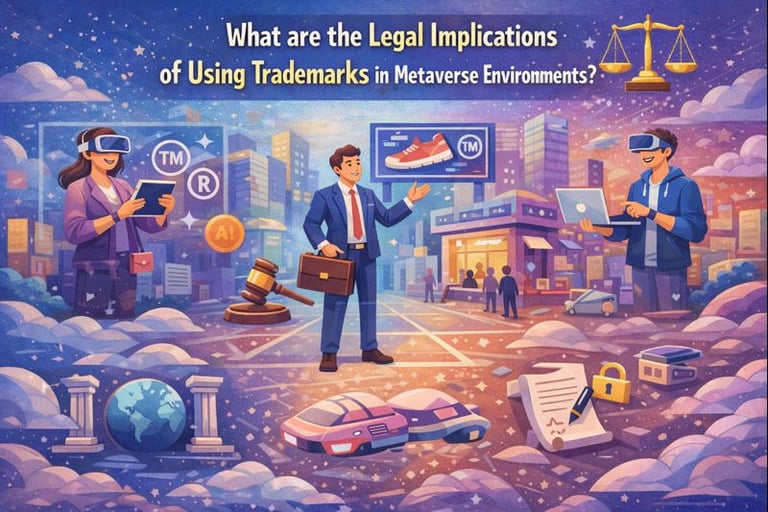
What are the Legal Implications of Using Trademarks in Metaverse Environments?
The expansion of metaverse platforms has created novel legal challenges for trademark protection, raising critical questions about infringement, enforcement, jurisdiction, and the evolution of intellectual property rights in virtual environments.
IPR
Saurabh Rajure
1/4/20263 min read
Introduction
The metaverse is an emerging virtual ecosystem in which users interact through virtual worlds, augmented reality, and blockchain-enabled platforms. With the increased commercial transactions within such environments, the significance of trademarks has grown exponentially and has emerged as an important digital asset. Companies continue to display brand names, logos, and symbols in virtual world environments to offer virtual goods, services, and experiences. Doing so presents issues of ownership, infringement, enforcement, and jurisdiction over the trademark itself. Conventional laws on trademarks developed for physical markets make such new, decentralized, and cross-border metaverse platform applications rather uncertain. Identifying the legal ramifications of trademark use in the metaverse becomes very important to businesses, creators, and policymakers.
Trademark Protection in the Metaverse
The metaverse utilizes trademarks in relation to virtual goods like digital apparel, virtual real estate, and non-fungible tokens. Although these goods exist only virtually, courts in different countries have started to recognize these as commercial products that can infringe upon a trademark. Registration of trademarks usually involves certain products and/or services, and typically, controversies arise where these virtual goods may not belong to certain classifications. There is a need to include downloadable virtual goods and online services within the registered trademarks of these goods and/or services.
Trademark Infringement and Dilution Risks
One of the major legal aspects of the use of trademarks within the boundaries of the metaverse concerns the rising possibility of infringement or dilution. Such a possibility mainly concerns the unauthorized use of well-known trademarks in relation to virtual products. This can lead to confusion among the relevant consumers as to the possible affiliation or endorsement of the certain brand. Moreover, dilution of a well-known trademark might occur within the boundaries of the metaverse because of the possible negative impact of the virtual scenario on the distinctiveness of such a trademark.
Jurisdictional and Enforcement Challenges
The metaverse exists simultaneously across a variety of different jurisdictions, making it more challenging to effectively enforce traditional trademarks. It can be difficult to determine which jurisdictions' laws will apply, particularly if the metaverse platforms exist in a decentralized manner or across a variety of regions. It can be difficult to enforce these rights, particularly because these rights may be violated anonymously by users of the metaverse using digital wallets and avatars. Such a problem can be particularly challenging for rights holders because they would need to use the enforcement processes offered by the metaverse platforms, such as take-down notifications.
Role of NFTs and Blockchain Technology
Also, blockchain technology and NFTs bring in a fresh set of legal issues. The involvement of trademarks in NFTs has raised concerns regarding ownership and licensing. While the purchase of an NFT does not provide the consumer with trademark rights, the consumer assumes rights beyond the legal scope. The use of smart contracts with the purchase of an NFT may hinder legal remedies if the infringing content has already been embedded in the blockchain.
Defenses and Fair Use in Virtual Spaces
In the matter of the metaverse and trademarks, defenses such as ‘fair use,’ ‘artistic expression,’ and ‘parody' could come into play. The fact is that virtual reality spaces mix business with creative expression in such a manner that separating infringement of trademarks from artistic expression would prove quite challenging.
Regulatory and Policy Developments
National governments and international bodies are slowly beginning to look at the regulation of intellectual property within virtual reality space. Regulatory debates are centered on how the current system of trademark protection can be modified to incorporate the products offered within the digital space.
Conclusion
The use of trademarks in metaverse environments presents significant legal implications that challenge traditional intellectual property frameworks. Issues of infringement, dilution, jurisdiction, and enforcement require careful consideration by rights holders and regulators alike. As virtual commerce continues to expand, trademark law must evolve to provide effective protection while supporting creativity and technological advancement.