
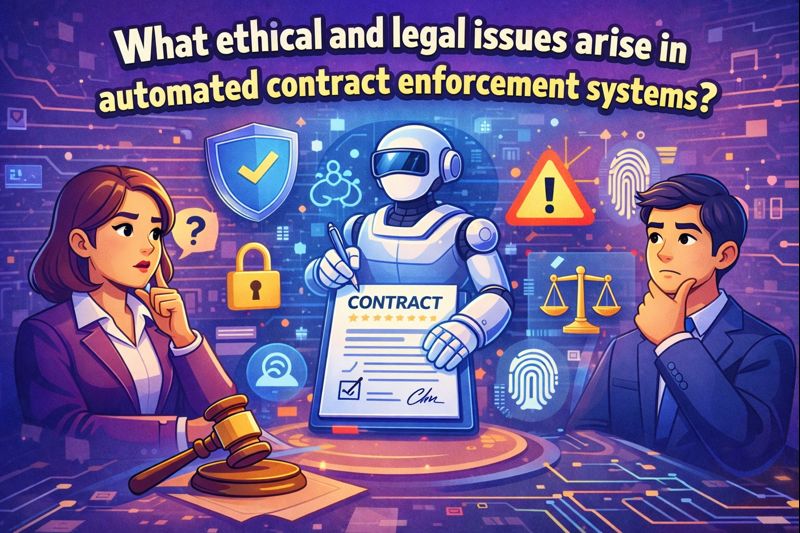
What ethical and legal issues arise in automated contract enforcement systems?
This article aims to explore various legal and ethical concerns surrounding automated contract enforcement systems by explaining what automated contracts are and thereafter analyzing whether the current legal framework addresses the concerns arising due to them.
CORPORATE LAWS
Khushi Thakur
12/30/20254 min read
What is an automated contract?
An automated contract, also known as a “smart contract,” is a computerized transaction protocol that executes the terms of a contract. Automated contracts involve self-executing code, which aims to digitally facilitate the execution and enforcement of a contract using a computer protocol. It enables automatic execution of contractual obligations without human oversight through code.
Ethical Issues In Automated Contract Enforcement
1. Absence of Human Judgement and Equity:
Automated contract enforcement works in accordance with pre-defined and integrated codes and computerized protocols, based on strict contractual parameters, which leaves no room for human discretion. This raises ethical considerations when, despite the occurrence of some unforeseeable events, enforcement takes place. Traditionally, the law of contracts addresses such situations through various doctrines and principles like equity, frustration, force majeure, good faith, etc. These considerations require human intervention and conscience in order to understand scenarios. The most recent example of such unforeseeable, unfortunate hardship is pandemics, which forced courts to think beyond ‘black letter law’ and extend consolations by relieving parties of strict contractual performance. These flexibilities of justice, equity, and good conscience equipped courts to intervene with strict enforcement of contracts in apt cases as and when deemed fit. However, AI-integrated systems fail to take into account these hardships, resulting in strict enforcement of contracts that might be valid in the eyes of the law but questionable ethically.
2. Consent and Transparency:
In the Law of Contracts, consent holds much significance. It won’t be an exaggeration to say that “consent is the essence of a contract.” When parties agree to contractual terms in automated contract enforcement systems, it's difficult to say whether they truly understand the implications of it or not. This raises the question of whether the parties provided their truly informed consent. It becomes much more relevant when enforcement includes imposition of automated penalties or reduction of money without prior notice. Let’s say X runs out of Google storage; when the notification pops up on his phone screen, he agrees to buy the plan on a trial basis. After two months, while going through his “PhonePe” history, he discovers his account is being deducted of a particular sum of money every month through autopay, without him getting any prior notice. This shocks him, as while agreeing to the plan, he did not fully know about the implications.
3. Algorithmic Bias and Power Imbalance:
Wherever the use of AI is involved, the inevitable concern of bias arises. Automated contract enforcement systems maybe biased on the basis of the data used in their model designs. When this happens, such automated enforcement can disproportionately affect one party whose bias does not align with the other. The current technological and legal framework fails to devise accountability mechanisms to correct or account for such biased enforcement outcomes, specifically where no human involvement is there and the system is completely automated.
Legal Issues in Automated Contract Enforcement
1. Intention and Validity of Contracts
A valid agreement requires clear manifestation of intention as well as free consent from both parties as essential ingredients. For automated contract enforcement systems, execution of code overrides any other requirement, even the assessment of essential ingredients of a contract. While it may seem that parties truly had the intention to contract, it would always be questionable as to whether they truly intended to consent to every automated outcome, particularly ones that arise from unforeseen scenarios or coding errors. Thus, the courts would be additionally burdened with distinguishing between legal intention and mechanical execution.
2. Penalty Clauses and Proportionality
Smart contracts are designed in a way that they tend to impose immediate penalties upon fixed scenarios like breach or failure to perform a contractual obligation. These penalties can range from deduction of a nominal sum of money from the bank account to termination of service. It’s a well-settled principle that penalties must be proportionate in nature. The question arises—who is to assess this ‘proportionality’? It is needless to say that the perception of proportionality is subjective and is to be assessed on a case-by-case basis by the courts. Hence, automated penalties are destined to face challenges in enforceability if they operate without proportionality assessment.
3. Liability and Accountability
When an automated contract enforcement system causes harm, who shall be held accountable for it remains the moot question. Should it be the system developer? Whether it should be the platform provider? And to what extent? All of these questions fail to be answered by the existing legal frameworks.
4. Due process and Access to Remedies
Automated systems bypass traditional means of dispute resolution. These systems work without notice, which is an essential part of the principles of natural justice. These systems leave no opportunity for negotiations and reconciliation between the parties. This raises questions with respect to upholding principles of natural justice and procedural fairness. The overriding of principles of natural justice and procedural safeguards is contrary to constitutional principles and fundamental rights.
5. Data Protection
Automated contract enforcement mechanisms continuously monitor performance of contractual obligations while keeping track of the history between the parties, which raises questions about the protection of business-sensitive or personal data of the parties.
Conclusion
Automated contract enforcement marks a prominent shift in the manner contracts are being enforced. Reliance on these systems rather than the manual way promises better efficiency, reduced costs, saving of time, and certainty. However, it also exposes businesses to the aforementioned legal and ethical concerns, which the existing legal framework fails to address. To mitigate the risks, businesses need to adopt a structured approach and exercise utmost caution while deploying automated contract enforcement systems. This can be done by opting for hybrid contracts, adopting human override clauses in the contract, integrating clauses for allocation of liability, and incorporating dispute resolution clauses as well. In the end, automated enforcement should serve as a tool to promote contractual certainty rather than as a replacement for legal principles that protect justice and fairness in business transactions.