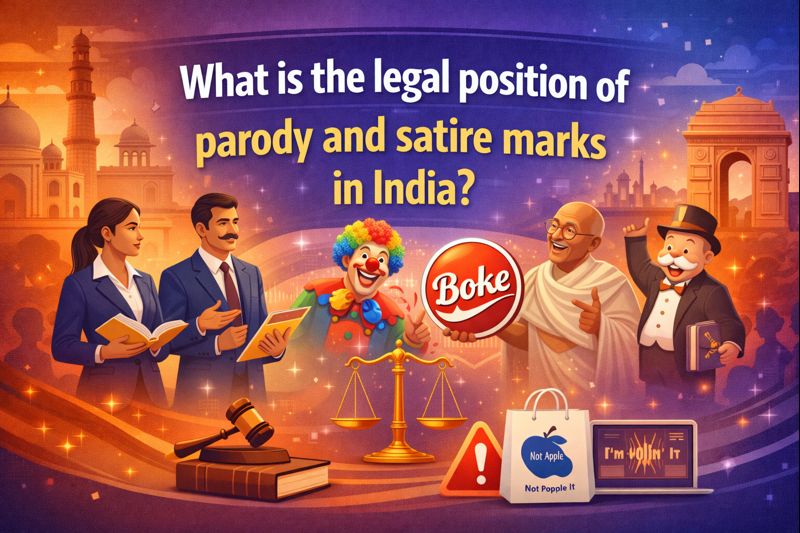
What is the legal position of parody and satire marks in India?
Parody and satire, widely used in marketing and spoof advertising, often twist famous brands, raising legal concerns about trademark rights, parody marks, satire, personality rights, and the protection of free speech.
IPR
Aishwarya
1/13/20264 min read
INTRODUCTION
In the digital age, satire and parody have become potent instruments for social critique, humor, and political commentary because memes, spoof advertisements, and satirical content spread quickly on the Internet, and well-known trademarks and business names are frequently altered or used for artistic expression. This kind of application shows significant legal issues around freedom of speech and brand protection, even though it is fascinating and powerful. Instead of specifically addressing parodies or satirical marks, Indian trademark law has historically concentrated on safeguarding brand reputation and avoiding consumer misunderstanding. Thus, by striking a balance between trademark rights under the Trademarks Act 1999 and the constitutional guarantee of freedom of speech and expression under Article 19(1)(a).
PARODY AND SATIRE IN TRADEMARK LAW
When a well-known mark is purposefully exaggerated or distorted to convey humor or criticism, then it is known as parody. On the other hand, satire uses wit or irony to expose or critique institutions, commercial practices, or societal norms. In India, stand-up comedy, cartoons, digital memes, and spoof advertising campaigns all regularly feature satire and parody. Since they rely on the public’s awareness of the original mark, these forms of expression are legally sensitive under trademark law. While parody doesn't aim to replace the original brand, it often requires significant similarities to be effective. This puts the trademark owner’s right to protect brand identity and reputation at odds with creative freedom. Under Indian law, parody is not always considered an infringement; rather, its validity depends on its context, impact, and aim.
PARODY AND SATIRE IN ADVERTISING AND DIGITAL MEDIA
The use of parody in advertising and promotional content has increased as a result of social media marketing and influencer culture. Memes and parody advertisements sometimes leverage well-known brand names to entice and maintain viewers. The recent examples, including sarcastic references in stand-up comedy and Parle-G parody memes, show how readily content of this type may attract legal attention. In the digital environment, the line between commercial and non-commercial use is blurred, as creators may indirectly benefit through views or sponsorships. The Indian courts are therefore required to adapt traditional trademark principles to evolving digital realities.
PARODY AND PERSONALITY RIGHTS
The harmony between expression and proprietary interest is crucial for personality rights. Because of the expansion of digital platforms, celebrities are increasingly seeking protection against unapproved commercial use of their identity, including their name, picture, voice, and likeness. In Amitabh Bachchan versus Rajat Nagi and others (2022) 6 HCC (Del) 641, the Delhi High Court held that a celebrity’s right to publicity is a part of their personal rights and grants them exclusive control over the commercial use of their identity, prohibiting the unapproved use of the actor’s persona in fraudulent schemes and commodities.
TRADEMARK INFRINGEMENT AND DILUTION CONCERNS
Although the Trademarks Act 1999 does not specifically address parody or satire. The trademark infringement arises when an unauthorized use of a registered mark is identical or deceptively similar and is likely to confuse consumers. In parody cases, the court examines whether an average consumer would assume a commercial link or endorsement. If the parody clearly communicates humor or criticism without misleading the public, it is less likely to be considered infringement. The use of registered trademarks in accordance with honest practices, provided such use does not take unfair advantage of or harm the reputation of the mark. The courts have relied on this to protect fair, non-deceptive, and known commercial expressive uses, including parody and satire. Another problem is trademark dilution; especially for well-known marks, satirical use that casts a brand in a negative light might harm its uniqueness or reputation. The Indian courts utilize the dilution principle with questions even where the use is clearly expressive or non-commercial.
FREEDOM OF SPEECH AND JUDICIAL INTERPRETATION
Article 19(1)(a) of the constitution protects artistic expression, humor, and criticism, but reasonable restrictions under Article 19(2) prevent misuse. In Tata Sons Ltd. v. Greenpeace International (2011) 45 PTC 275, the court held that trademark law cannot be used to suppress criticism or public conversation. The court determined that non-commercial parodies meant for social commentary should be protected if they do not mislead consumers. This case still sets a precedent for trademark disputes involving parodies in India.
NORMATIVE FAIR USE AS A PROTECTIVE TOOL
The doctrine of the normative fair use permits limited use of a trademark When it is necessary to identify the trademark owner or its product, particularly in criticism, commentary, or comparative advertising. For parody to qualify under this doctrine, the use must be restricted to what is reasonably required for identification and must not suggest a sponsorship endorsement or affiliation. The trademark should not function as a badge of origin for the parodist’s goods or services. In Royal Challengers Sports Private Limited v. Uber India Systems Private Limited, CS (COMM) 345/2025, the court held that an ordinary consumer would not assume a business relationship between the parties and characterized the advertisement as light-hearted commentary rather than trademark misuse, reinforcing normative fair use as a viable defense for parody in India.
CONCLUSION
The legal position of satire and parody marks in India is still evolving and is primarily decided by judges. Although trademark honors are legally protected against dilution and misuse, Indian courts are increasingly acknowledging that trademarks cannot be used to suppress social commentary, humor, or criticism. By striking a balance between intellectual property law and constitutional norms, the judiciary has established a tiny but substantial space for satire and parody as creative expression expands in the digital age , more explicit legislative of judicial rules may reinforce this delicate balance between property rights and free expression.