
What liability issues arise in smart city and IoT service contracts?
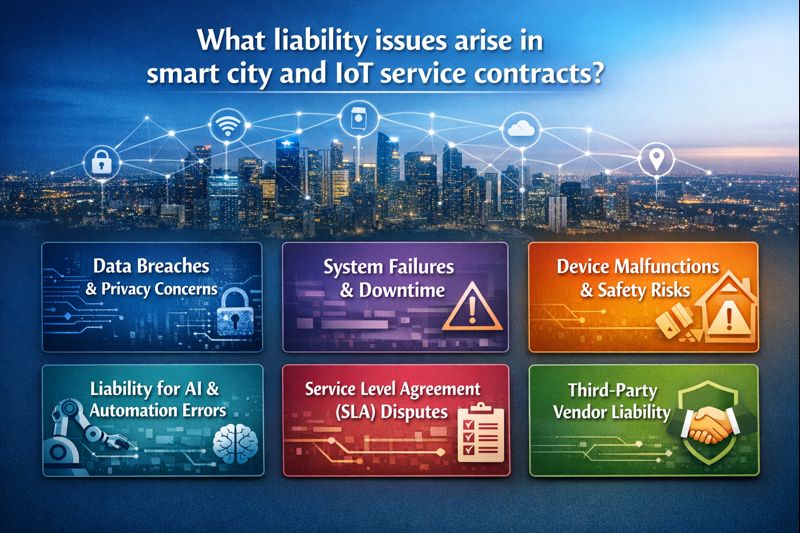
Smart city and IoT service contracts generate complex liability due to distributed architectures, multi-vendor dependencies, regulatory obligations, and cybersecurity risks. This article analyzes contractual, statutory, and technological bases shaping these emerging liabilities.
CORPORATE LAWS
Shalwin Dutt
12/24/20254 min read
I. Introduction
Smart city infrastructures integrate sensors, data platforms, connectivity layers, and automated decision systems to deliver urban functions such as traffic management, energy distribution, surveillance, and environmental monitoring. Their technical complexity arises from a dense mesh of Internet of Things (IoT) devices operating across heterogeneous systems, frequently supplied by multiple vendors. This creates distinctive liability challenges because failures rarely originate in a single component and because contractual obligations must coexist with statutory duties relating to data protection, cybersecurity, and the continuity and resilience of essential services.
Unlike traditional IT outsourcing frameworks, smart city systems operate continuously, manage intimate data flows, and involve dynamic machine-to-machine interactions. Failures can impact public safety, privacy, or critical infrastructure. Liability analysis must therefore account for distributed operational control, multi-vendor dependencies, and regulatory obligations that increasingly treat availability, integrity, and resilience as legal requirements rather than discretionary performance targets.
II. Contractual Character of Smart City and IoT Service Agreements
Smart city service agreements allocate operational responsibilities between municipalities, system integrators, cloud platforms, telecommunications providers, device manufacturers, and analytics vendors. Their legal character is threefold. First, they allocate technical obligations and define which party controls hardware, firmware, networks, platforms, and data workflows. Second, they establish performance, interoperability, and data-handling standards that shape the functional reliability of civic infrastructure. Third, they control the compliance and risk distribution by warranties, indemnities, limitation provisions, and flow-down provisions through subcontractors.
Although, the technical causation hardly agrees with contractual privity. There can be a performance failure, e.g. misconfigured traffic sensors or intermittent connections in environmental monitoring, and in that case, there can be several levels of responsibility. The difficulty comes in where contracts do not specify integration of responsibilities, distribution of data handling, or shared-responsibility models, and hence the vagueness in the manner of assigning the liability.
III. Performance Failures and Availability Liability
The express contractual undertakings of providers are very important to the courts, which examine the technologically complex failures of service delivery in terms of contractual law. The Commercial Court, in GB Gas Holdings Ltd v Accenture (UK) Ltd, found Accenture liable because of its failure to provide a functional IT migration system, and system complexity does not work to weaken performance commitment enforceability.
On the same note, the Technology and Construction Court, in the case of BSkyB Ltd v HP Enterprise Services UK Ltd, granted huge damages following a faulty customer relationship management platform supplied by HP. The court scrutinized representations about capability, integration foreseeability, and the provider’s superior technical knowledge.
Although not smart-city cases, these decisions establish analytical principles highly relevant to smart-city contracting: system complexity does not excuse underperformance, integration responsibilities must be honored, and suppliers may be liable where their systems fail to meet availability or functionality commitments. Where downtime or degraded performance affects smart-city infrastructure, these precedents support contractual liability where services fail to satisfy specified availability, interoperability, or service-level thresholds.
IV. Data Protection and Privacy Liability
The deployment of smart cities regularly handles sensitive personal information, such as location information, biometric identifiers, environmental measurements attributed to households, video analytics, and mobility trends. Controllers and processors under the General Data Protection Regulation (GDPR) are required to ensure the processing systems are confidential, intact, available, and robust. These are obligations regardless of the allocation that are the same under a contract and may give rise to a liability even in case the contractual performance is technically satisfactory.
The liability exists in cases where the data is processed without any legitimate reason, beyond what is defined by municipal intentions, or transferred without proper protective measures. Article 24 GDPR asserts direct liability on the controllers to take steps that prove that they are adhering to the Regulation and highlights the aspect of non-delegability of some statutory obligations. Since various participants in smart-city layers use personal data, it may be complicated to pinpoint the controller and processor. Where there was no provision of sufficient technical and organizational measures on a contractual basis, municipalities might be held liable to the failures of the vendor.
V. Security Failures, Cyber-Physical Harm and Negligence Liability
Smart-city IoT devices interact with physical infrastructure such as water systems, traffic signals, public transport networks, and surveillance architectures. Cybersecurity vulnerabilities in these devices can therefore produce physical harm or disruption. ENISA identifies smart cities as cyber-physical environments with heightened systemic risk due to device interdependence and limited patching capabilities.
Negligence of liability may arise where vendors fail to implement industry-recognized cybersecurity practices. Although exclusion clauses may limit contractual liability, the case of Photo Production Ltd v Securicor Transport Ltd, UK courts confirm that such clauses remain subject to public-policy constraints. Where failures involve public-safety-critical infrastructure, judicial scrutiny may intensify, and exclusions attempting to absolve suppliers of foreseeable cybersecurity risk may be limited.
VI. Multi-Vendor Architectures and Responsibility Lapses.
Smart-city ecosystems typically use many vendors; attribution is challenging in the situation when a hitch arises due to interactions between hardware, firmware, networks, cloud applications, and analytical layers. The absence of express flow-down accountability can result in the localities being without legal remedy against the vendor of the component that caused the series of failures.
The liability is determined on technical control, integration of responsibility, higher expertise, and the predictability of system interactions. These principles help to direct the distribution of the liability of the multi-vendor smart city settings.
VII. Standards-Based Liability and Regulatory Liability.
In addition to the contractual and tortious liability, regulatory laws bring forth autonomous responsibilities. According to NIST SP 800-53 Rev 5, availability, continuity, and resilience are considered important security controls for cyber-physical systems. GDPR Article 32(1)(b) requires controllers and processors to ensure processing systems have ongoing “integrity, availability, and resilience.”
In India, the Reserve Bank of India’s Master Direction—Outsourcing of IT Services (2023) mandates regulated entities to ensure availability, continuity, and resilience of outsourced systems, a principle directly relevant where smart-city financial or service-delivery platforms operate on outsourced infrastructures. Non-compliance with these statutory duties generates liability independently of contractual breach, establishing a dual framework of private and public legal exposure.
VIII. Conclusion
The multi-vendor technological dependency and statutory requirements, coupled with express contractual requirements, create a sense of liability in smart-city and IoT service contracts. The history of failed IT projects shows that in cases where suppliers cannot use the complexities of the system to exonerate themselves when there are poor performance results, regulatory frameworks place both municipalities and vendors with specific obligations in terms of data protection, security, availability, and resilience, explicitly.
A successful liability framework for smart-city projects should align with operational control and responsibility, provide explicit integration and security requirements, and integrate regulatory compliance into contractual structure. In the absence of this clarity, there will be a risk of missed accountability gaps in smart-city ecosystems that will compromise the safety of people, legal certainty, and reliability of the systems.