
What response time and problem-solving standards should IT outsourcing agreements include?
Clear response and resolution standards help organizations stay stable during technical failures and hold service providers accountable for timely and effective support.
CORPORATE LAWS
Sofia Khan
12/18/20254 min read
Introduction
Any organization that decides to outsource its IT work is handing over something fragile: its daily operations, its data, and its ability to work without interruption. Outsourcing is convenient, but it also comes with risk. If the service provider is slow, unresponsive, or careless, the entire business feels the impact.
For this reason, the most important part of an outsourcing agreement is not the pricing or the list of services. It is the section that tells the vendor how quickly they must respond when something breaks and how soon they must solve the problem. These standards act like a safety net. They protect the organization from sudden breakdowns and give both sides a clear understanding of what must happen when things go wrong.
In the absence of these standards, issues easily drag on. Calls get ignored. Emails go unanswered. Responsibility shifts from one person to another. By the time a solution arrives, the business has already suffered losses. A carefully written outsourcing agreement prevents this by setting expectations that are measurable and fair.
Why Response Time Matters
Response time is simply the time taken by the vendor to acknowledge that a problem has been reported. It does not mean the issue is fixed instantly. It just ensures someone on the vendor’s side is aware, alert, and ready to act.
A good agreement sets different response times depending on how serious the issue is:
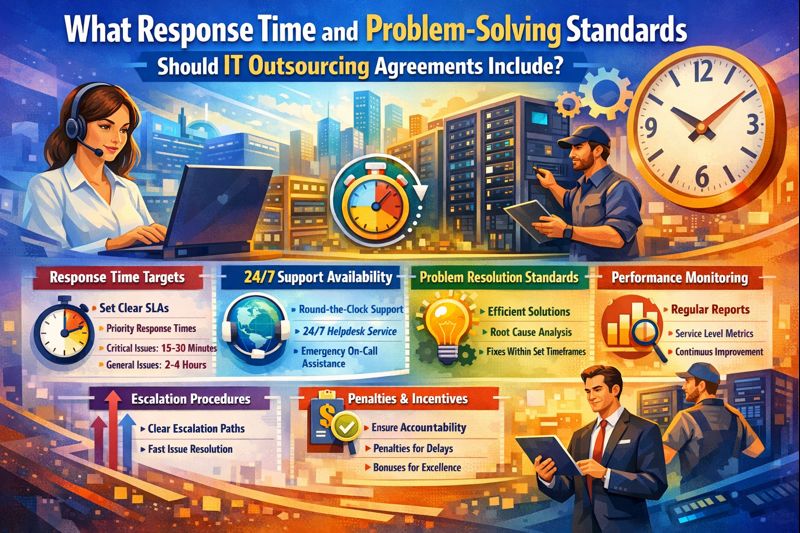
Critical issues: When systems stop working, data is at risk, or security is compromised. These deserve immediate attention usually within 15 to 30 minutes.
1) High-severity issues: Important functions stop working, but the entire system is not down. A response time of 1 to 2 hours is common.
2) Medium issues: Features or modules that affect certain users. These usually require a 4- to 6-hour response.
3) Low-severity issues: Minor errors or cosmetic problems. Vendors typically respond within 24 hours.
Good response times create discipline. They ensure that issues never disappear into a support inbox or sit unacknowledged for long hours. Even a simple acknowledgement can give the business the reassurance that the problem is being handled.
Reasonable and Reliable Resolution Times
Resolution time is different from response time. A vendor may respond in minutes, but solving the issue depends on the nature of the problem. Still, businesses need a clear idea of how long they might have to wait.
Typical resolution times used in well-drafted agreements are:
1) Critical issues: 4 to 8 hours, depending on the situation.
2) High issues: Usually within a business day.
3) Medium issues: Two to three business days.
4) Low issues: Five to seven business days.
A thoughtful contract also separates temporary solutions from permanent ones. A temporary fix may be used to restore normal activity quickly, but the vendor must return later for a complete repair. This prevents short-term patches from becoming long-term habits.
Clear Classification of Issue Severity
For response and resolution standards to work, both sides must share a common understanding of what counts as “critical,” “high,” “medium,” or “low.” Without this, misunderstandings are inevitable. What feels urgent to the organization may feel routine to the vendor.
A good agreement removes this confusion by defining:
1) The type of event that qualifies as a critical issue
2) The systems or functions that are considered essential
3) The conditions that change the severity (for example, data risk or financial impact)
4) Whether the number of users affected influences the severity level.
These definitions create fairness. They ensure that everyone is speaking the same language during a crisis.
Escalation Path: Knowing Who Steps In Next
Not every issue gets solved at the first level of support. Sometimes junior technicians do their best but reach a limit. In such cases, there must be a clear escalation path that explains who takes over next.
A well-structured escalation process usually includes:
1) First-level support
2) Senior engineers
3) Project managers or team leads
4) Vendor leadership for repeated failures
5) Emergency contacts for critical issues
The purpose of escalation is not to pressure the vendor but to ensure that a problem receives the right level of attention at the right time. This prevents delays and gives the organization confidence that the issue will not be ignored.
Service Credits and Penalties
To maintain accountability, many organizations include service credits or financial adjustments when the vendor repeatedly misses agreed timelines. These are not meant to create conflict but to keep the relationship fair.
Common mechanisms include:
1) Reduced charges if uptime targets are not met
2) Credits in the next billing cycle
3) Financial penalties for serious or repeated delays
4) The right to end the contract in case of persistent underperformance
These tools encourage the vendor to take timelines seriously. They also ensure the business receives some compensation if service levels fall below acceptable standards.
The Role of Regular Reporting
Transparency is essential in long-term outsourcing. When a vendor provides regular reports, the organization gains a clear understanding of the overall health of its IT environment.
Typical reports include:
1) Logs of incidents and downtime
2) Monthly or quarterly performance summaries
3) Insights into recurring issues
4) Root-cause analysis for major failures
These reports are not just for record-keeping. They help the organization identify weak spots, plan upgrades, and understand whether the vendor’s support system is improving or declining over time.
Continuous Improvement as an Ongoing Obligation
Technology does not stay still, and neither should an outsourcing arrangement. Many organizations now include a requirement for continuous improvement to ensure the vendor evolves with technological changes.
This may include:
1) Updating tools and security practices
2) Improving workflows
3) Suggesting better long-term solutions
4) Training internal teams when necessary
A continuous improvement clause keeps the relationship dynamic and ensures that the business does not fall behind due to outdated systems or slow support practices.
Conclusion
Clear response-time and problem-solving standards are the most practical way to bring stability and accountability into an IT outsourcing relationship. They help organizations stay prepared for unexpected failures and give vendors a structured framework to deliver consistent service. When severity levels are defined, escalation paths are clear, and timelines are realistic, both sides work together smoothly. In the end, a well-written outsourcing agreement is not just about managing IT services it is about protecting the organization’s ability to operate without interruption.