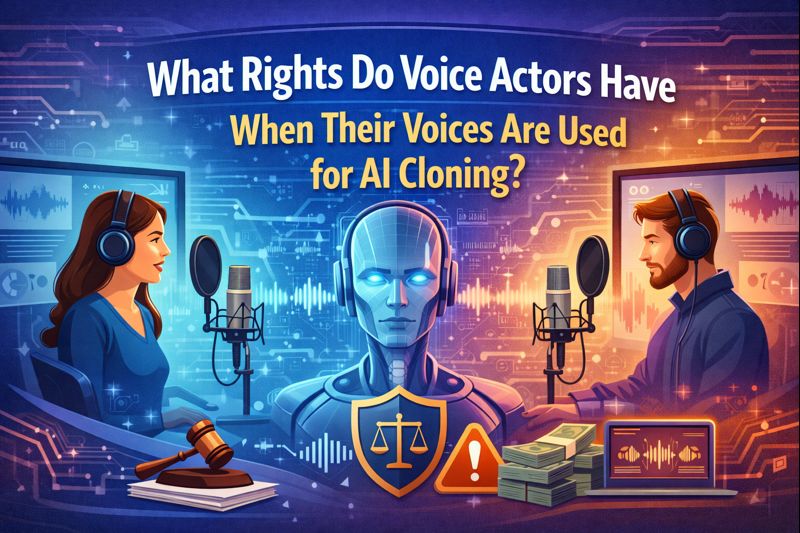
What Rights Do Voice Actors Have When Their Voices Are Used for AI Cloning?
The voice actor also has numerous rights. These rights include protection by contract, right of personality, and right to publicity. The right to these voices is protected against illegal copying by the AI. The cloning is considered illegal when it does so without consent. The only aspect that is dependent on unclear global laws is having many voice artists in this situation. This explains why there is a call for stricter laws and royalties in light of this.
IPRCORPORATE LAWS
Mehak Rastrogi
1/13/20265 min read
INTRODUCTION
With the advent of these new AI developments, voice actors face challenges that have never been imagined or "heard of," as the voice itself is unbelievably duplicable, and only a few minutes of recording are required to "recreate the voice of a performer." These digital duplicates act as a platform for "virtual assistants, video videogames, audiobooks, and ads without the performers' consent or knowledge." The "monastic building of their defenses" is comprised of the fundamental rights of the "right of publicity," the "right of personality," and the "contractual agreement," but there are myriad voices that have been unsealed for exploitation as technology is advancing at a rate much faster than the disjointed global legislation. " The purpose of this paper will be to elicit more specific information and insight on these fundamental rights and the role of the courts. To render viable information to voice actors, it will be derived and empowered by proven principles of current U.S. and global legislation and current industry trends.
Personality Rights and Right of Publicity.
Personality rights protect the name, voice, and likeness of a person from the commercial exploitation of his or her person under Article 21 of the Indian Constitution. In some instances involving voice cloning in the name of AI technology in the Indian judicial system, the court ordered an injunction for invasion of privacy and the issue of fraudulent endorsements in the case of deepfakes of “Anil Kapoor vs. Simply Life India.” In the U.S., the state law for the right of publicity in New York in the Civil Rights Laws potentially enables voice actors to file an action for non-useful clones in an ongoing case against Lovo Inc.
Copyright restrictions and performers' rights.
On the basis of their rights under the Copyright Act of 1957, Sections 38A & 38B of India, the moral as well as economic rights over their live performances are granted to the actors except for the clones created through AI. A voice recording held by a performance has copyright protection, while a raw voice does not; however, cloning involves copyright violation if it is done on a copyrighted piece. The foreign cases like SAG & SAG-AFTRA agree on the need for licensing of the AI voice and a copy of the game being provided.
Significant Court Cases Deciphered.
1. Arijit Singh Case (Delhi High Court, 2024): The high court denied any claims for 'transformative use' or interim damages relief, although it applied moral rights in an injunction suit against the two AI algorithms for using the singer's voice in creating ringtones and covers.
2. Jackie Shroff Suit: The right of publicity owns the voice, and there is no way that the AI chatbots can copy the voice pattern of the actor.
3. Paul Lehrman & Linnea Sage v. Lovo.ai (2024): The case highlighted solvency towards AI companies when voice actors claimed fraud in the collection of their data, thus being able to proceed with claims of publicity and contract. Civil and criminal remedies for victims of unapproved AI voice cloning by voice actors exist and are varied, yet much needs to be overcome, particularly in the area of enforcement and legislative consequences.
Civil Remedies
Even the voice artists would file suits and seek interim injunctions to stop cloning immediately and permanent injunctions in the future if they have evidence to support the claim for replication. In Indian courts, there have been awards of 50 lakh rupees, together with costs, in the matter involving singer Arijit Singh. Damages would involve actual damages in the form of loss of endorsement deals due to the work getting cloned, profits the defendant would have made, and punitive damages. Even though the moral rights under Section 57 of the Copyright Act are for the purpose of protecting integrity, passing-off claims or defamation would involve courts giving apologies to the public.
Criminal Remedies
The punishment for identity theft, which includes misuse of voice, under Section 66C of the Information Technology Act 2000 in India, prescribes imprisonment up to three years and a fine of up to 1 lakh. Section 66D deals with cheating by impersonation using the assistance of artificial intelligence and aids in prosecuting the offender. Compensation claims are possible through Section 43A because "it is the careless data handlers who do train AI on stolen audio." There needs to be intent for any criminal threshold. However, high-profile FIRs like those ordered by the Delhi High Court can be viable.
Key Challenges
To claim likeness, there would need to be audio forensics evidence, which would not be an easy thing to defend in a fair use dispute in which the AI companies can claim the AI-created work is a transformation. Another party that would impede the plans to take action against the U.S./China developers would be the issue of extraterritoriality and lack of MLAT on the IP. Without posthumous rights, the legacies would be in jeopardy, while in 20+ states in the U.S., the rights never expire, while in India, they expire with the performers. The deepfakes would easily sidestep the filtering process on the sites; the detection is a slow process in relation to the rapid rate of creation.
Conclusion
Voice actors find themselves at the crossroads as the AI voice cloning technology recommends to them to make it easy and jeopardizes their own existence and their voice, which is a result of many dedicated years of accuracy. Whether it is the win of the Delhi High Court to safeguard the timbres of Arijit Singh and Anil Kapoor from being handed over to unauthorized copying, or it is the struggle of the U.S. actor Paul Lehrman being exploited by the company Lovo.ai through a right of publicity claim, courts worldwide also hold the stance that voices aren’t materials to be manipulated and thus have the right to consent and compensation. The remedies, like the injunction orders of the court, fines from the IT Act, and the damages, appear to be targeting the shadows, as international technology companies would bypass the enforcement of the law, and the concept of the worst-case damage doesn’t get support from the Indian Law .
However, concerns and challenges are left to be addressed: similarity even after defensive transformation, chasing external violators, and filling and plugging gaps in acts after watermarks and content transparency have been taken into account in MeitY and AI acts. Assume a very old-time storyteller found the soft-selling whistle and spun a web of deception in the cries for bad-guy heist thefts that steal the heart for the pirated fortune, apparently not adequately protected by an injunction. Genuine equity shall demand interventionist legislation: digital acts in copyright laws, mandatory royalty licenses, and AI control over digital theft. Finally, vocal artists need to adjust their rights way sooner than algorithms. The social world shall leverage the power of AI in a balanced way by taking into account informed consent, fair pay, and human oversight to ensure the artists behind this enabling technology are not muted. Their voices, the humanities' connective link, have a right to have their say not like those repugnant AI things in the machines.