
What role do implied terms play in interpreting commercial contracts under Indian law?
When you sign a business When you sign a business contract in India, you probably focus on the price, the deadlines, and the penalties. These are the express terms—the things you actually wrote down. But in the eyes of Indian law, a contract is more than just the ink on the paper. There are often "invisible" rules called implied terms. These are conditions that aren't written down but are still legally binding. Understanding how they work is vital because they can change the outcome of a legal battle, even if you thought your written contract was perfect.
CORPORATE LAWS
Pari Luthara
1/2/20264 min read
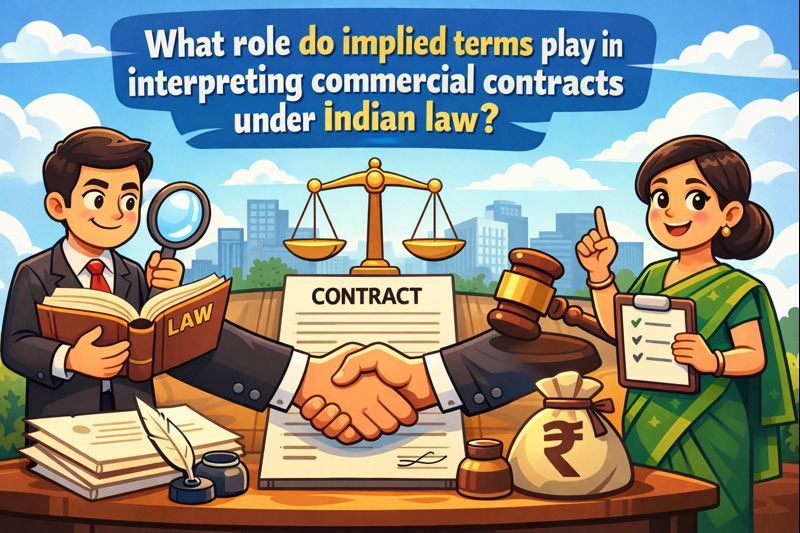
What Exactly Are Implied Terms?
In simple terms, an implied term is a rule that a court adds to a contract to fill a gap. Think of it like a "common sense" clause.
If you hire a painter to paint your office, the contract might not say, "The painter must use a brush and not their bare hands." It is implied that they will use the proper tools and perform the work with reasonable skill. In India, these terms help ensure that business deals make sense and actually work in the real world.
The Foundation: The Indian Contract Act, 1872
The main law governing deals in India is the Indian Contract Act (ICA). Section 9 of this Act is the starting point. It says that a promise can be "implied" if the proposal or acceptance is made in any way other than using words.
While the Act is old, Indian courts have modernized it by following two famous tests from English law to decide when to "read between the lines."
The Two "Golden Tests" for Implied Terms
When a dispute reaches an Indian court, the judge doesn't just guess what should be in the contract. They use two specific "tests" to see if a term should be implied.
1. The Business Efficacy Test
This test asks, "Is this term necessary to make the contract work?" If a contract is missing a detail that makes the whole deal impossible to finish, the court will imply that detail. For example, if a company agrees to store goods in a warehouse, it is implied that the warehouse will be safe and weatherproof. Without that, the "business" of the contract (storing goods) fails.
Key Rule: The court won't add a term just because it seems "fair" or "reasonable." It will only add it if the contract cannot function without it.
2. The Officious Bystander Test
Imagine a nosy person (an "officious bystander") was watching the two parties sign the contract. If that person asked, "Wait, shouldn't you include a rule about X?" and both parties would have replied, "Oh, of course! That goes without saying!"—then that term is implied.
It is meant to cover things that were so obvious that the parties didn't think they needed to write them down.
The Five Conditions (The "Penta-Test")
In recent years, the Supreme Court of India has become very strict about adding implied terms. In the famous case of Nabha Power Ltd. v. Punjab State Power Corporation Ltd. (2018), the court said that five conditions must be met before they will imply a term:
Condition: Reasonable and Equitable What it means: The term must be fair to both sides.
Condition: Business Efficacy What it means: The contract won't work without it.
Condition: So Obvious What it means: It "goes without saying."
Condition: Capable of Clear Expression What it means: You must be able to write the term down clearly.
Condition: No Contradiction What it means: It cannot go against anything already written in the contract.
Types of Implied Terms in India
Not all implied terms come from a judge's imagination. Most fall into three categories:
A. Terms Implied by Law (Statute)
Sometimes, the law automatically inserts terms into your deal.
The Sale of Goods Act: If you buy a product, the law implies that the seller actually owns the item and has the right to sell it.
The Workman's Compensation Act: In employment contracts, certain safety and payment protections are implied by law, even if the employer didn't mention them.
B. Terms Implied by Custom or Trade Usage
In India, different industries have their own "unwritten rules." If a specific practice is followed by everyone in a certain trade (like the textile market in Surat or the spice trade in Kerala), the court may assume that your contract includes those traditions.
Example: If it’s standard practice in a port that "delivery" happens at the gate and not the ship, that becomes an implied term.
C. Terms Implied by Fact
These are specific to your unique deal. They are the "gap-fillers" that the court uses to make sense of a specific situation that the parties forgot to address.
Why Courts Are Careful (The "Four Corners" Rule)
Indian courts generally follow the "Four Corners" Rule. This means they prefer to stay within the four corners of the written page.
In modern commercial law, judges are very hesitant to imply terms. Why? Because big companies have expensive lawyers. If a 100-page contract was drafted by a legal team and they "forgot" something, the court usually assumes they left it out on purpose.
The Supreme Court has warned that judges should not be "creative." They are there to interpret the contract, not rewrite it. If you made a bad deal, the court won't imply a term just to save you from losing money.
Summary: What This Means for You
If you are drafting or signing a commercial contract in India, keep these three things in mind:
Don't leave it to chance: If a detail is important to you, write it down. Don't assume the "Business Efficacy" test will save you later.
Check the industry standards: Be aware of the "customs" in your specific trade, as they might be binding on you even if they aren't in the contract.
The written word is king: An implied term can never contradict a written term. If your contract says "No refunds under any circumstances," a court cannot imply a "reasonable refund" term.
Conclusion
Implied terms are the "safety net" of Indian contract law. They exist to prevent a contract from becoming total nonsense. However, because the Supreme Court now follows the "Penta-Test," that net is smaller than it used to be. The best strategy is to be as clear as possible so that no "officious bystander" ever has to get involved.